Before a single plank reaches a yacht, a teak deck already has a long history. It begins as a slow-growing tree in a hot climate, spends months drying and settling, and passes through saws, kilns and grading benches before it becomes the warm, striped surface guests walk on barefoot. Most of the making happens far from the water, in timber yards and decking workshops where the wood itself is turned into a product.
A luxury yacht teak deck is a set of prefabricated teak planks and panels, made from graded teak timber that has been sawn, dried, machined and bonded into deck sections before they are ever fitted to a boat. The work is about the wood: choosing the right trees, cutting them into straight, even planks, drying them slowly so they will not shrink at sea, and joining them into panels with sealed seams.

How It’s Made
Step 1: Choosing the trees
It starts with the timber. The best decking teak comes from mature trees grown slowly in warm climates, where tight growth rings give the wood its dense, oily character. Buyers look for straight trunks with few knots, because a knot becomes a weak spot and a dark blotch in a pale, even floor. Plantation-grown teak now supplies much of the trade, and yards check the paperwork as carefully as the wood, because old-growth teak from protected forests is restricted. A single large yacht can need several tonnes of teak, from trees planted decades before the yacht was drawn.
Step 2: Sawing and drying the timber
The logs are sawn into boards in a timber mill, cut slightly thicker than the finished plank to leave room for planing later. The sawyer cuts each log to get the longest straight lengths possible, because a deck is laid in long runs and short offcuts are little use. Only the cleanest stock goes forward. Freshly sawn teak holds a great deal of water, and a plank laid while still wet will shrink and open its seams, so the boards are stacked with thin sticks between them to let air move over every face, then left to dry for months. Many yards finish in a kiln, where heat and humidity are stepped carefully over several weeks until the moisture is steady through the core.
Step 3: Grading and matching the wood
Once dry, every board is graded by eye and by hand. Graders check the colour, the straightness of the grain and the width of the growth rings, and sort the boards into piles for different parts of the deck. The palest, most even boards are kept for the wide open areas where guests walk, while darker boards go to the edges or to the margin boards that frame the deck. Matching matters: a deck made from one batch of timber ages evenly in the sun, while a deck mixed from many batches will silver in patches. The yacht deck itself is built around these matched planks, and the grading bench is where its even look is decided.

Step 4: Machining the planks to size
The graded boards go through planers and saws that cut them to their final size, usually around 45 millimetres wide and 9 to 12 millimetres thick for a deck laid over a fibreglass base. Each plank is planed flat on both faces and cut with a square edge, so that when two planks sit side by side the gap between them is even along its whole length. Some workshops cut a small groove along each edge, which gives the caulking something to grip. The ends are cut square too, because the planks are laid in staggered joints and a ragged end would show as a crooked line. At this stage the planks are numbered in order, so the fitter at the boatyard can lay them in the planned sequence.
Step 5: Bonding the planks into panels
Many modern teak decks are not laid plank by plank on the boat at all. Instead, the workshop bonds the machined planks onto a light backing sheet, forming large prefabricated panels that match the shape of the deck. The planks are glued down in order, held flat with weights and clamps while the adhesive cures, and the panel is checked for flatness with a long straightedge. Curved sections, such as the sweep of the bow, are cut to a template taken from the yacht, sometimes with a computer-controlled saw. A panel that leaves the workshop flat and true saves the boatyard days of fitting, The way a yacht deck works in daily use depends on the seams between these planks staying watertight.
Step 6: Caulking, sanding and packing
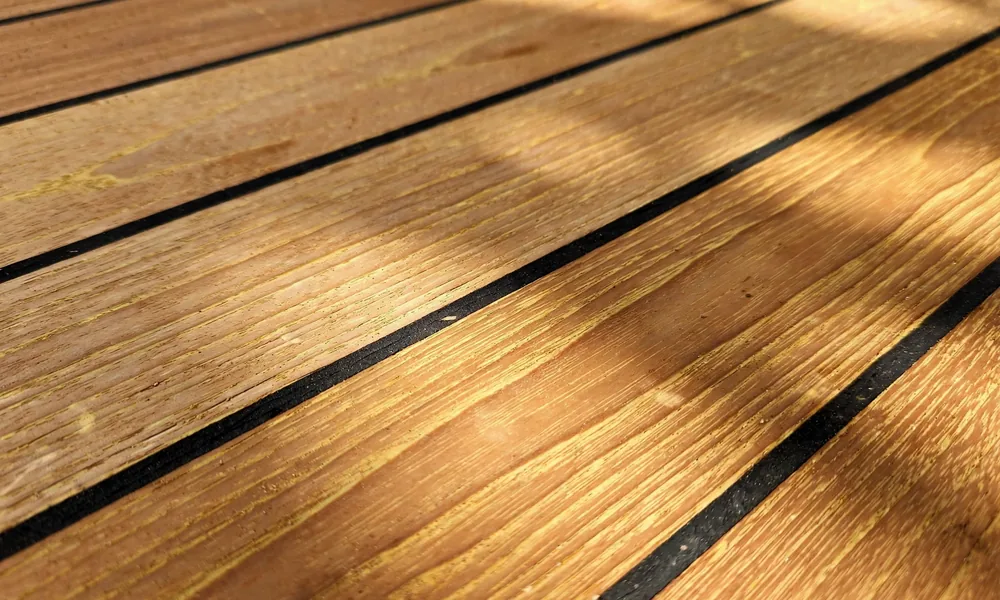
With the planks bonded, the seams are filled with a black rubber caulking, the flexible compound that gives a finished deck its striped look. The caulking is squeezed into each gap, smoothed with a blade and left to cure before the panel is sanded. The panels are then sanded smooth, first coarse to level the planks and caulking, then fine to bring up the grain. The wood is left bare, never varnished, because a working deck must grip when wet. Each panel is inspected under a raking light, then wrapped, labelled with its position on the yacht, and crated. A yacht sundeck built the same way arrives as numbered panels, laid in order like pieces of a very expensive puzzle.
The journey from tree to deck is slow on purpose. Teak grows slowly, dries slowly and is worked slowly, and every shortcut shows up later as a seam that opens or a plank that cups in the sun. The deck is the part of the yacht guests touch with every step, and the quality of the timber, not the speed of the build, is what they feel underfoot.
Teak Deck Specifications
| Feature | Typical Detail |
|---|---|
| Timber | Graded plantation teak, straight grain, few knots |
| Plank width | Around 45 millimetres |
| Plank thickness | 9 to 12 millimetres over a backing or deck base |
| Drying | Air dried for months, then kiln dried to a steady core moisture |
| Panels | Planks bonded to a backing sheet, cut to deck templates |
| Seams | Black rubber caulking, flexible and watertight |
| Finish | Sanded bare, oiled or left to silver in the sun |
How Much Does a Teak Deck Cost?
Prices are estimates and vary with yacht size, timber grade and workshop. A new teak deck for a large luxury yacht can run an estimated $100,000 to $500,000 or more, with the timber itself a large part of the cost, because good teak is scarce and slow grown. Re-caulking an existing deck typically costs an estimated $10,000 to $40,000, but the deck is the floor of the yacht, and cheap timber is a false saving that shows up in every bare footstep.
A Rare Fact About Teak Decks
Here is a detail most owners never notice: teak contains a natural oil that makes it almost waterproof on its own, and that oil is also what gives the wood its grip when wet. On the old wooden ships, sailors washed the decks with seawater every morning, not just to keep them clean but to keep the wood swollen and the seams tight, and the salt water fed the grain instead of rotting it. A well-made teak deck can last decades with nothing more than soap, water and a soft brush.


