Stand on the quay behind a luxury yacht and look at the flat wall at the back. It does not look like much: a wide panel of gleaming fibreglass or teak. But that wall, the transom, is one of the hardest-working parts of the boat. It closes the hull, carries the tender garage, holds the swim platform, supports the passerelle, and takes the full force of the following sea when a wave catches up from behind.
A luxury yacht transom is the flat or gently curved panel that closes the stern of the yacht, built from reinforced fibreglass or composite, and it works as a structural wall, a garage door, a boarding platform, and a mounting point for engines, ladders, and toys, all at once. The best transoms are engineered like a door that is also a wall: they open to launch a tender, fold down to become a beach club, and close again to keep the sea out, while carrying the weight of the yacht’s heaviest gear.

How It Works
Step 1: Closing the hull and carrying the load
The transom’s first job is structural. It closes the open back of the hull, tying the two sides together and giving the stern its stiffness. On a luxury yacht, the transom is built from layers of fibreglass and foam core, laid up by hand and cured until it is rigid, then reinforced with knees and stringers that spread the load into the hull. It has to resist the pressure of the water pushing in from behind and the weight of everything bolted to it, from the tender garage to the outboard engines on smaller yachts. The stiffness of the whole stern depends on this one wall, much as the strength of the yacht’s luxury yacht keel depends on the spine running below the waterline.
Step 2: The tender garage and the opening door
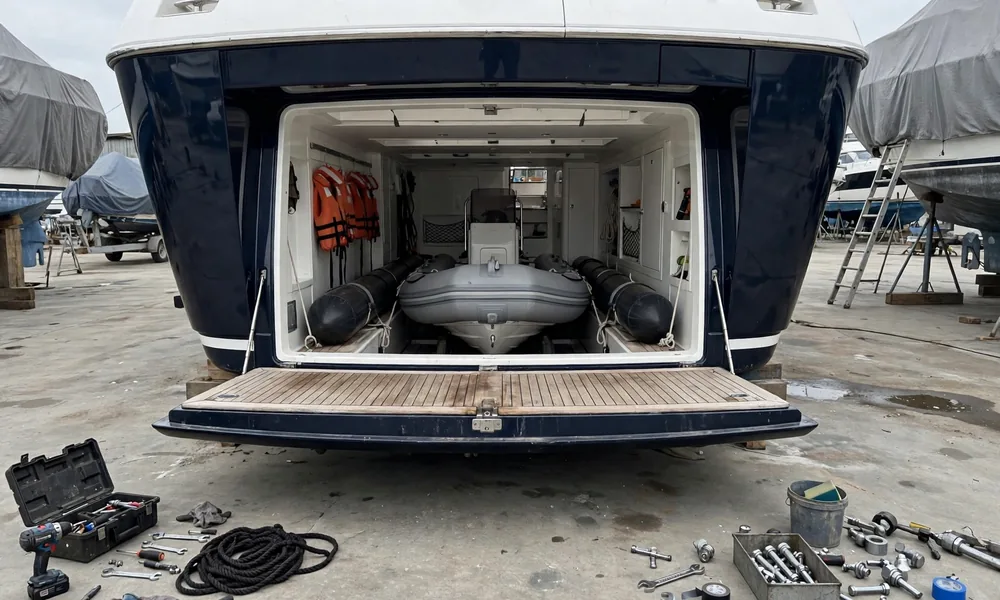
On many luxury yachts, the transom is also a garage door. Behind it sits a tender, a small boat used to ferry guests to shore, along with jet skis, paddleboards, and diving gear. The transom door is hinged at the bottom and opens downwards, lowered by hydraulic rams until it is level with the water, where it becomes a launch ramp. The door has to be watertight when closed and strong enough to carry the tender’s weight when open, and the seals around its edge are checked every time the yacht is hauled out.
Step 3: The swim platform and the beach club
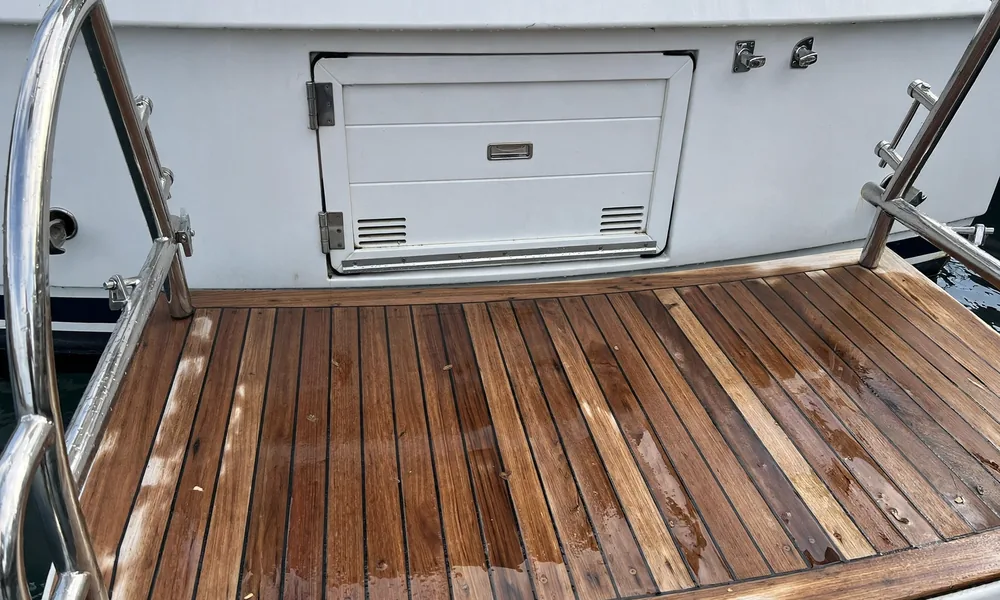
When the transom door opens fully, or when a separate platform folds out, the stern becomes a beach club: a flat deck at the waterline where guests can swim, sunbathe, and step straight into the sea. The platform’s hinges and rams are made from marine-grade stainless steel, and they are sized to lift not just the platform but the weight of several people standing on it. The platform is the part of the yacht guests remember most, and it only exists because the transom was designed to open.
Step 4: Engines, steering, and the gear on the wall
The transom also carries hardware. On smaller luxury yachts, outboard engines bolt directly to it, and the panel has to take the full thrust of the engines without flexing. On larger yachts, the transom holds the steering gear, the trim tabs that level the boat, the underwater lights, and the name boards. Each fitting is through-bolted with a backing plate, and every hole is sealed against the sea, because a single unsealed bolt can let water into the core and rot the panel from the inside. The attention to fittings matches the detail in the luxury yacht hull specs, where every number on the hull has a reason behind it.
Step 5: The passerelle and boarding from the quay
When a yacht is moored stern-to, guests board over the transom, and the passerelle, a narrow gangway, extends from it to the quay. The passerelle is stored in a slot in the transom and slides out on rails, with a handrail that folds up and a small wheel at the end. The transom has to carry the weight of the passerelle and the people walking on it, and the slot has to stay dry when the boat is at sea. It is a small detail, but boarding a yacht over a wobbly gangway is the first impression a guest gets, and the transom is what makes it feel solid.
Step 6: Keeping the sea out and staying beautiful
The transom is the most visible part of the yacht from behind, and it is finished to the same standard as the rest of the boat: fair, glossy paint or varnished teak, with the yacht’s name and home port in polished letters. But beauty is the easy part. The hard part is keeping it watertight. The seals, the hinges, and the door edges are inspected regularly, and the core is checked for moisture with a meter, because a transom that has taken on water becomes heavy and weak. The care is the same as the care behind the luxury yacht flybridge, where the finish is part of the engineering, not an afterthought.
Specifications
| Specification | Typical luxury yacht transom |
|---|---|
| Construction | Fibreglass and foam core, hand-laid, reinforced with stringers |
| Width | Close to the full beam, often 5 to 7 metres on a 30-metre yacht |
| Tender garage | Hydraulic door, opens down to form a launch ramp |
| Swim platform | Teak, fixed or hydraulic, with shower and ladder |
| Hardware | Marine-grade stainless steel hinges, rams, and fittings |
| Passerelle | Sliding or hydraulic gangway stored in the transom |
| Finish | Gloss paint or varnished teak, yacht name and port |
What a Luxury Yacht Transom Costs
A luxury yacht transom is not sold on its own, so its cost is part of the yacht’s build, but the transom assembly, including the hydraulic door, the swim platform, and the garage, typically adds between about $150,000 and $500,000 to the cost of a 30-metre yacht. These are estimates based on typical superyacht outfitting figures, not fixed prices. The hydraulics and the custom door are the expensive parts, and a full beach-club conversion, where the transom opens into a lounge with a bar and a shower, can cost considerably more. The price is the cost of making one wall do the work of four.
A Rare Fact
On some of the largest yachts, the transom door is so big that it doubles as a dance floor. When the door is lowered to the horizontal and the tender is launched, the crew can lay a teak deck over it, turning the open stern into a stage for parties at anchor, with the sea lapping a few centimetres below the dancers’ feet. It is the same door that keeps the ocean out at twenty knots, and on a calm evening it becomes the floor of the party.
The transom is the yacht’s back wall, its garage, its beach, and its front door, and it does all of it without ever looking busy. The next time you see a yacht from behind, look past the name and the polished teak, and you will see the engineering: a wall that opens, a platform that floats, and a door that holds back the sea. It is the quietest piece of cleverness on the whole boat.


