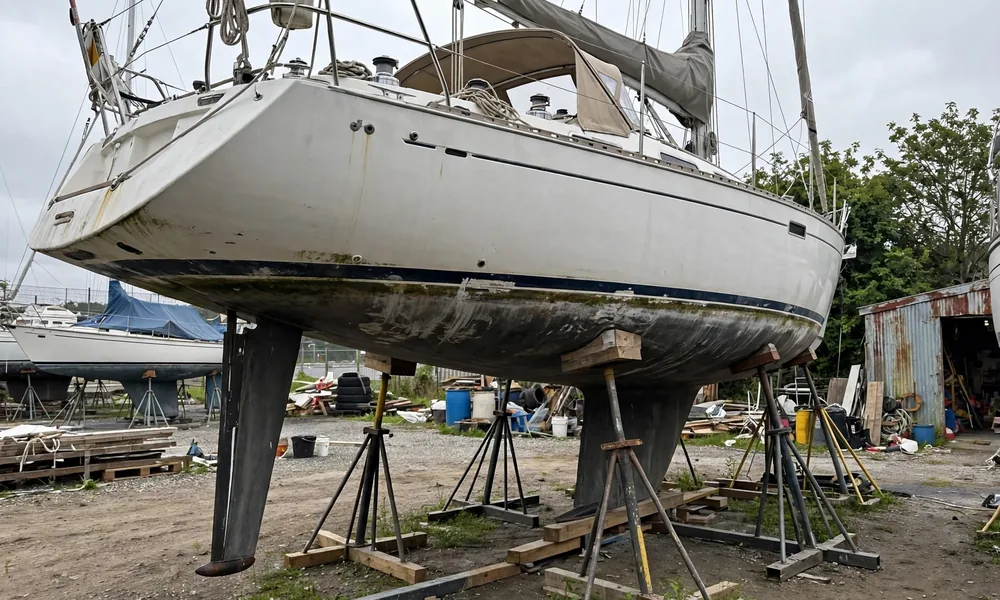
Below the waterline, where no guest ever looks, hangs the heaviest single piece of a yacht. It is a fin of steel or lead, bolted to the bottom of the hull, and it does two jobs at once: it stops the wind from pushing the yacht sideways, and it stops the yacht from tipping over. Without it, a sailing yacht would simply fall on its side.
The keel of a luxury yacht is not a decoration. It is a wing, turned on its side and hung underwater, and it works by the same physics that keeps an aeroplane in the sky. Water flows past it, pressure builds on one side, and the yacht is pulled upright and held on course, even in a gale.
Here is how a luxury yacht keel works, from the wind on the sails to the ballast deep below the hull.
1. The wind tries to tip the yacht over
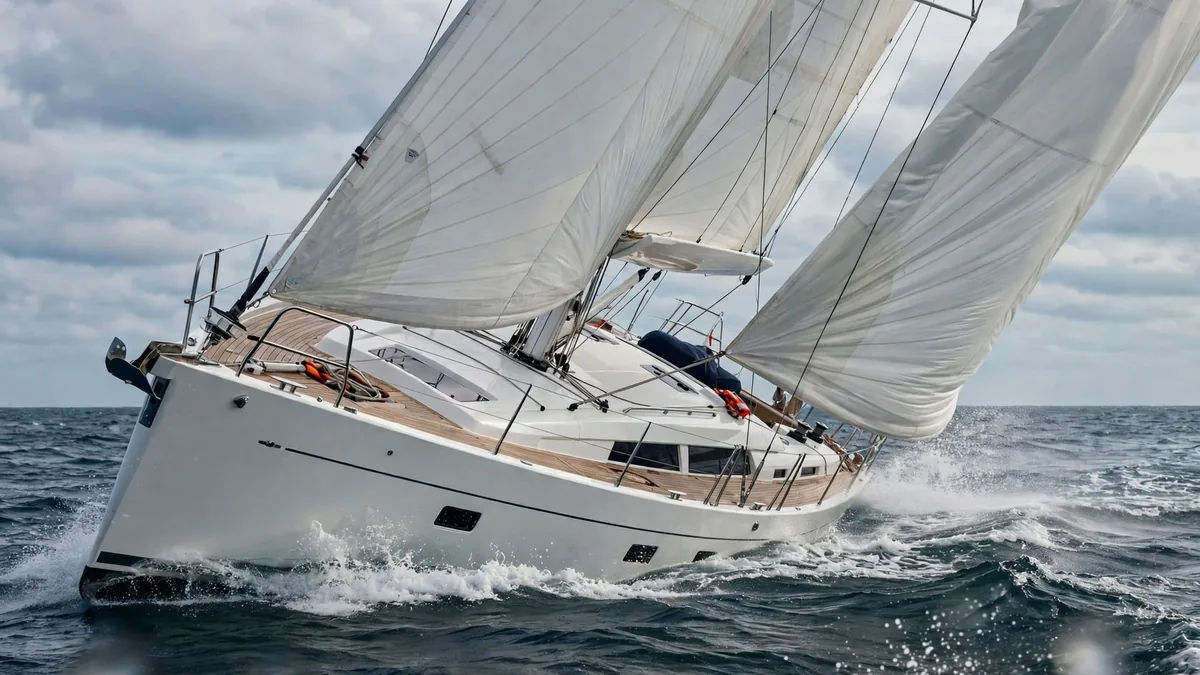
Everything starts with the sails. Wind presses on the canvas high above the deck, and that pressure tries to push the top of the mast sideways. A strong gust can heel a yacht over by twenty degrees or more.
At the same time, the wind tries to push the whole yacht sideways, sliding it across the water instead of forward. A hull on its own cannot resist that push, because a smooth hull slips sideways almost as easily as it moves forward. The keel exists to stop both of these things, and it does so from a position no one can see. The forces at work here are set out in the luxury yacht keel specifications, where weight, depth, and righting moment are listed in detail.
2. The keel acts as an underwater wing
A keel is shaped like a wing, with a curved side and a flatter side, and water flowing past it behaves like air flowing past an aircraft wing. As the yacht moves forward, water is forced around the keel, pressure drops on one side, and a force called lift pushes the keel sideways, against the direction the wind is pushing the yacht.
The result is that the yacht sails forward instead of sliding sideways. A good keel lets a yacht point close to the wind, while a poor one lets the yacht slip and lose ground. The shape is tuned in a towing tank, where scale models are pulled through water and the forces measured, and a change of a few centimetres in the keel’s profile can make a real difference to speed. The cost of getting this balance right is part of why a luxury yacht keel is so expensive, where design time and materials both count.
3. Ballast pulls the yacht upright
The second job of the keel is to carry ballast, and this is the heavier part of its work. A luxury yacht keel is filled with lead or cast iron, sometimes as much as a third of the whole yacht’s weight, hung as low as possible below the hull.
When the wind heels the yacht over, the ballast is lifted out to the side, and gravity pulls it back down. That pull creates a righting moment, a force that rotates the yacht back upright, and the deeper the keel, the stronger that force. The same balance between weight and shape governs the keel of a much larger vessel, and the figures for a ship are listed in the luxury ship keel specifications.
4. The keel is bolted to the hull
The keel is not part of the hull. It is a separate structure, bolted on through the bottom of the boat with stainless steel bolts as thick as a wrist. The joint between keel and hull is one of the most stressed parts of any yacht, because every wave and every gust tries to work it loose.
The bolts are tightened to a precise torque, the joint is sealed against seawater, and the whole structure is checked with ultrasound for cracks. On a modern yacht the keel is often built as a fin with a separate bulb of lead at the bottom, a torpedo shape that puts the weight as low as possible without making the fin any deeper.
5. Lifting keels, and keeping the keel sound
Not every luxury yacht has a fixed keel. Some have a lifting keel, a fin that can be raised into the hull with a hydraulic ram, so the yacht can sail in deep water and then lift its keel to enter a shallow anchorage. Others use a twin keel, two shorter fins that let the yacht stand upright on sand when the tide goes out, or a canting keel, a fin that swings from side to side under computer control to keep the yacht flat in strong wind.
A keel works only if its surface is smooth. Marine growth, barnacles and weed, attach themselves to the fin within weeks, roughening the surface and slowing the yacht, so the keel is painted with antifouling paint and cleaned every year when the yacht is lifted out of the water. At the same time the keel bolts are inspected and the joint checked for leaks, because a keel that is looked after lasts as long as the yacht, while a neglected one can corrode quietly out of sight.
The Luxury Yacht Keel: Specs
| Specification | Typical range |
|---|---|
| Keel type | Fin with bulb, lifting, twin, or canting |
| Keel depth | About 2 to 3.5 metres below the hull |
| Ballast weight | About 30 to 40 percent of total displacement |
| Ballast material | Lead, or cast iron on some yachts |
| Fin material | Steel, or composite with a steel core |
| Keel bolts | Stainless steel, up to 8 or more bolts |
| Righting moment | Enough to recover from about 120 degrees heel |
| Maintenance | Annual lift-out, antifouling, bolt inspection |
What Does a Luxury Yacht Keel Cost?
A luxury yacht keel is estimated to cost roughly $50,000 to $400,000, depending on the size of the yacht and the design. A fixed fin keel with a lead bulb for a 20-metre yacht is estimated at roughly $50,000 to $120,000, while a canting keel with hydraulics and computer controls for a 40-metre racing yacht can be estimated at $250,000 to $400,000. The lead ballast alone is estimated at roughly $5,000 to $20,000, and a keel bolt replacement is estimated at roughly $10,000 to $30,000.
A Rare Fact
The deepest keel ever fitted to a sailing yacht was built for a racing yacht called Mari-Cha IV, and it reached more than six metres below the hull. The keel was so deep that the yacht could not enter most harbours, and it had to be lifted by a crane in a special dock. On the open ocean, the deep keel made her one of the fastest monohulls ever built.
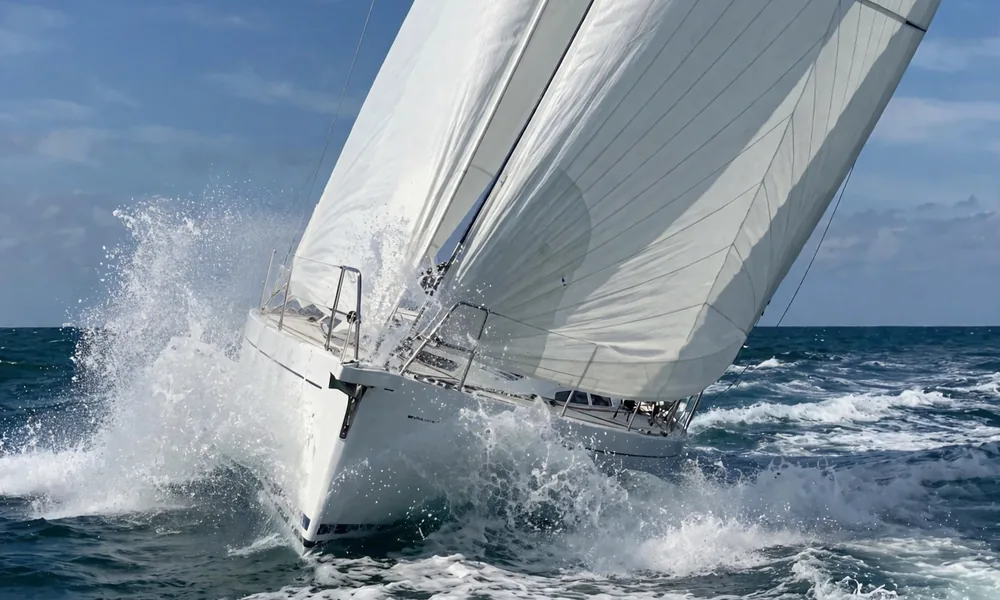
The keel is the part of a yacht that nobody photographs and everybody depends on. It is a wing that never flies, a weight that never moves, and the reason a yacht can lean into a gale and come back upright. The next time a yacht heels over in a strong wind and the crew stays calm, look below the waterline in your mind, and you will see why.