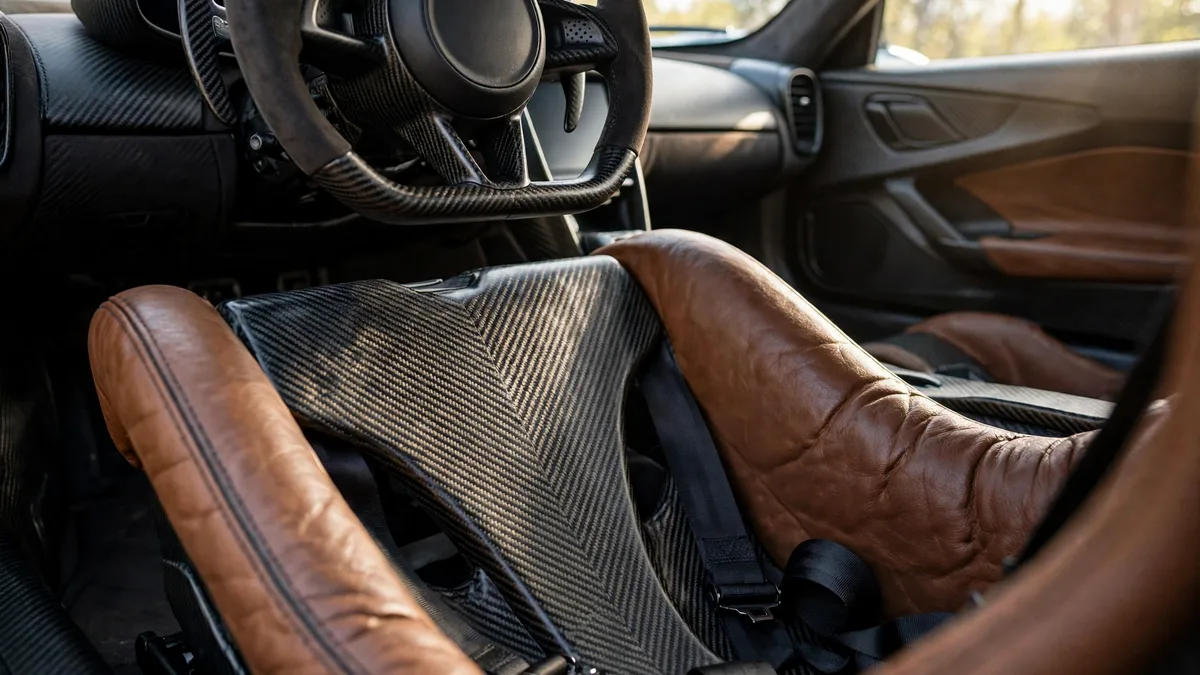
A hypercar seat does not invite you to sit down. It asks you to climb in, lower yourself between high bolsters, and let the car hold you in place. There is no softness to sink into, no armrest, and no recline button. What there is, instead, is a shape so precisely fitted to a human body at speed that after a few corners you stop noticing the seat at all, which is the whole point.
That shape is the result of an argument between two demands that hate each other. The seat must be light enough for a car that counts every gram, and strong enough to hold a driver through cornering forces that would throw an ordinary chair across the cabin. It must sit almost on the floor, and still be comfortable for a three-hour drive. The seat solves that argument with carbon fibre, clever geometry, and almost nothing else.
How a Hypercar Seat Works
A hypercar seat works as a single rigid shell, moulded to the shape of a seated driver, bolted directly to the car’s chassis with almost no adjustment. Instead of the heavy steel frame, springs and motors of an ordinary seat, it uses a thin carbon fibre structure that is stiff in exactly the directions that matter and shaped so the driver’s weight spreads evenly across it. Padding is thin and targeted, the harness does the holding, and the steering wheel and pedals move to meet the driver.
Step 1: The carbon shell carries the load
The heart of the seat is its shell, a single piece of carbon fibre moulded into the shape of a seat back, base and side bolsters. Carbon fibre is enormously stiff for its weight, so a shell only a few millimetres thick can support a driver through braking and cornering forces several times their own body weight. The fibres are laid in different directions, layer by layer, so the shell is strongest where the loads are greatest. The materials of a hypercar seat start with that shell, often under five kilograms on its own.
Step 2: The shape holds the driver in place
A hypercar seat holds you with shape, not with softness. High side bolsters cup the ribs and hips, a raised thigh bolster stops the legs sliding under braking, and a narrow waist keeps the torso centred. The angles are taken from racing seats, refined with pressure mapping that shows exactly where a driver’s body presses hardest. Because the shell does the holding, the padding can be thin: a few millimetres of foam where the bones meet the shell, and nothing where the shape already fits.
Step 3: The mounting bolts it to the chassis
Most hypercar seats bolt straight to the floor or to a fixed bracket on the chassis, with no sliding rails at all. Some offer a small range of adjustment on a lightweight rail, but many are fixed: the factory fits the seat to the buyer’s measurements, and the pedals and steering column move instead. Fixing the seat saves the weight of the rails and motors, lowers the driver’s hips closer to the floor, and makes the seat part of the car’s structure.
Step 4: The harness spreads the forces
At the speeds a hypercar reaches, a normal three-point belt is not enough. The seat is built around a four, five or six-point harness, with slots moulded into the shell for the shoulder straps and a slot in the base for the crotch strap. The harness spreads deceleration across the chest, hips and shoulders instead of loading one point, and it holds the driver tight against the shell so the body and the car move as one. The hypercar chassis is what the seat bolts to, and the harness is what ties the driver to both.

Step 5: Padding and trim do the comfort work
What little comfort a hypercar seat offers comes from thin pads, not from springs. Moulded foam pads, often in two or three densities, sit in the shell where the shoulder blades, lower back and thighs press hardest, and they are covered in leather or Alcantara, a suede-like material that grips clothing and breathes. Some makers fit pads in different thicknesses, like a tailor adjusting a suit, so the same shell fits different drivers.
Step 6: Heating, cooling and weight keep the balance
A few hypercar seats still offer heating, and a handful offer cooling, but every feature is weighed against grams. A heating element adds weight and wiring, so makers use the thinnest elements they can, or skip heating entirely. Cooling usually means small fans pushing air through the perforated pads, not the heavy refrigeration of a luxury saloon. The whole seat, shell, pads, trim and harness, typically weighs between seven and fifteen kilograms, against twenty-five or more for an ordinary electric leather seat.
Step 7: Crash protection is built into the shape
The seat is also a safety device. Its high back and headrest support the head in a rear impact, the bolsters keep the torso from sliding sideways, and the shell is designed to flex in a controlled way rather than shatter. In a severe crash the seat stays attached to the chassis, the harness stays attached to the seat, and the driver stays in the survival space it defines. The suspension of a hypercar may smooth the road, but it is the seat that keeps the driver connected to the car when the road runs out.

| Specification | Typical value |
|---|---|
| Shell material | Carbon fibre composite, a few millimetres thick |
| Seat weight | About 7 to 15 kilograms complete |
| Shell weight | About 4 to 6 kilograms bare |
| Harness | Four, five or six-point, with shell slots |
| Adjustment | Fixed or small manual slide; pedals and wheel move instead |
| Trim | Leather or Alcantara over thin moulded foam pads |
| Mounting | Bolted directly to the chassis or a fixed bracket |
Price is where a hypercar seat earns its reputation. A pair of carbon-shell seats in a hypercar is typically a 10,000 to 30,000 US dollar option, and a single replacement shell from a maker can cost 8,000 to 15,000 dollars (estimate) before trim and fitting. The cost is the carbon work: each shell is laid up by hand, cured in an autoclave, and fitted with pads cut to the buyer’s measurements. A racing seat built the same way for a track car costs less, roughly 2,000 to 5,000 dollars, because it skips the leather and the road-car crash testing. Those are estimates (estimate), not list prices.
A rare fact: some hypercar seats are moulded from a scan of the buyer’s own body. The customer is 3D-scanned, and the foam pads are shaped to their exact spine, hips and shoulders, like a made-to-measure suit. The result is a seat that only really fits one person, which is why the steering wheel and pedals are made adjustable instead: the car adapts around the seat, not the other way around.
The hypercar seat works because it stops pretending to be a chair. It is a moulded shell, a harness mount and a structural bracket in one, shaped to a body at speed and bolted to the floor. It gives up softness, adjustment and features to buy lightness, stiffness and feel. Sit in one, and the car stops feeling like something you drive, and starts feeling like something you wear.