Put on a pair of noise-cancelling headphones on a busy train and the world simply falls away. The rumble of the engine fades, the chatter of fellow passengers softens to a murmur, and the music in your ears sounds as if it were recorded in an empty room. It feels like magic, but it is engineering: microphones listening to the noise around you, a chip working out its exact opposite, and a speaker playing that opposite sound so the two cancel each other out. All of it happens in a few thousandths of a second, over and over again.
Making a pair of these headphones is a balancing act. They must be light enough to wear for hours, sealed enough to block sound physically, clever enough to cancel it electronically, and comfortable enough that you forget they are there. Inside each earcup sits a driver, several microphones, a processor and a battery, all fitted into a space barely bigger than a biscuit. Here is how noise-cancelling headphones are made, step by step.
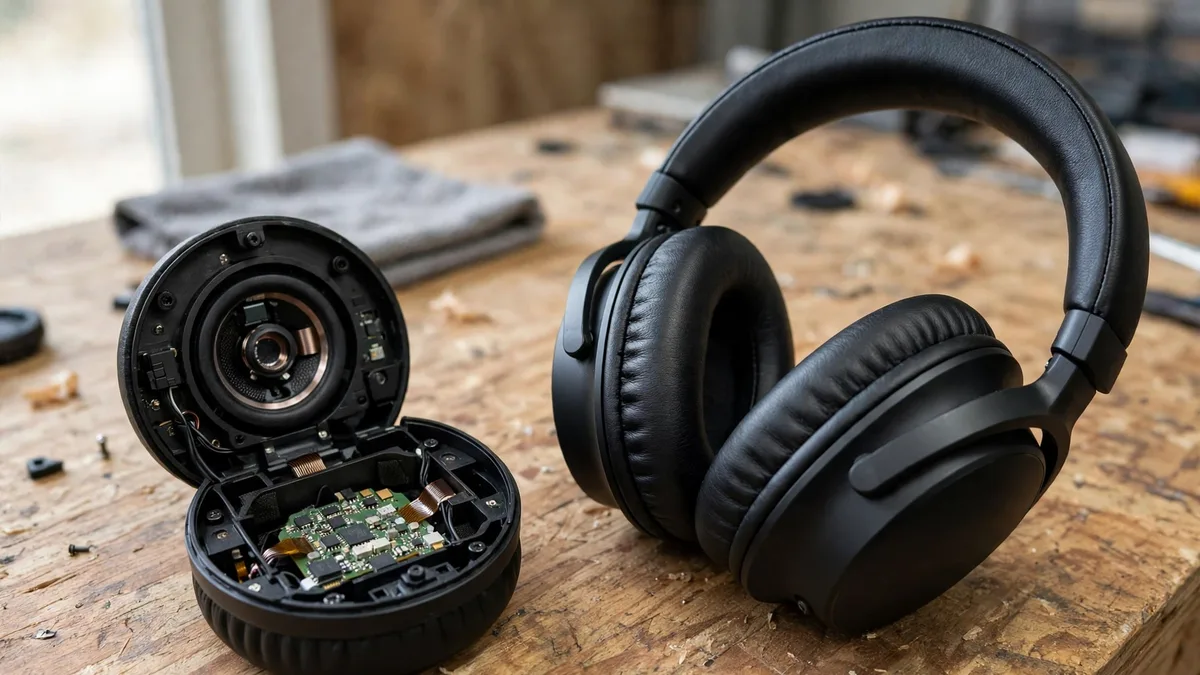
How Noise-Cancelling Headphones Are Made
Step 1: Moulding the earcups and headband
Everything starts with plastic. The earcups, the headband and the yokes that join them are injection moulded from tough, lightweight polymers, heated until liquid and forced into steel moulds under high pressure. Once cooled, each part is trimmed and checked for warping. The headband is given a steel or spring-steel core so it can flex thousands of times without losing its grip, and the whole frame is weighed: a few grams too many here means a pair of headphones that feels heavy after an hour. The driver inside the earcup is a precision part in its own right, as explained in how a wireless earbuds driver is made, which covers how a tiny speaker is built to move air accurately.
Step 2: Building the driver
The driver is the speaker at the heart of each earcup, and it is built like a miniature loudspeaker. A thin diaphragm, often made from a coated polymer or a bio-cellulose film, is glued to a voice coil wound from hair-fine copper wire, and the coil is suspended inside a ring magnet. When current flows through the coil, the diaphragm moves, pushing air and making sound. The parts are assembled by hand under magnification, and the diaphragm is tensioned evenly so it does not buzz or distort. Each driver is then tested with a sweep of tones, and its frequency response is measured. Drivers that do not match each other closely are rejected, because your left and right ears must hear the same sound, or the music feels lopsided.
Step 3: Fitting the microphones
Noise cancelling lives or dies on its microphones. Each earcup carries several tiny microphones: some on the outside, listening to the noise before it reaches your ear, and some on the inside, listening to what is left after the seal and the driver have done their work. The microphones are smaller than a grain of rice and are soldered onto a flexible circuit board by machine, then the board is fitted into the earcup with the microphones poking through precisely drilled holes. Each one is tested for sensitivity before the earcup moves on.

Step 4: Assembling the electronics
Next comes the brain of the headphones. A small printed circuit board carries the noise-cancelling processor, the Bluetooth radio, the amplifier and the battery management chip. The processor is the star: it takes the sound from the outside microphones, inverts it, and sends the inverted signal to the driver, all within a few milliseconds. The board is assembled by pick-and-place machines that set components the size of sand grains onto solder paste, then it is baked in an oven to fix them in place. After that, the firmware is loaded and the board is tested on a rig that plays recorded train and aircraft noise at it, measuring how much of the noise disappears. A board that cancels less than its target is reworked or scrapped.
Step 5: Adding the cushions and sealing the earcup
Comfort and silence both depend on the ear cushions. They are made from memory foam, cut and shaped to match the curve of an ear, then wrapped in soft synthetic leather or fabric. The cushions are clipped onto the earcups, and the seal they make against the head is checked, because even a small gap lets low-frequency noise leak in and defeats the electronics. The battery is fitted, the buttons are connected, and the earcup is closed up. The materials used in the cushions, drivers and housings are covered in noise-cancelling headphones materials engineering, which explains why each one was chosen.

Step 6: Tuning, testing and final checks
The last step is tuning. Each pair is placed on a dummy head fitted with microphones in its ears, and played a library of sounds: jet engines, office chatter, traffic, wind. Engineers adjust the cancelling algorithm until the noise drops as far as it can without making the music sound thin or hollow. The battery is charged and discharged, the Bluetooth connection is tested at range, and the headphones are dropped, flexed and shaken to make sure nothing rattles loose. Only then are they cleaned, boxed and shipped. The same driver principles appear at a much smaller scale in earbuds, as shown in how a wireless earbuds driver works, where the speaker must fit into a space the size of a fingertip.
Noise-Cancelling Headphones Specifications
| Feature | Typical figure |
|---|---|
| Driver size | 30–40 mm dynamic driver |
| Noise reduction | About 20–35 dB active cancelling |
| Microphones | 4–8 per pair |
| Processing delay | A few milliseconds |
| Battery life | About 30–40 hours with cancelling on |
| Weight | About 240–260 g |
| Bluetooth range | About 10 m |
| Charging | USB-C, fast charge in about 15 minutes |
What Noise-Cancelling Headphones Cost
As an estimate, a premium pair of noise-cancelling headphones costs roughly $80 to $150 to manufacture, with the driver, the noise-cancelling processor and the battery accounting for much of that. The retail price is higher, reflecting research, tuning and marketing, but the factory cost shows where the money goes: the electronics and the acoustic engineering, not the plastic. Cheaper models cut costs by using fewer microphones and simpler processors, which is why their cancelling is weaker on low, steady sounds like engines.
A Rare Fact
Active noise cancelling works best on low, steady sounds, such as an aircraft engine, because the sound wave is long and predictable, giving the processor time to build its opposite. It struggles with sudden, sharp sounds like a dropped plate, because the noise is over before the opposite wave can be made.
Noise-cancelling headphones are a quiet triumph of making: a speaker, a handful of microphones and a chip the size of a fingernail, fitted into a pair of earcups, working together thousands of times a second. The next time a train fades away and the music takes over, it is worth remembering that the silence was built, piece by piece, by hand.


