Put a pair of wireless earbuds in your ears and you are wearing two of the smallest loudspeakers ever made. Each one is barely wider than a fingertip, yet it can reproduce a double bass, a whisper, and a cymbal crash, all from a driver smaller than a coin. The driver is the part that actually makes the sound, a tiny machine of magnets, coils, and a diaphragm thinner than a human hair, and everything else in the earbud exists to serve it.
The challenge is absurd. A full-size speaker has room for a large cone, a heavy magnet, and a cabinet to shape the sound. An earbud driver has about ten millimetres of space, a battery sitting millimetres away, and a seal in your ear canal that changes every time you move. Yet modern earbuds sound better than the wired headphones of a decade ago, and the reason is the engineering inside that tiny driver.
There are several kinds of driver, and each sounds different, but they all work on the same idea: turn an electrical signal into movement, and turn movement into sound waves in the air. Here is how it works.

How It Works
Step 1: Receiving the signal over Bluetooth
Before the driver can make a sound, the music has to reach it. Your phone sends the audio wirelessly over Bluetooth, using a codec that compresses the sound so it can travel through the air. The earbud’s chip receives the signal, decodes it, and turns it back into an electrical waveform, all in a fraction of a second. The quality of that codec matters: a basic codec throws away more detail than a modern one, and the driver can only reproduce what it is given. The chip also handles noise cancelling, touch controls, and battery management.
Step 2: Turning current into motion with a voice coil
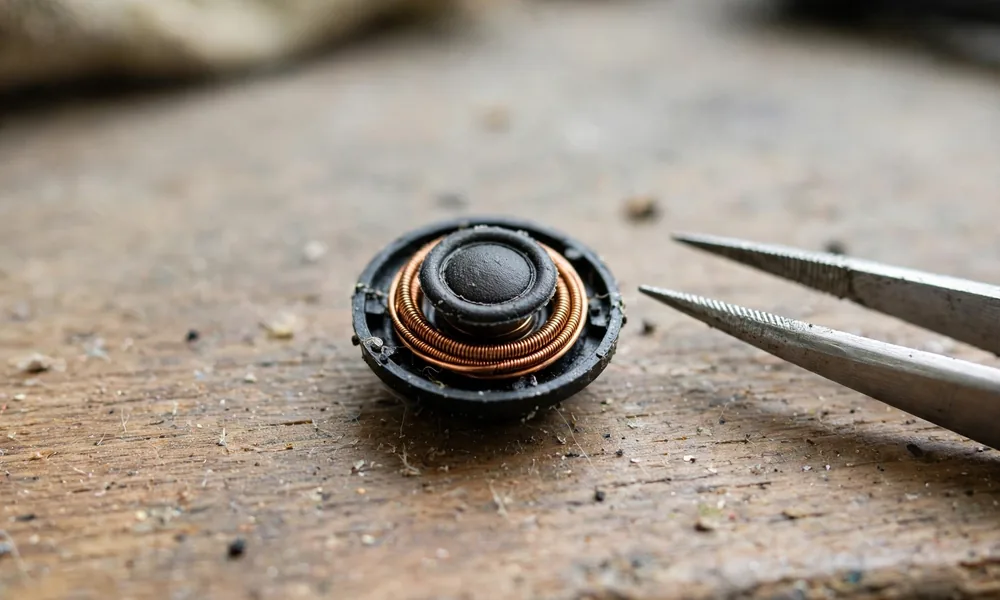
At the centre of the driver sits a voice coil, a tiny ring of copper wire attached to the back of the diaphragm. When the electrical signal flows through the coil, it becomes an electromagnet, and the coil is pulled toward or pushed away from a permanent magnet sitting behind it. The signal changes thousands of times per second, so the coil vibrates in step with the music, and those vibrations are what become sound. The coil is wound with extraordinary precision, because a coil that is even slightly off-centre will rub and distort. The same principle of a coil moving in a magnetic field drives much larger machines, including the motors described in drone motor specs explained.
Step 3: Moving air with the diaphragm
The diaphragm is the part you actually hear. It is a thin, stiff dome, usually between 6 and 13 millimetres across, that is pushed back and forth by the voice coil. As it moves, it pushes the air in your ear canal, and those pressure waves are what your eardrum receives as sound. The material matters enormously: cheap diaphragms are made from plastic, while premium ones use beryllium, titanium, or graphene, materials that are stiff enough to move as one piece without flexing, yet light enough to stop and start thousands of times per second. A diaphragm that flexes smears the sound, which is why the best earbuds invest so much in this one tiny part.
Step 4: Tuning the sound with the housing
The driver does not work alone. The housing around it, the vents, and the acoustic chamber all shape the sound before it reaches your ear, and engineers tune them the way a luthier tunes a violin. A small vent behind the driver relieves pressure so the diaphragm can move freely, while the shape of the nozzle that sits in your ear canal affects the bass. The seal of the ear tip matters too: a loose tip lets the bass leak away, which is why earbuds come with several tip sizes. Some earbuds use two drivers instead of one, with a separate balanced-armature driver for treble, a design borrowed from hearing aids and covered in wireless earbuds driver specs explained.
Step 5: Cancelling the noise around you
Many earbuds also cancel the noise of the world around you, and that job starts with microphones. Tiny microphones on the outside of the earbud listen to the noise around you, while microphones inside listen to what is actually reaching your ear. The chip then creates an inverted copy of the noise, a sound wave that is the exact opposite, and plays it through the driver at the same moment. The two waves cancel each other out, and the noise disappears. It works best on steady sounds like engines and air conditioning, and less well on sudden sounds like a door slamming.
Step 6: Powering it all from a tiny battery
Finally, all of this runs on a battery smaller than a pea. Each earbud carries a cell of roughly 50 to 70 milliamp-hours, enough for about five to eight hours of listening, and the charging case holds several more charges. The driver itself uses very little power, which is why the battery can be so small, but the Bluetooth radio and the noise cancelling are hungrier. The case charges over USB-C or wirelessly, and the whole system is designed so that the earbuds are always topped up whenever they are put away. The precision engineering of tiny vibrating parts is a familiar story in miniature machines, including the haptic motors described in haptic motor materials engineering.
Wireless Earbuds Driver Specs
| Specification | Typical range |
|---|---|
| Driver type | Dynamic driver, sometimes balanced armature or planar |
| Driver size | About 6 to 13 millimetres across |
| Diaphragm material | Plastic, titanium, beryllium, or graphene |
| Frequency response | About 20 hertz to 20 kilohertz |
| Impedance | About 16 to 32 ohms |
| Bluetooth codecs | SBC, AAC, aptX, LDAC depending on model |
| Noise cancelling | Feedforward and feedback microphones, active cancellation |
| Battery per earbud | About 50 to 70 milliamp-hours, 5 to 8 hours |
| Total weight | About 4 to 6 grams per earbud |
What Do Wireless Earbuds Cost?
Wireless earbuds are estimated to cost from around $20 for basic models to $250 to $300 for flagship pairs from major brands, with the driver and its tuning accounting for a large share of the difference. Prices are estimates only, and the gap between a cheap pair and a good pair is mostly the driver: its materials, its precision, and the tuning that went into it. A well-made driver can last for years, which is why a good pair of earbuds is often better value than replacing cheap ones again and again.
A Rare Fact
The diaphragm in a premium earbud driver can be thinner than a human hair and lighter than a grain of sand, yet it moves back and forth up to 20,000 times per second. At that speed, the difference between a good driver and a great one comes down to tolerances measured in micrometres, smaller than a speck of dust. One of the most expensive diaphragm materials, beryllium, is so stiff and light that it was first used in aerospace and X-ray equipment, long before anyone thought to put it in an earbud.

The next time you press play, spare a thought for the tiny driver in your ear. It is a loudspeaker, a computer, and a precision instrument, all smaller than a coin, and it is the reason a whole orchestra can fit in your pocket.