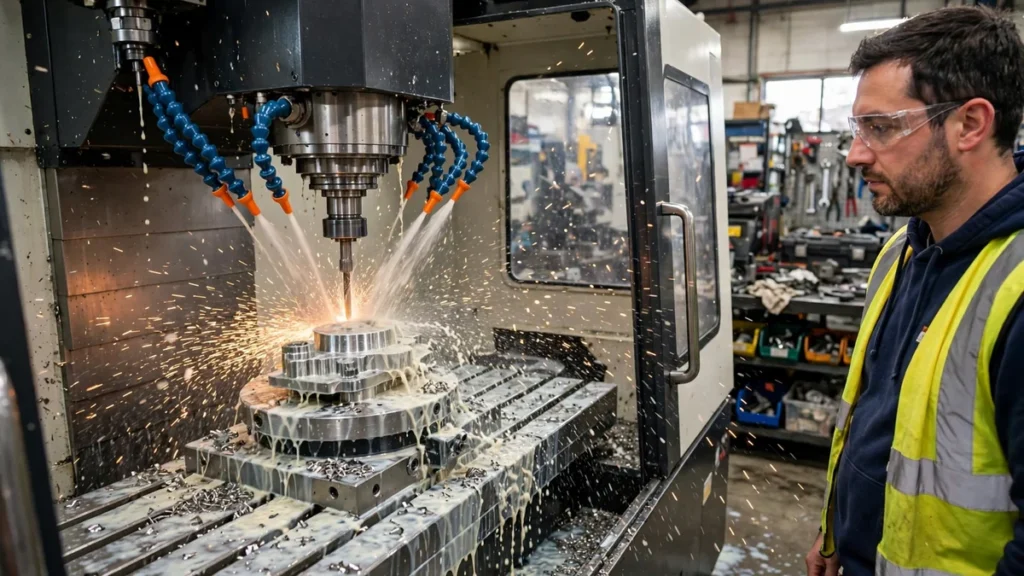
The block of aluminium going into the machine is the size of a shoebox and weighs nine kilograms. Ninety minutes later, what comes out weighs less than a kilogram — a bracket for a jet engine, all curves and pockets drilled to a precision the eye cannot see, its surfaces shining like a mirror. The machine has simply removed, with extraordinary patience, everything that was not supposed to be there.
Precision CNC machining is the quiet craft behind almost everything modern: the phone in your pocket, the engine in your car, the implants in a hospital, the turbines in a power station. A computer-controlled cutting tool moves through metal with an accuracy measured in thousandths of a millimetre, repeating the same cut thousands of times without ever getting tired. The numbers that describe it sound abstract until you hold a finished part and realise a human hair is roughly seventy times thicker than the margin of error.
This guide explains the numbers in plain English — tolerance, axes, spindle speed, feed rate and surface finish — and what each one means for a part that has to fit perfectly, first time, every time. The specs of metal 3D printing show the opposite approach — adding material instead of removing it — but for precision metalwork, CNC machining is still the standard.

How Precision CNC Machining Works
Step 1: The digital blueprint
It starts not with metal but with a computer model. An engineer designs the part in CAD software, defining every curve, hole and surface to the micrometre, and CAM software then translates that model into a toolpath — a list of thousands of tiny movements the cutting tool must make. The program, written in a language called G-code, tells the machine where to go, how fast to move and how deep to cut.
Step 2: The cutting
The workpiece is clamped into the machine, and a spinning cutter — an end mill, a drill or a lathe tool — begins removing metal, a fraction of a millimetre at a time. The spindle can spin at 12,000 revolutions per minute or more, and the cutter moves along three, four or five axes at once, carving shapes no human hand could reproduce. Coolant floods the cutting zone, carrying away heat and chips, because even a few degrees of temperature change can expand the metal enough to ruin the tolerance.
Step 3: The measuring
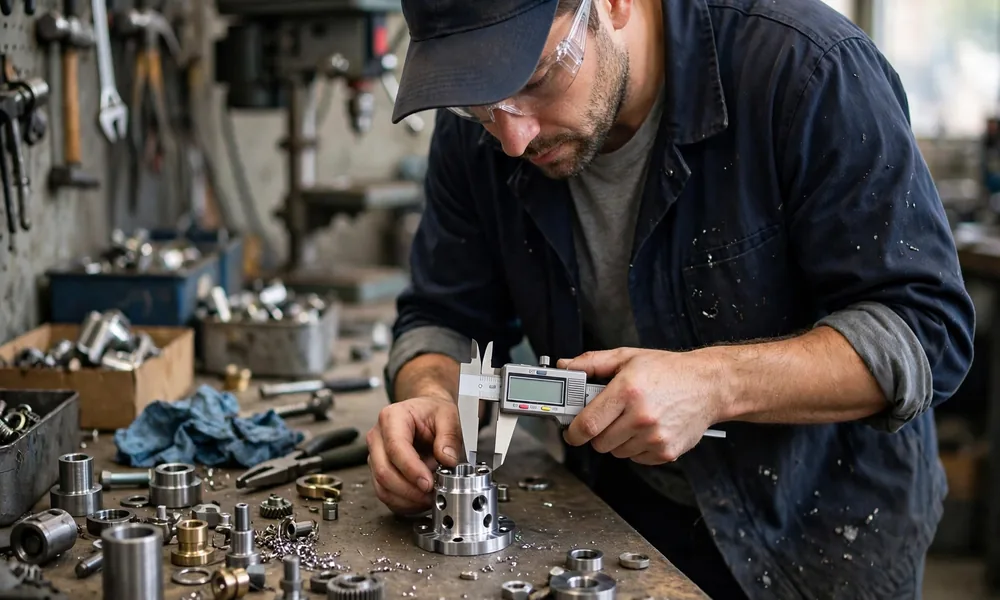
When the cutting stops, the part is measured — often on the machine itself, with a touch probe that checks critical dimensions before the part is even unclamped. Then it goes to a coordinate measuring machine, a device so accurate it can detect a deviation smaller than a speck of dust, which maps the whole part in three dimensions and compares it against the original model. Only when every measurement passes does the part leave the workshop.

Precision CNC Machining Specs
The spec sheet of a CNC machine is a short list of numbers, and each one answers a different question: how accurately can it cut, how fast can it work, and how fine a finish can it leave — unlike additive manufacturing, which adds material instead of removing it.
| Spec | Typical number | What it means | How it compares |
|---|---|---|---|
| Tolerance | ±0.005 mm | How close a cut must be to the design size | A human hair is about 0.07 mm; this tolerance is fourteen times finer |
| Repeatability | ±0.002 mm | How identically the machine repeats the same cut | A good machine repeats within 2 microns; a worn one drifts ten times further |
| Spindle speed | 12,000 to 24,000 rpm | How fast the cutting tool spins | Basic mills run 6,000 rpm; high-speed machines reach 30,000 rpm or more |
| Number of axes | 3 or 5 axes | How many directions the tool and part can move | 3-axis machines cut from above; 5-axis machines reach undercuts and curves in one setup |
| Feed rate | 5 to 20 metres per minute | How fast the cutter moves through the metal | Aluminium cuts fast; hardened steel needs a slower feed to protect the tool |
| Surface finish | Ra 0.4 to 1.6 µm | How smooth the finished surface is, in microns | Ra 3.2 µm feels slightly rough; Ra 0.4 µm is mirror-smooth to the touch |
Tolerance is the number that defines the whole craft. A tolerance of ±0.005 millimetres — five microns — means a part designed to be exactly 50.000 millimetres wide may measure anywhere from 49.995 to 50.005 and still pass. A human hair is about 70 microns thick, so the allowed error is roughly a fourteenth of a hair’s width.
Repeatability is different from tolerance, and in some ways more important. Tolerance is about hitting the target; repeatability is about hitting the same spot every time. A machine with repeatability of ±0.002 millimetres will cut the thousandth part of a batch almost exactly like the first, which is what makes mass production of precision parts possible at all. Worn ball screws, loose bearings and thermal drift all erode repeatability, so workshops test it constantly.
Spindle speed is the number that decides how fast the work gets done, and it is a balancing act. A cutter spinning at 24,000 rpm removes aluminium at a furious rate, but the same speed in hardened steel would destroy the tool in seconds. The right speed depends on the material, the tool and the depth of cut, and modern machines adjust it constantly. High-speed machining is about taking many light, fast cuts instead of few heavy ones.
The number of axes decides what shapes are possible. A three-axis machine moves the cutter left and right, forwards and backwards, and up and down — enough for most flat parts, brackets and housings. A five-axis machine adds two rotations, tilting and turning the part so the cutter can reach undercuts and sculpted shapes in a single setup. Every time a part is unclamped and moved, a little accuracy is lost. The specs of metal injection moulding show an alternative for tiny, complex parts made in huge volumes.
Surface finish, measured as Ra in microns, is the number you can feel with your fingertip. An Ra of 3.2 microns feels slightly rough, like fine sandpaper; an Ra of 0.8 microns feels smooth; an Ra of 0.4 microns is mirror-smooth. The finish matters far beyond appearance: on a bearing surface or a seal, a rough finish wears faster and leaks sooner. Achieving a fine finish takes time — slower feeds, sharper tools, lighter cuts — so engineers specify the roughest finish that will do the job.
What Does Precision CNC Machining Cost?
A precision CNC machine itself costs roughly $50,000 to $500,000 (estimate), with five-axis machines at the top of that range and beyond. For the customer, the price is per part: a simple aluminium bracket might cost $20 to $100 (estimate), while a complex aerospace or medical component can cost $500 to $5,000 or more (estimate).
A Rare Fact
The first computer-controlled machine tool was built at MIT in the early 1950s, and it was programmed with punched paper tape — the same technology used in player pianos. The machine took its instructions from holes punched in a long strip of paper. Every CNC machine in the world today is a direct descendant of that paper-tape machine.