Sixty miles off the coast, the oil platform never stops. It burns through food, fuel, drilling mud, and spare parts every day, and the only way any of it arrives is by sea. On the horizon a grey workhorse of a ship is coming in, its wide flat deck stacked with containers, its cranes folded, its bow pushing through a swell that would send a yacht home.
An offshore supply vessel, usually called a platform supply vessel or PSV, is the delivery truck of the offshore world. It carries everything a rig needs, from drinking water to drilling chemicals, and it does it in weather that keeps most ships in port.

How an Offshore Supply Vessel Is Made
A supply vessel starts with the cargo it must carry. Naval architects work out the deadweight, the deck area, and the tank capacity for fuel, water, and drilling mud, and from those numbers they draw a ship that is typically sixty to ninety metres long, with a broad beam and a long flat deck aft. The hull is shaped for a heavy load and a rough sea rather than for speed, with a flared bow that throws spray clear and a stern designed to work close to a platform without damage.
Step 1: Cutting steel and building the hull in blocks
The ship is built from steel plate, cut by computer-controlled plasma torches into panels that are welded into blocks, each one a section of the hull or the superstructure. The blocks are built upside down or on their sides in the yard, then lifted by gantry crane and welded together in the dry dock, like a giant three-dimensional puzzle. The hull steel is thicker than on a ferry of the same size, because a supply vessel works in ice, bumps against platforms, and carries loads that shift in a seaway.
Step 2: Fitting the engine room and the power plant
Below deck, the engine room is fitted with two or four main diesel engines, usually producing several thousand kilowatts in total, driving generators rather than the propellers directly. This diesel-electric arrangement is the key to the ship: the generators feed a common electrical bus, and the power is shared between the main propulsion, the bow thrusters, and the deck cranes as the work demands.
Step 3: Installing the propulsion and the thrusters
A supply vessel does not just need to go forward; it needs to go sideways and to stay still. The main propulsion is usually a pair of azimuth thrusters, propellers in pods that can rotate through 360 degrees, giving the ship thrust in any direction. At the bow, one or two tunnel thrusters push the front of the ship sideways, and together the thrusters give the captain full control at low speed.
Step 4: Building the deck and the cargo systems
The working heart of the ship is its open aft deck, a flat steel expanse of several hundred square metres, fitted with container sockets, tie-down points, and a deck crane that can lift containers and pipes over the side. Below the deck, tanks hold drilling mud, brine, and cement, with pumps and pipework to transfer them to the platform through hoses. How a ship dry dock works matters to every supply vessel, since the ship returns to one regularly for the hull inspections and thruster overhauls that keep it working offshore.
Step 5: Fitting the bridge and the dynamic positioning system
On the bridge, the most important system is dynamic positioning, or DP. Using satellite navigation, gyrocompasses, and sensors that measure wind and current, the DP computer works out exactly where the ship is and drives the thrusters automatically to hold it in place, often to within a metre, even in rough weather. The bridge itself is fitted with a full set of navigation radars, communications, and controls for the deck cranes, and it is built with a clear view over the working deck aft so the captain can watch the cargo operations. A supply vessel holds its station the way a tug holds a ship alongside, and how a tugboat works shows the same low-speed power and control, scaled down to a smaller hull.

Step 6: Sea trials, DP proving, and delivery
The final stage is the sea trial, and for a supply vessel the trial is a working test. The ship runs at full speed to measure its fuel consumption, then the crew tests the DP system by holding position in open water while the engineers watch the thruster loads and the position error. The deck crane is tested at full load, the mud pumps are run, and the ship practices coming alongside a platform fender to prove it can work in a real offshore operation. Only when the DP holds, the crane lifts, and the speed matches the contract does the ship get its final coat of paint and its papers, ready to sail out to the platforms it will serve for the next twenty-five years. The research ships that share its waters are built to a similar working philosophy, and how a research vessel is made shows the same focus on deck space, sea keeping, and systems that must work far from help.
Offshore Supply Vessel Specifications
| Specification | Typical figure |
|---|---|
| Length | 60 to 90 metres |
| Deadweight | 3,000 to 5,000 tonnes |
| Deck area | 700 to 1,000 square metres |
| Speed | 12 to 14 knots |
| Power | 4,000 to 8,000 kW diesel-electric |
| Dynamic positioning | DP2, holds position within a metre |
| Crew | 15 to 25, plus up to 50 offshore workers |
What an Offshore Supply Vessel Costs
A platform supply vessel is a serious capital asset. A new sixty-metre PSV typically costs an estimated $30 million to $45 million, while a larger ninety-metre vessel with DP2, a heavy deck crane, and full mud and bulk cargo systems can reach an estimated $60 million to $80 million. Charter rates run into tens of thousands of dollars a day, and the owners recover the cost over decades of service.
A Rare Fact About Offshore Supply Vessels
Some supply vessels carry a cargo you would never guess from looking at them: liquid mud. Drilling mud is a dense, carefully mixed fluid that cools the drill bit and carries rock cuttings out of the well, and a PSV carries it in dedicated tanks below deck, pumping it to the platform through hoses while holding station in open water. A single vessel can deliver hundreds of tonnes of mud in one trip, and the mud is worth far more than the fuel the ship burns to carry it. It is the least glamorous cargo at sea, and one of the most valuable.
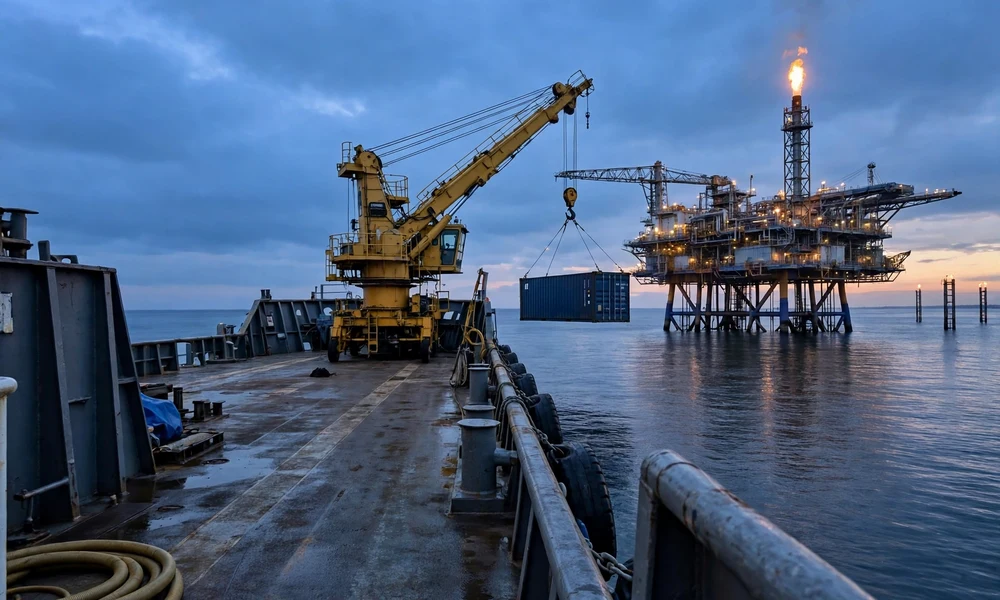
The next time you see a grey, flat-decked ship heading out to sea with containers stacked high and no passengers aboard, think of the work it is going to do. It will cross open water in weather that keeps other ships in port, hold itself still beside a platform in a swell, and hand over everything from drinking water to drilling mud. The offshore supply vessel is not the most beautiful ship at sea, but it is the one the whole offshore industry depends on, and it is built to prove it every single day.


