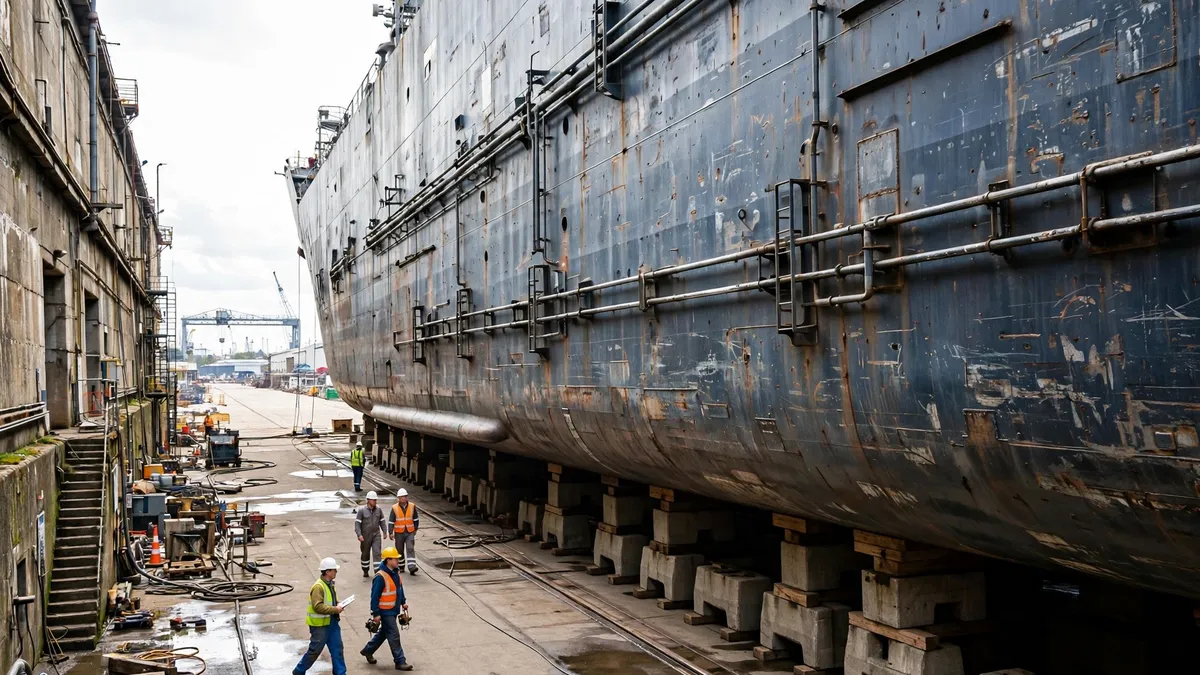
From the quayside, a ship in dry dock looks wrong. A vessel that belongs in the water is standing in the open air, held up by rows of squat concrete blocks, its hull fully exposed: rust streaks, patches of weed, the dull red of antifouling paint, and a propeller the size of a small house. It looks stranded, but it is exactly where it is supposed to be. A dry dock is the one place where a ship can be properly inspected, repaired and repainted, and every large vessel visits one every few years.
The problem is simple: you cannot repair the bottom of a ship while it is floating. The underwater hull takes the worst punishment of any part of the vessel — salt water, marine growth, collisions with debris, and the constant flexing of the hull in waves — yet it is the part you can never see while the ship is in service. Divers can patch small problems, but a full inspection, a propeller change or a hull repaint needs the water gone.
How a Ship Dry Dock Works
Step 1: The dock is flooded and the gate opens
Work begins with the dock full of water. Pumps fill the basin until the water inside matches the level outside, and the heavy steel gate at the seaward end, called a caisson, is floated out of its seat or swung open. Tugs guide the ship in, slowly and precisely, because the gap between the hull and the dock walls is often only a few metres.
Step 2: The ship is positioned over the keel blocks
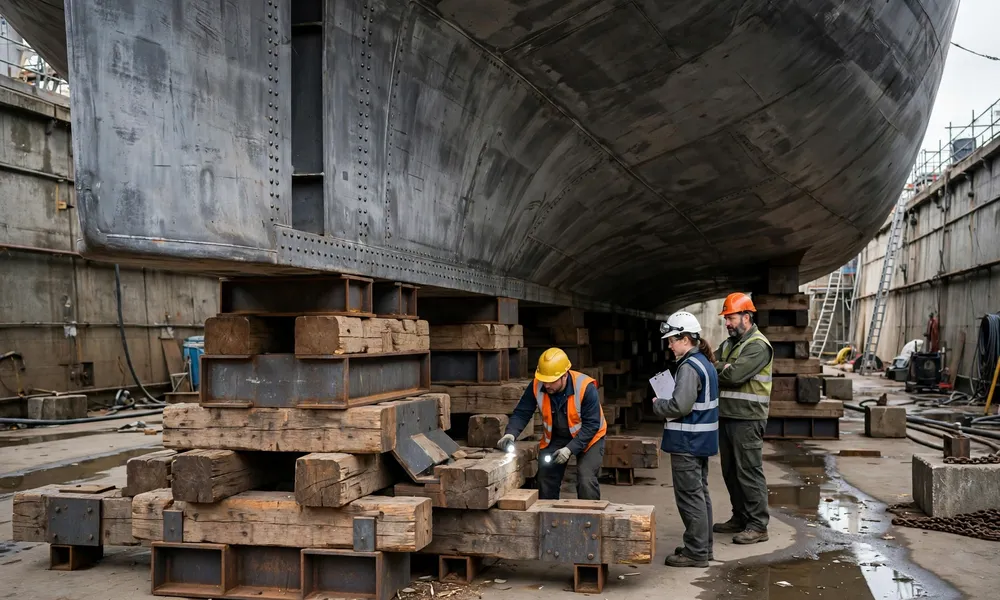
Before the ship arrives, workers lay out rows of keel blocks along the centre line of the dock floor. These are squat stacks of concrete and timber, built to exact heights so that together they form a cradle matching the shape of the ship’s keel. The ship is manoeuvred until its keel is directly above the blocks, using lines from the dock walls and measurements from the dockmaster. The entire weight of the ship will soon rest on those blocks alone.
Step 3: The water is pumped out and the ship settles
Once the ship is in position, the gate is closed and sealed, and powerful pumps begin removing the water. As the water level falls, the ship slowly sinks onto the keel blocks, and for a short time it is balanced on its keel while still partly floating. The dockmaster watches the ship’s stability closely, because a vessel that lists to one side while settling can slide off the blocks.
Step 4: Workers inspect the hull they could never see before
With the hull exposed, surveyors walk the full length of the ship at ground level, examining steel that has spent years underwater. They look for corrosion, cracks, dents from groundings or collisions, and the condition of the propeller, rudder and thrusters. Divers can find some of these problems, but nothing replaces a person standing next to the steel with a light and a hammer, tapping plates and listening for the dull sound that means a plate has thinned. The hull steel itself is covered in the materials behind a container ship hull, where the same forces that wear the steel down shape how it is built.
Step 5: Cleaning, blasting and repainting begin
Before any repair, the hull is cleaned. High-pressure water jets strip away weed, barnacles and loose paint, and in many yards abrasive blasting takes the steel back to bare metal. Then the painters move in with several coats, including antifouling paint that slowly releases compounds to stop marine growth from attaching. A clean hull matters for more than looks: a hull fouled with barnacles can burn several percent more fuel, so the repaint pays for itself in fuel savings within months.
Step 6: Repairs and upgrades happen all at once
Dry dock time is expensive, so owners pack as much work as possible into the few weeks the ship is out of the water. Propellers are polished or replaced, rudders are overhauled, thrusters are serviced, and sea valves are tested. The engine room team works through its own list at the same time, overhauling machinery that cannot be stopped at sea. The scale of that machinery is described in the materials behind a cruise ship engine, where a ship’s power plant explains why so much of this work can only happen in dock.
Step 7: The dock is flooded again and the ship floats free
When the work is finished and the surveyors have signed off, the process reverses. The blocks and shores are removed, the dock is flooded, and the ship rises off its cradle as the water returns. The gate opens, tugs take the lines, and the ship slides back out to sea, usually with a fresh coat of paint and a hull that will not be seen again for years. The dock is then pumped dry and prepared for the next vessel, because a busy yard may turn a dock around in days.
Ship Dry Dock Specifications
| Specification | Typical value |
|---|---|
| Dock length | 200 to 500 metres for large commercial docks |
| Dock width | 30 to 70 metres between the walls |
| Water pumped per docking | Tens of thousands of cubic metres |
| Time to pump dry | 4 to 12 hours, depending on dock size |
| Typical docking duration | 10 to 30 days for a scheduled refit |
| Keel block load | Thousands of tonnes carried on the centre line |
| Docking interval | Every 2.5 to 5 years under class rules |
| Gate type | Floating caisson or hinged steel gate |
The underwater systems inspected in a dry dock include some of the most specialised machinery at sea, including the vehicles that work far below the surface, such as those in the materials behind a deep-sea submersible, where the same pressure and corrosion problems are solved at far greater depth.

How Much Does a Ship Dry Dock Cost?
Dry docking is one of the most expensive routine events in a ship’s life, and the price is an estimate because it depends on the ship’s size, the yard, and how much work is done. Hiring the dock itself for a large container ship or cruise ship typically costs in the region of fifty thousand to two hundred thousand dollars per day, and a scheduled docking of two to three weeks can easily reach one to three million dollars before a single repair is priced in.
A Rare Fact About the Ship Dry Dock
The oldest dry dock still in use in Britain was built in the early eighteenth century, and it works on exactly the same principle as a modern one: a basin, a gate, and pumps to remove the water. What has changed is the scale and the speed. Early docks were emptied by men working hand pumps or by waiting for the tide, a process that could take days. A modern dock’s pumps can empty a basin holding tens of thousands of tonnes of water in a few hours.