The ship held position in the grey Atlantic swell, and on the bridge nobody was watching the horizon. They were watching a screen, where a thin yellow line traced the path of a torpedo-shaped vehicle two thousand metres below. The ship was not going anywhere, and that was the point. A research vessel is a ship built to stand still in bad weather, lower instruments into the deep, and bring the ocean back up in samples, and every part of it is shaped by that job.
A research vessel looks like an ordinary ship from a distance, but it is built more like a floating laboratory that happens to have a hull. The laboratories have to stay level enough for microscopes and balances to work, the engines have to run quietly enough not to deafen the sonar, and the deck has to carry cranes, winches, and a moon pool that can swallow a submersible.
How a Research Vessel Is Made
The build begins with the hull, and the hull of a research vessel is a compromise between two competing demands. It has to be strong enough to work in ice and heavy weather, and quiet enough that its own noise does not drown out the instruments it carries. Naval architects give it a rounded, full form that rolls gently rather than snapping back, and the steel is thicker at the bow and the waterline where ice and waves strike hardest.
Step 1: Shaping a quiet, stable hull
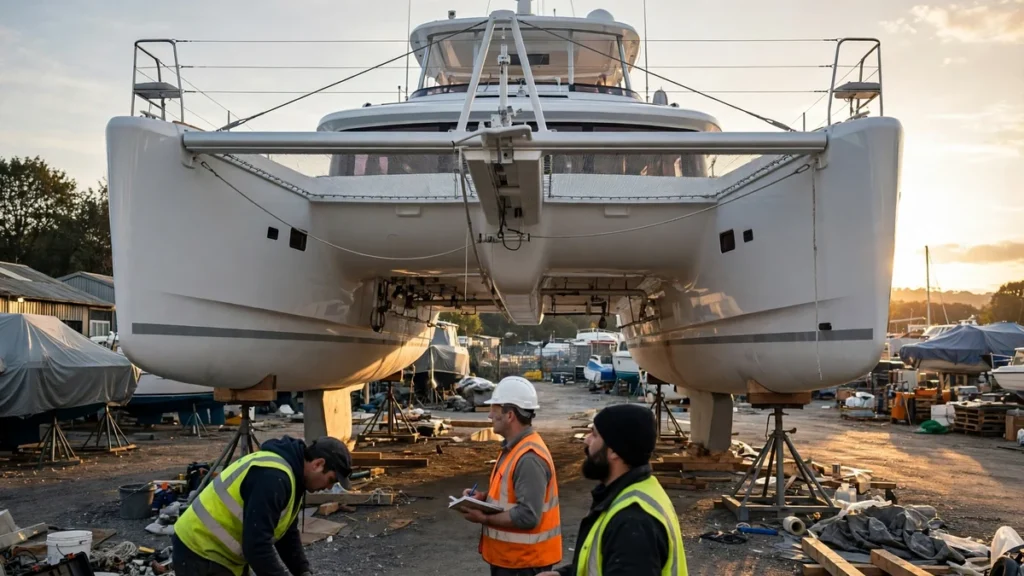
The first steel goes down as flat plates cut by machine, then rolled and pressed into the curves of the hull. Workers weld the plates into sections called blocks, each one a piece of the ship several metres across, and the blocks are lifted into the dry dock and joined with full-penetration welds that are tested with ultrasound. The engine room is placed low and amidships, on flexible mounts that stop vibration reaching the hull, and the propeller is chosen for quiet running rather than top speed.
Step 2: Fitting the laboratories and the moon pool
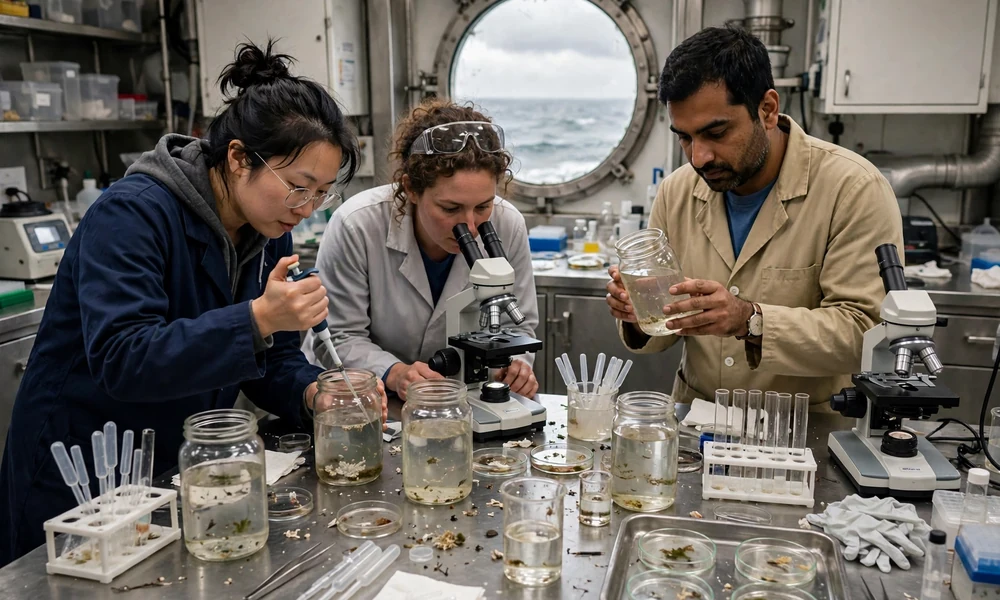
Once the hull is closed, the laboratories go in, and they are the reason the ship exists. A modern research vessel carries wet labs for handling seawater samples, dry labs for electronics and computers, and a chemistry lab with fume hoods and clean benches. The moon pool is cut through the hull amidships, a vertical shaft open to the sea below, and it lets the crew lower instruments and small vehicles straight down through the ship, sheltered from the waves. A ship ballast water system works on a similar idea of moving seawater in and out of the hull, but a moon pool is a working hole in the ship, and its doors have to seal against the pressure of the ocean.
Step 3: Installing cranes, winches, and the A-frame
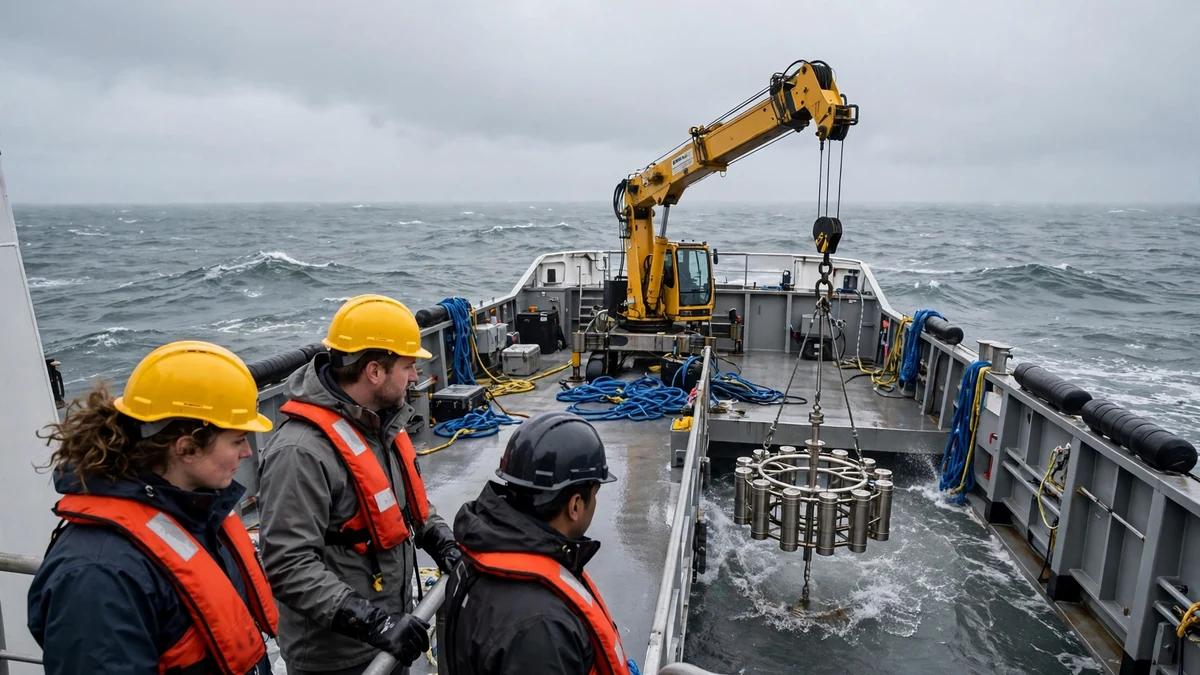
The working deck is where the science happens, and it is built like a construction site that floats. The stern gantry, a tall A-frame that swings over the back of the ship, can lift tens of tonnes of equipment over the side, and it is welded to reinforced foundations that run deep into the hull structure. Winches the size of small cars are bolted to the deck, each carrying kilometres of steel wire or fibre-optic cable, and they are driven by electric motors so the crew can pay out cable at a steady centimetre-per-second pace.
Step 4: Powering the ship for silence and endurance
Research vessels usually run on diesel-electric power, with generators feeding electric motors that turn the propellers. The arrangement matters because the generators can be switched on and off to match the load, and because electric motors run far more quietly than a direct-drive diesel. The ship also needs dynamic positioning, a system of thrusters and satellite navigation that holds it in one spot while the scientists work, even in wind and current. A cruise ship waste system deals with the output of thousands of people, but a research vessel must also treat its own scientific waste, storing samples, chemicals, and contaminated water in sealed tanks until the ship returns to port.
Step 5: Fitting sonar, sensors, and the bridge
The instruments are the most expensive part of the ship, and they are fitted with extraordinary care. Multibeam sonar arrays are mounted in a blister under the hull, a smooth fairing that protects the transducers and keeps the water flow clean. The bridge is fitted with navigation and science displays side by side, so the captain and the chief scientist can see the same picture: the ship’s position, the depth below, and the location of every instrument in the water. Submarine sonar works on the same physics, listening for echoes in the dark, but a research vessel uses its sonar to map the seabed rather than to hide from it.

Step 6: Sea trials, calibration, and the first expedition
The finished ship goes to sea for trials that test the science as well as the ship. The crew runs the dynamic positioning system in a strong current, lowers a test weight on the main winch to full ocean depth, and calibrates the sonar against a known patch of seabed. The laboratories are tested with real samples, the winches are loaded to their rated capacity, and the noise of the ship is measured underwater to confirm it is quiet enough for the instruments. Only when the calibration data is clean does the ship sail on its first expedition, usually a short cruise with a small science team, before it is trusted with a months-long voyage to the far ocean.
Research Vessel Specifications
| Specification | Typical figure |
|---|---|
| Overall length | 60 to 110 metres for a global-class vessel |
| Displacement | 3,000 to 8,000 tonnes |
| Endurance | 40 to 60 days at sea without resupply |
| Scientific complement | 20 to 40 scientists and technicians |
| Main winch capacity | Up to 10,000 metres of cable |
| A-frame lifting capacity | 20 to 50 tonnes |
| Dynamic positioning | Holds position within a few metres |
| Cruising speed | 12 to 15 knots |
What a Research Vessel Costs
A new global-class research vessel typically costs an estimated $100 million to $250 million to build, depending on size, ice capability, and the instrument package, with the largest icebreaking research ships reaching an estimated $400 million or more. The instruments alone can account for tens of millions, because a single multibeam sonar system or a deep-water remotely operated vehicle costs more than a small yacht. Operating the ship costs an estimated $30,000 to $60,000 per day at sea, covering fuel, crew, and science support, which is why every day of a research cruise is planned months in advance.
A Rare Fact About Research Vessels
Some research vessels carry a bubble system under the hull that releases a curtain of tiny air bubbles while the sonar is running, because bubbles scatter sound and would normally ruin the readings, yet the system is there to sweep larger bubbles away from the transducers. Even rarer, a handful of research ships are built with a hull that can flood its own tanks and sink the stern until the deck is almost at water level, letting the crew float heavy equipment straight on board instead of lifting it over the side.