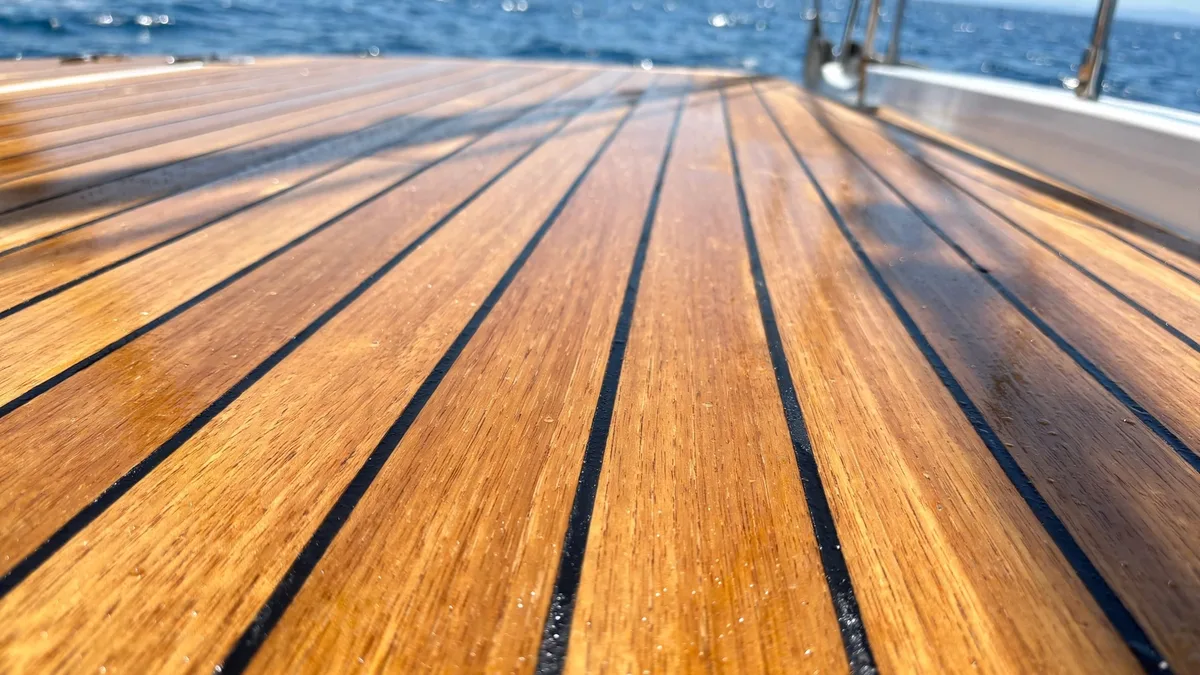
Step aboard a yacht on a hot morning and the first thing your bare feet meet is the deck: warm, honey-coloured wood, grooved planks running the length of the boat, seams of dark caulking between them. A teak deck is not just the prettiest surface on a yacht. It is the grip under your feet, the insulation over your head, the waterproof skin over the hull, and the first thing the sea tries to destroy.
A yacht teak deck works by combining a wood that nature already waterproofed with a construction method that lets it move, drain and breathe. Teak is full of natural oils and silica, so it resists water, rot and the sun; the planks are laid with flexible seams that take up movement as the boat flexes; and the whole deck is built so that water runs off it instead of pooling. It is a system that asks for care, but repays it with decades of service. This is how it works.
How a Yacht Teak Deck Works
Step 1: Starting with the right wood
It begins with teak itself, Tectona grandis, a hardwood from Southeast Asia that is unlike almost any other timber used at sea. Teak is dense with natural oils that repel water, it contains silica that makes it hard-wearing, and it barely shrinks or swells as it gets wet and dries out again. A teak plank can sit in salt water and sun for years and still hold its shape, which is why shipbuilders have used it since the days of wooden warships.
Step 2: Laying the planks
The deck is built from narrow planks, typically 40 to 60 millimetres wide, laid side by side along the curve of the deck. Each plank is cut to follow the shape of the boat, and they are laid over a structural sub-deck — usually fibreglass or plywood — that actually carries the load. That gap is the key to the whole system, because it is where the caulking goes, and the caulking is what makes the deck watertight. The way the deck is built, plank by plank, is covered in how a yacht teak deck is made, where the laying, the gluing and the finishing are set out step by step.
Step 3: Caulking the seams
Between every pair of planks is a seam filled with a flexible black compound, traditionally pitch and cotton, today a modern polysulphide or polyurethane sealant. The caulking is pressed deep into the gap and tooled flush, and it does two jobs: it stops water getting between the planks and down to the sub-deck, and it flexes as the planks expand and contract with heat and moisture.
Step 4: Fixing without screws showing
Modern teak decks are usually glued down, not screwed. The planks are bonded to the sub-deck with a strong marine adhesive, which means there are no screw holes to leak, no plugs to fall out and no metal fastenings to corrode in salt water. Older decks were screwed and the holes were plugged with small teak bungs, and those plugs are still seen on classic boats, but glue has taken over because it spreads the load across the whole plank instead of concentrating it at a few points. The result is a deck with a clean, unbroken surface, and far fewer places for water to get in.
Step 5: Giving grip when wet
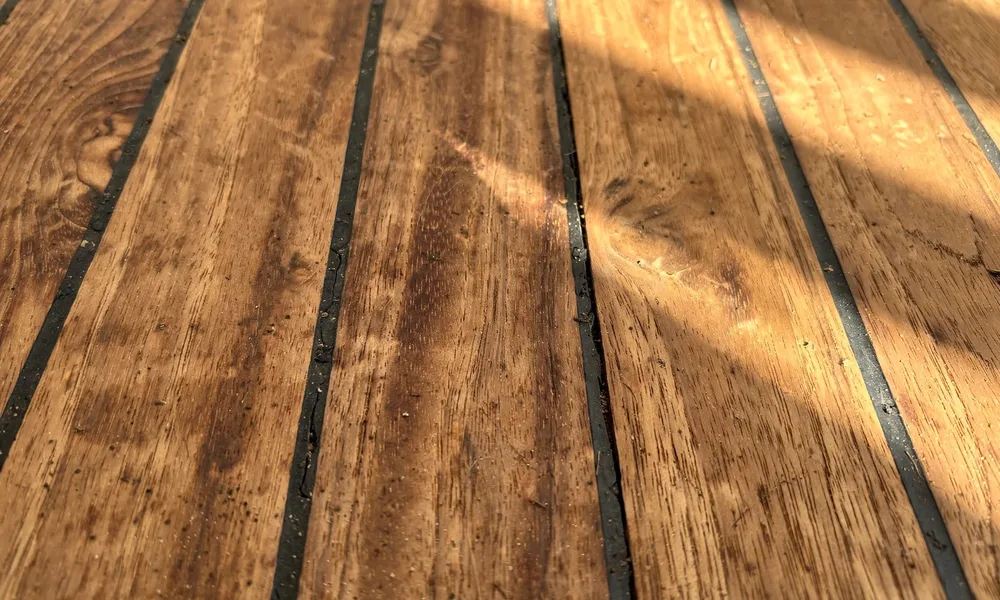
A deck that is slippery when wet is dangerous, and this is where teak earns its keep. The wood’s grain, worn slightly by years of walking, gives bare feet a natural grip even when the deck is soaked, and the silica in the timber adds to the friction. Sailors have trusted teak underfoot in rough weather for centuries, and the reason is simple — it grips when everything else slides. That grip is part of the safety system of the boat, not just a comfort.
Step 6: Insulating against heat and noise
Teak is also insulation. A dark fibreglass deck in tropical sun can get hot enough to burn bare feet, but teak stays noticeably cooler because the wood is a poor conductor of heat and its light, silvery-weathered surface reflects the sun. The deck is doing two jobs at once, and doing them both quietly. The same thinking about decks and the systems around them runs through other yacht hardware, from the rig above deck in superyacht mast specs explained to the propulsion at the stern in yacht propeller specs explained.

Step 7: Ageing, wearing and being renewed
Teak decks change with time. The planks wear slowly — each wash and each footstep takes a fraction of a millimetre — and after many years the deck can be sanded lightly to expose fresh wood, or re-oiled to bring back the honey colour. Eventually, after twenty or thirty years, the planks become too thin and the deck is replaced, a major refit that strips the old teak and lays a new one. The deck repays care, and punishes its absence.
Yacht Teak Deck at a Glance
| Specification | Detail |
|---|---|
| Wood | Teak, Tectona grandis, from Southeast Asia |
| Typical plank width | 40 to 60 millimetres |
| Typical plank thickness | 9 to 12 millimetres for a glued deck |
| Seam material | Modern polysulphide or polyurethane caulking |
| Fixing method | Marine adhesive bonding; older decks screwed and plugged |
| Typical lifespan | 20 to 30 years with proper care |
| Main advantage | Natural grip when wet, cool underfoot, rot resistant |
| Main drawback | Expensive, heavy, and needs regular gentle care |
What Does It Cost?
A teak deck is one of the most expensive surfaces you can put on a boat, and the price is driven by the timber itself. As rough estimates, a new teak deck typically costs around $800 to $1,500 per square metre installed, so a full deck on a mid-sized yacht can easily run to tens of thousands of dollars. Those figures are estimates, not quotes — the real number depends on the size of the deck, the quality of the teak, the yard and the region.
A Rare Fact
Teak’s reputation at sea is so old that it was the deck timber of choice for warships and ocean liners for over a century — the decks of the great liners, including the Queen Mary 2, are laid in teak, and the wood was once so valued that the British navy reserved the finest teak forests for its ships. A modern teak deck is, in effect, a piece of naval history that you walk on every time you step aboard.
A teak deck is not the cheapest way to cover a yacht, and it is certainly not the easiest to look after. But it is the only deck that grips your feet in a squall, stays cool in the tropics, quiets the cabin below and grows more beautiful as it silvers with age. It works because the wood and the way it is laid were designed by the sea itself, over centuries, and no synthetic surface has yet managed to do all of its jobs at once.