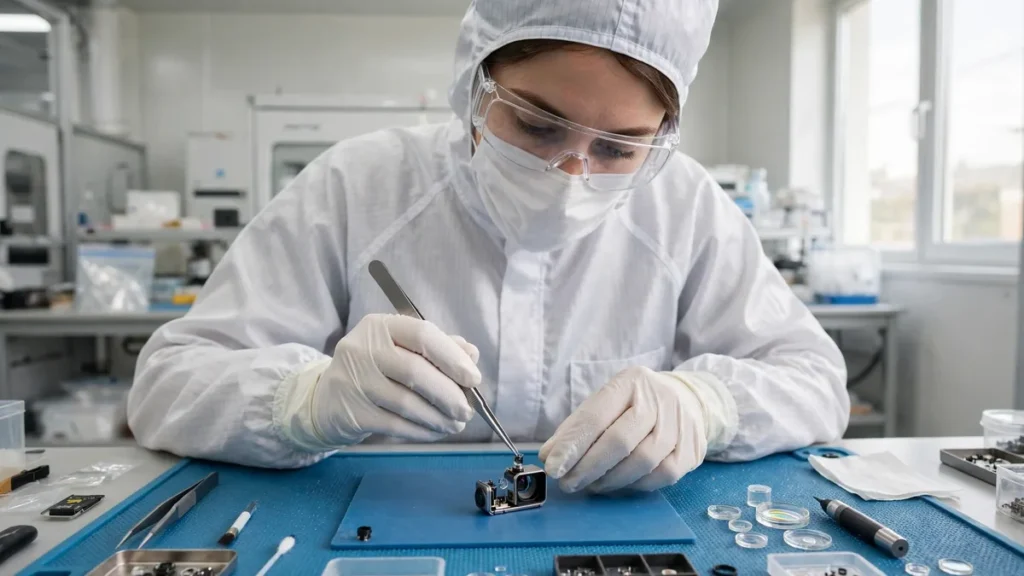
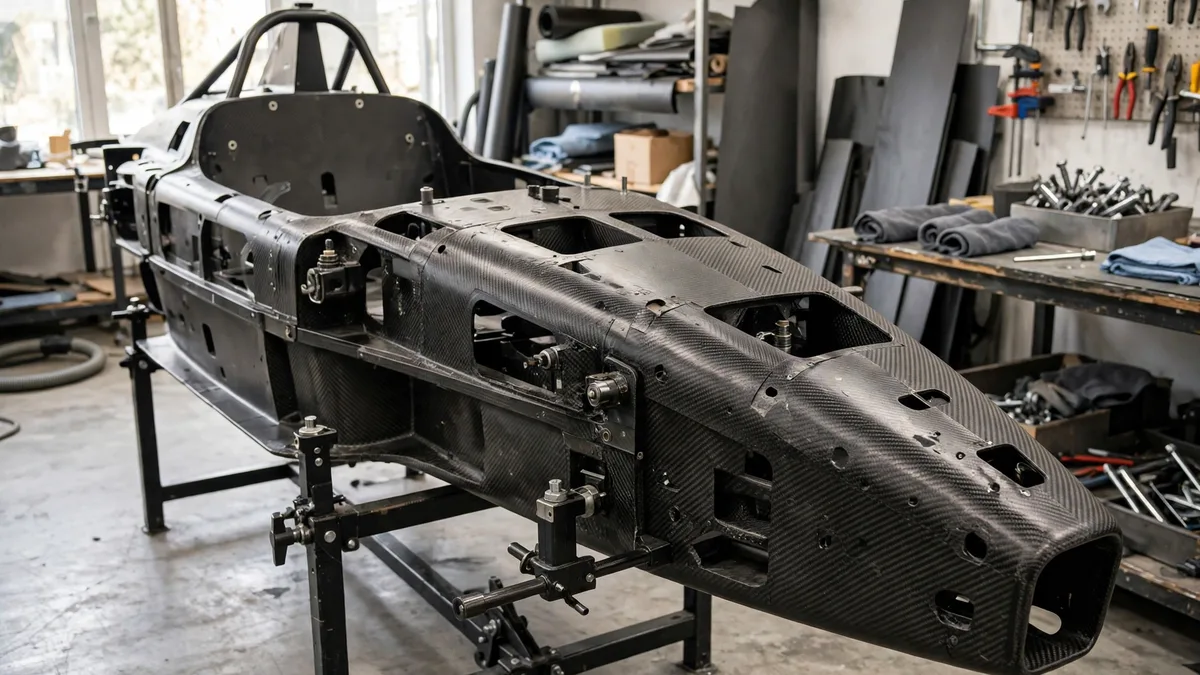
There is a car whose body is not really a body at all, but a single shell. The Pagani Huayra monocoque is the spine, the safety cell and the skeleton of the car in one piece: a tub of woven carbon fibre so light that two people can lift it, and so strong that it can carry a twin-turbo V12 and survive forces that would tear a steel frame apart. It has no separate chassis rails, no welded joints, no bolts holding its core together. It is one continuous structure, laid up by hand, layer by layer, in a small workshop in Italy.
Building it takes weeks, and almost nothing about the process is automated. Sheets of carbon fibre are cut by hand, placed into moulds by hand, and checked by hand, because the shape is too complex and the tolerances too tight for a machine to manage alone. A single mistake in the layup, a wrinkle or an air pocket, can weaken the whole shell. Here is how the Pagani Huayra monocoque is made, step by step.
How the Pagani Huayra Monocoque Is Made
Step 1: Cutting the carbon fibre
The work begins with rolls of carbon-fibre prepreg, fabric in which the carbon threads are already soaked in resin. The rolls are kept cold, because at room temperature the resin slowly starts to cure. Technicians unroll the fabric onto cutting tables and cut it into hundreds of individual pieces, each one shaped for a specific part of the tub: the floor, the sills, the bulkheads, the roof. The pattern of the weave matters, so pieces are cut at different angles, some with the fibres running lengthways for stiffness, others at forty-five degrees for strength against twisting.
Step 2: Laying up the shell
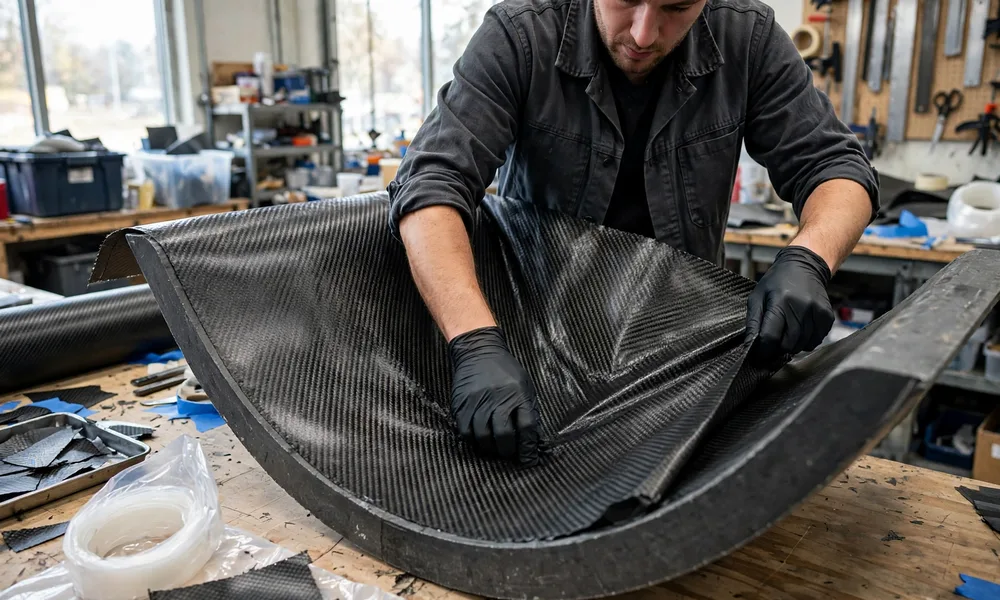
Next comes the layup, the most skilled job in the whole build. Technicians work in pairs, placing each sheet of carbon into a polished mould, smoothing it down with their hands and small rollers, and pressing out every bubble of air. Some areas of the tub need only a few layers; the sills and the bulkheads, which carry the greatest loads, can need dozens. Where the structure must be even stronger, the carbon is combined with titanium wire woven into the fabric, a material Pagani calls carbo-titanium, which adds toughness without much weight. The choice of fibres and resins is explained in Pagani Huayra monocoque materials engineering, which covers what makes this carbon different from the kind used in ordinary cars.
Step 3: Adding the core and inserts
Before the mould is closed, the shell is given its inner structure. Honeycomb core panels are fitted into the floor and the sills, giving the tub stiffness without solid weight, like the cardboard inside a hollow door. Metal inserts are placed where the suspension, the engine and the seatbelts will bolt on, because carbon fibre alone cannot hold a threaded bolt under load. These inserts are bonded in place and their positions are measured with laser trackers, since a mounting point that is a millimetre out means a suspension arm that does not fit.
Step 4: Curing in the autoclave
The sealed mould is rolled into an autoclave, a giant oven that is also a pressure vessel. Inside, the temperature rises to around 120 degrees Celsius while the pressure climbs to several times atmospheric pressure, squeezing the layers together and curing the resin into a hard, glassy solid. The cycle takes hours, and the temperature is raised and lowered on a strict schedule: too fast, and the resin cracks; too slow, and it never fully hardens. When the mould is opened, the monocoque is revealed, a single dark shell with the carbon weave visible. It is weighed immediately.
Step 5: Trimming, bonding and machining
The cured shell is trimmed with diamond cutting tools, its edges cleaned up and its openings cut for the doors, the windscreen and the engine bay. Then the separate parts of the tub, the main shell, the front subframe mounts and the rear crash structure, are bonded together with structural adhesive and, in places, titanium fasteners. Mounting points are machined on a five-axis milling machine, because the suspension and engine must bolt on to within a fraction of a millimetre. The shell is then inspected with ultrasound and X-ray, hunting for voids or delamination hidden inside the layers. A flaw found here means the tub is scrapped, however many weeks of work it represents. The body panels that will clothe this shell are shaped with equal care, as shown in how a hypercar aerodynamic body is made, where carbon panels are formed to cheat the wind.

Step 6: Testing and final inspection
The finished monocoque is put through its final tests. It is measured on a coordinate measuring machine, a device that probes hundreds of points on its surface and compares them to the design, catching any twist or sag. It is then load-tested, with forces applied to the suspension mounts and the seatbelt anchors to prove it can carry them. From here it goes to the assembly line, where the engine, the gearbox and the interior are fitted around it. The same single-shell idea protects drivers at far higher speeds in racing, as explained in how a Formula 1 monocoque works, where the tub is the driver’s survival cell.
Pagani Huayra Monocoque Specifications
| Feature | Typical figure |
|---|---|
| Material | Carbon fibre and carbo-titanium |
| Construction | Single-piece monocoque tub |
| Weight | About 100–120 kg for the bare tub |
| Cure cycle | Autoclave, about 120°C under pressure |
| Build time | Several weeks per tub |
| Torsional stiffness | Over 25,000 Nm per degree (estimate) |
| Core | Honeycomb in floor and sills |
| Inspection | Ultrasound, X-ray and laser measurement |
What a Pagani Huayra Monocoque Costs
Pagani does not sell the monocoque separately, but as an estimate, the materials and labour in a single tub run to several hundred thousand dollars, and the finished Huayra sells for several million. The cost comes from the hand labour, the weeks in the workshop, the expensive prepreg and the autoclave time, plus the scrapped tubs that never make it to a car. It is the most expensive single part of the car, and the one that defines everything else about it.
A Rare Fact
The Huayra’s monocoque uses carbo-titanium, a fabric in which titanium wire is woven directly into the carbon fibre. Pagani developed it because pure carbon fibre, for all its strength, can shatter in a sharp impact, while titanium adds ductility, the ability to bend slightly instead of breaking. The result is a shell that is both lighter and tougher than a conventional carbon tub, and it is one of the reasons the Huayra can be both a road car and a machine capable of speeds beyond 230 mph.
A monocoque like this is easy to admire and hard to comprehend: hundreds of pieces of cloth, laid by hand, baked under pressure, and turned into a single shell that carries an engine, two people and a storm of aerodynamic force. It is not assembled. It is grown, layer by layer, into the shape of a car.