Hold a modern phone up to a distant building and pinch to zoom, and the building jumps closer. The trick is a folded path: light enters through a small window on the back of the phone, hits a prism, turns ninety degrees, and travels sideways through a stack of lenses before reaching the sensor. That sideways journey is the periscope zoom lens, and it is one of the smallest precision optical systems ever built for a mass-market product.
The factory that builds it does not look like a phone factory. Instead there are clean rooms kept cleaner than an operating theatre, technicians in white suits, and machines that place glass elements with an accuracy measured in microns. A speck of dust inside a periscope module is not a cosmetic flaw; it is a dark spot on every photograph the phone will ever take.
This is a look inside the production line where the periscope zoom lens is made, from a blank of glass to a sealed module ready for a phone.
How a Periscope Zoom Lens Is Made
Step 1: Moulding and polishing the lens elements
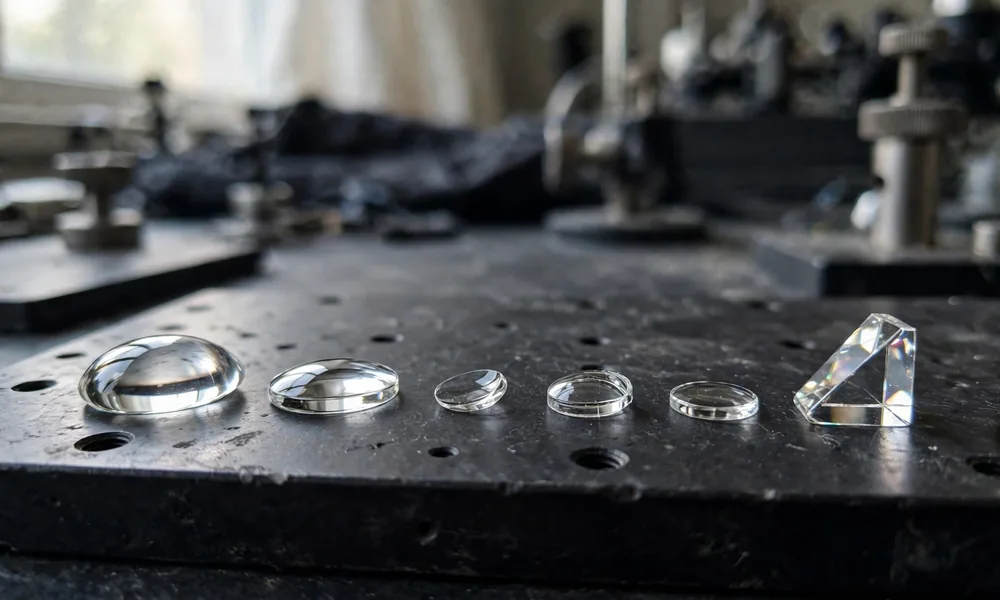
Production begins with optical glass, melted and moulded into small blanks, each barely wider than a shirt button. Some elements are ground and polished the traditional way, on machines that remove glass a few atoms at a time until the curve is right to within a fraction of a wavelength of light. Others are moulded directly from hot glass, a process that reproduces complex aspherical shapes. Every element is then coated with thin films that cut reflections and keep stray light from washing out the image. Each element is inspected under magnification before it moves on.
Step 2: Making the prism
The heart of the periscope is the prism, a small wedge of glass that bends the incoming light through a right angle. Prisms are cut from larger blocks of optical glass, ground to exact angles, and polished on every face. The reflecting face is coated with a mirror film so that almost no light is lost at the turn. If the prism angle is off by a fraction of a degree, the image lands on the wrong part of the sensor. Each prism is measured with a laser interferometer, and only those within tolerance go forward.
Step 3: Building the lens barrel and the moving group
The lenses sit inside a tiny barrel, usually moulded from blackened engineering plastic or machined from aluminium, with internal baffles that swallow stray light. One group of lenses is mounted on a miniature carriage that slides along the barrel — this is the zoom mechanism. The carriage rides on polished guide rails and is driven by a voice-coil motor or a tiny stepper motor. The travel is only a few millimetres, but it has to be smooth and repeatable to within a few microns.
Step 4: Adding stabilisation
A long zoom magnifies shake as well as the subject, so the module carries its own stabilisation. A small lens group, or sometimes the whole barrel, floats on a flexure suspension and is nudged in real time by voice-coil actuators, guided by a gyroscope that senses the tremor of the hand holding the phone. The actuators must respond in milliseconds and settle without overshooting. The flexure is a springy metal frame thinner than a sheet of paper, stamped and etched to tolerances a human hair would dwarf.
Step 5: Assembly in the clean room
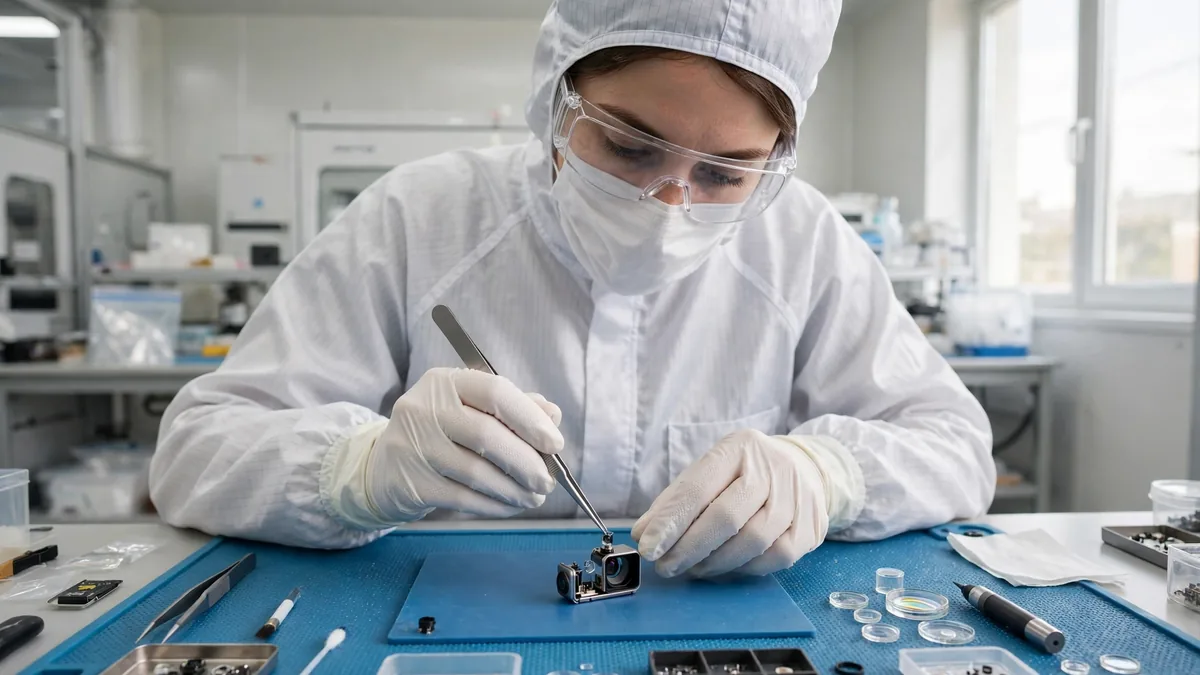
Assembly happens in a clean room where the air is filtered and the workers wear full suits, hoods, and gloves. Each lens is picked up by a vacuum tool and placed into the barrel by a machine that watches through a camera, aligning the elements to within a few microns of the optical axis. The prism is seated, the moving group is fitted, and the sensor-facing end is sealed. Adhesive is applied in dots so small they are barely visible, then cured with ultraviolet light. A single dust particle landing on a lens surface would mean starting the assembly again.
Step 6: Testing and calibration
Every finished module is tested, not sampled. It is pointed at a chart of fine lines and patterns, and a computer measures sharpness at the centre and the corners, checks the focus at several zoom positions, and looks for decentring, dust, and stray reflections. The stabilisation is shaken on a test rig while the camera records, to confirm the image stays steady. The focus motor is driven through its full range and back, hundreds of times, to prove it will not stick. Modules that fail any test are opened, cleaned, and rebuilt, or scrapped.
Step 7: Sealing, labelling, and packing
The modules that pass are sealed with a cover glass over the entrance window. Each module gets a tiny label with a serial number that traces it back to its batch of glass, its assembly station, and its test results. They are packed into trays, dozens to a tray, and shipped to the phone factory, where they will be soldered onto a circuit board and fitted into a phone within days.
Periscope Zoom Lens Specs
| Specification | Typical range |
|---|---|
| Optical zoom | About 3x to 10x, depending on the phone |
| Sensor size | About 1/2 inch to 1/1.3 inch |
| Aperture | About f/2.8 to f/4.5 at full zoom |
| Focal length | About 70 to 240 millimetres equivalent |
| Lens elements | About 5 to 7 elements, plus a prism |
| Stabilisation | Optical image stabilisation, sensor-shift or lens-shift |
| Module thickness | About 6 to 9 millimetres |
| Focus travel | A few millimetres, driven by voice-coil motor |
What Does a Periscope Zoom Lens Cost?
A periscope zoom module is not sold on its own to consumers, so there is no shelf price. Industry estimates put the cost of a complete module at roughly $15 to $40 per unit in volume, depending on the zoom range, the sensor, and the stabilisation system, with the longest-zoom modules estimated at the higher end. Prices are estimates only, based on reported supply-chain figures, and vary by supplier, volume, and specification. The full numbers are set out in periscope zoom lens specs explained, the materials behind the glass are covered in periscope zoom lens materials engineering, and the optics themselves are explained in how a periscope zoom lens works.
A Rare Fact
The periscope zoom lens is older than the smartphone by decades: the same folded-light trick was used in periscopes on submarines and in the viewfinders of old film cameras, where a prism bent the light around a corner. Its most unlikely ancestor is the endoscope, the thin medical camera doctors thread into the human body — it, too, folds light through a tiny tube. The connection is not just poetic: several of the engineers who first miniaturised phone periscope modules had worked on medical optics, and the clean-room discipline of the lens factory owes as much to the hospital as it does to the electronics industry.

A periscope zoom lens is a small thing to carry so much engineering: a prism, a sliding stack of glass, a floating stabiliser, and a sensor, all fitted into a space thinner than a pencil. The next time a distant sign snaps into focus on a phone screen, it is worth remembering the clean room where that little folded tunnel of light was built, one micron at a time.


