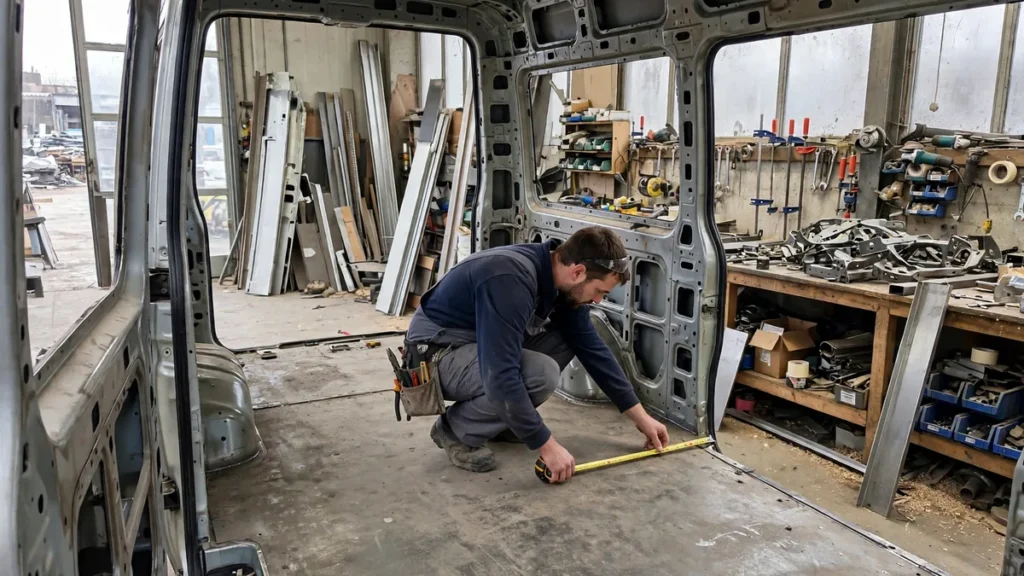
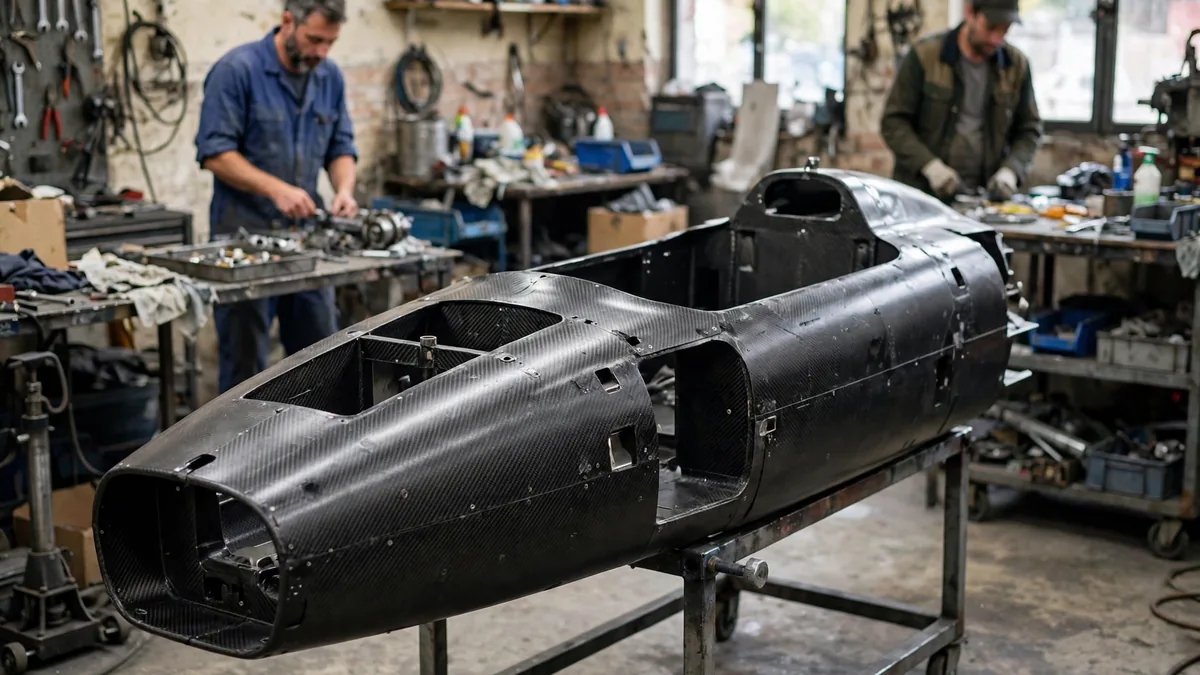
In a small workshop in San Cesario sul Panaro, Italy, a car is built the way a violin is built: slowly, by hand, one at a time. There is no assembly line in the usual sense. Instead, a handful of craftsmen lay sheets of carbon fibre into moulds, paint them with resin, and cure them in an oven, building the skeleton of a Pagani Huayra — a car that costs several million dollars and of which only a few dozen exist in the world.
That skeleton is called a monocoque, a single rigid tub that forms the core of the car. It carries the driver, the engine, the suspension, and the bodywork, and it has to be both feather-light and strong enough to protect its occupants in a crash at enormous speed. The material is carbo-titanium, Pagani’s own blend of carbon fibre woven with titanium threads, and the factory that builds it is more atelier than plant.
This is a look inside the production line where the Pagani Huayra monocoque is made, from a roll of woven fibre to a finished tub ready to become a hypercar.
How a Pagani Huayra Monocoque Is Made
Step 1: Cutting the carbon fibre
Production begins with rolls of carbon-fibre fabric, woven from thousands of hair-thin filaments, some of them interlaced with fine titanium threads — the carbo-titanium that gives Pagani’s tubs their name. The fabric arrives pre-impregnated with resin and stored in freezers, and it must be used within a strict window once it is thawed. Technicians cut the fabric into patterns, called plies, following templates laid out on large tables. Each ply has a direction: the fibres in one layer run one way, the next layer runs another, and the stacking order is specified to the ply, because the strength of the finished tub depends on it.
Step 2: Laying up the mould
The plies are laid by hand into a mould shaped like the finished monocoque. This is the slowest and most skilled step in the whole process. A laminator places each ply in its exact position, smoothing it into the curves of the mould and pressing out any air, because a trapped bubble becomes a weak spot. Some areas need only a few layers; others, like the points where the suspension bolts on, need dozens. A single monocoque can take days of laying up, and the work is checked constantly, ply by ply, against the build sheet.
Step 3: Vacuum bagging
Once the layup is complete, the mould is sealed inside a vacuum bag. The bag is a tough plastic film, taped and sealed around the mould, and the air is pumped out, pressing the plies tightly together and squeezing out any remaining air and excess resin. The vacuum also holds everything in place while the tub cures, so the layers cannot shift. The bagging is inspected for leaks before curing begins: a pinhole would let air in and spoil the part, so the seal is tested and re-tested.

Step 4: Curing in the autoclave
The bagged mould goes into an autoclave, a large oven that heats it under pressure. The temperature climbs to around 120 to 180 degrees Celsius, and the pressure squeezes the layers together while the resin hardens into a solid. The curing cycle is carefully controlled: heat too fast and the resin boils; too slow and it never fully hardens. The tub stays in the autoclave for hours, and sensors record the temperature and pressure throughout, so every tub has a complete curing record.
Step 5: Trimming and machining
When the tub comes out of the autoclave and is released from the mould, it is a rough shape with ragged edges. It is trimmed with diamond tools, and the mounting points for the engine, the suspension, and the bodywork are machined to exact dimensions. Holes are drilled and metal inserts are bonded in, so that bolts can be tightened into the carbon without crushing it. The machining is done on computer-controlled mills, but the finishing is done by hand, with the edges sanded and sealed.
Step 6: Inspection and testing
Every monocoque is inspected before it is allowed to become a car. Ultrasound and X-ray scans look inside the laminate for voids, delamination, or misplaced plies, and any flaw means repair or rejection. The tub is measured against its design dimensions to within fractions of a millimetre, and sample sections are cut from test panels cured alongside it and broken in a press, to prove the material reached its design strength. Only when the tub passes every check is it signed off by the engineer in charge.
Step 7: Fitting out the tub
The finished monocoque is then fitted with its metal subframes, the front and rear structures that carry the suspension and the engine. Wiring, fuel lines, and the pedal box are installed while the tub is still bare, because access is far easier before the bodywork goes on. The tub is weighed and balanced, and its details are recorded in the car’s build book, a document that follows the car for its whole life. From here, the monocoque moves to final assembly, where it will gain its engine, its body, and its interior.
Pagani Huayra Monocoque Specs
| Specification | Typical range |
|---|---|
| Material | Carbo-titanium carbon fibre composite |
| Tub weight | About 100 to 120 kilograms |
| Construction | Hand-laid, autoclave-cured monocoque |
| Cure temperature | About 120 to 180 degrees Celsius |
| Chassis stiffness | Among the highest of any road car |
| Production rate | A few dozen cars per year |
| Build time | Weeks per monocoque, by hand |
| Crash structure | Carbon crash boxes front and rear |
What Does a Pagani Huayra Monocoque Cost?
A monocoque is never sold on its own, so there is no shelf price. Industry estimates put the cost of a finished Huayra monocoque at roughly $300,000 to $500,000 per unit, with the complete car estimated at roughly $2.5 million to $3.5 million depending on specification. Prices are estimates only, based on reported figures for the car and its components, and vary by specification and market. The full numbers are set out in Pagani Huayra monocoque specs explained, the materials behind the tub are covered in Pagani Huayra monocoque materials engineering, and the build itself is described in how a Pagani Huayra monocoque is made.
A Rare Fact
Horacio Pagani, the founder, began his career building racing cars in Argentina before moving to Italy, where he worked at Lamborghini and built the Countach Evoluzione — one of the first cars in the world with a carbon-fibre monocoque. When he founded his own company, he could not afford an autoclave, so he bought a second-hand one and taught himself composites. The Huayra’s name comes from Huayra-tata, the god of wind in the Quechua language of the Andes, and the car’s four exhausts are made of titanium and arranged in a square, a signature Pagani detail that has become one of the most copied exhaust designs in the supercar world.

A Pagani Huayra monocoque is not manufactured so much as it is made — laid up by hand, cured under pressure, and checked until it is perfect, by people who know the name of the customer who will drive it. In a world of robots and production lines, it is a reminder that the fastest things on the road can still be built slowly.