Look at a bridge, a ship, or a skyscraper and you are looking at welding. Thousands of tonnes of steel hold together not with bolts or rivets, but with joints where two pieces of metal were melted and fused into one. A good weld is stronger than the steel around it. A bad weld can crack, and a cracked weld on a bridge or a pressure vessel can be a disaster.
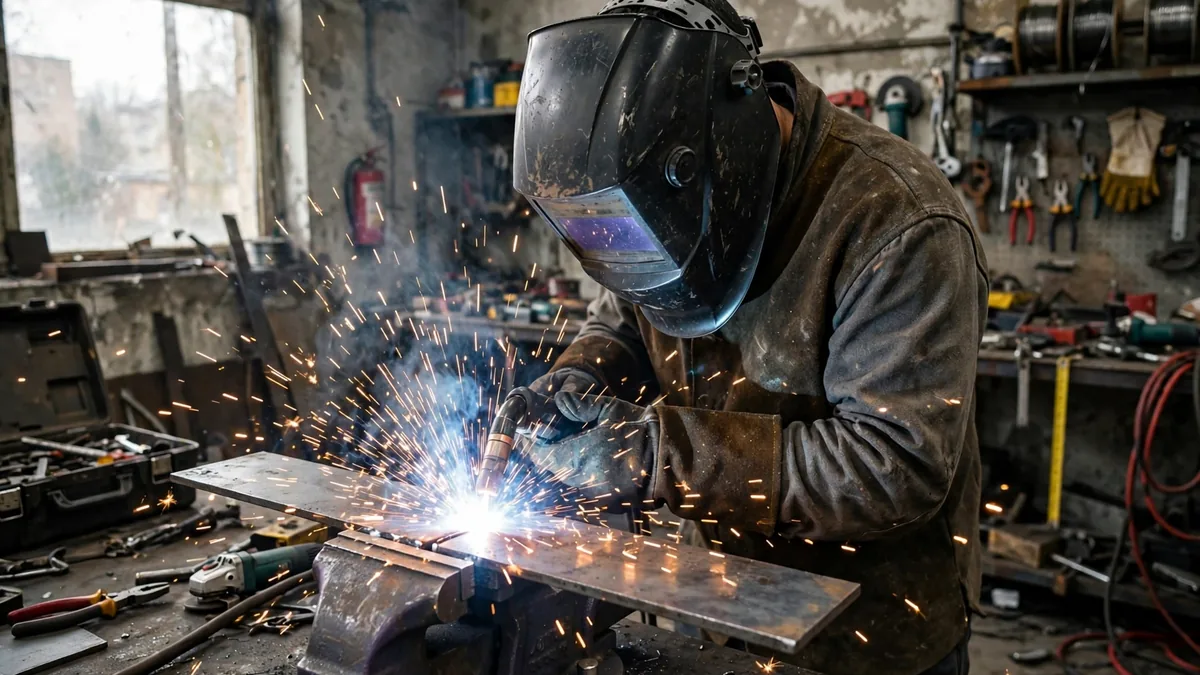
Steel welding is not one process but a family of them. An electric arc hotter than the surface of the sun melts the edges of two steel plates, filler metal flows into the joint, and a shield of gas or flux keeps oxygen away while the metal cools. The welder controls the heat, the speed, and the angle by hand, reading the glowing pool of molten metal like a language.
From a garden gate to a submarine hull, the same principles apply, scaled up and refined. This is how steel welding is made.
How It’s Made
Step 1: Choosing the steel and preparing the joint
A weld begins before any arc is struck. Engineers choose the steel grade for the job — mild steel for general work, high-strength steel for bridges and cranes, stainless steel where corrosion matters — and the welding process to match. The joint is then prepared: the edges of the plates are cut or ground into a bevel, usually a V shape, so the weld metal can reach all the way through the thickness. The surfaces are cleaned of rust, oil, paint, and mill scale, because any contamination trapped in the weld becomes a weak spot. The science of the finished joint is covered in how steel welding works.
Step 2: Setting up the arc and the shielding
Most steel welding uses an electric arc, struck between an electrode and the steel, that burns at around 3,500 degrees Celsius — hot enough to melt steel in a fraction of a second. The molten metal must be shielded from the air, because oxygen and nitrogen make welds brittle and full of holes. In stick welding, the electrode is coated in flux that burns into a protective gas and slag. In MIG welding, a wire feeds continuously from a spool while a bottle supplies argon or carbon dioxide gas. In TIG welding, a tungsten electrode makes the arc while the welder feeds filler rod by hand.
Step 3: Laying the root pass
The first run of weld metal, called the root pass, is the most important. It must melt fully through the bevel and fuse with both plates, with no gaps left at the bottom of the joint. The welder moves the arc steadily along the seam, watching the molten pool and keeping it the right size: too hot and it burns through, too cold and it fails to fuse. When the root pass is done, it is cleaned of slag and inspected, because every later pass builds on it. A flaw in the root is a flaw in the whole weld.
Step 4: Filling and capping the joint
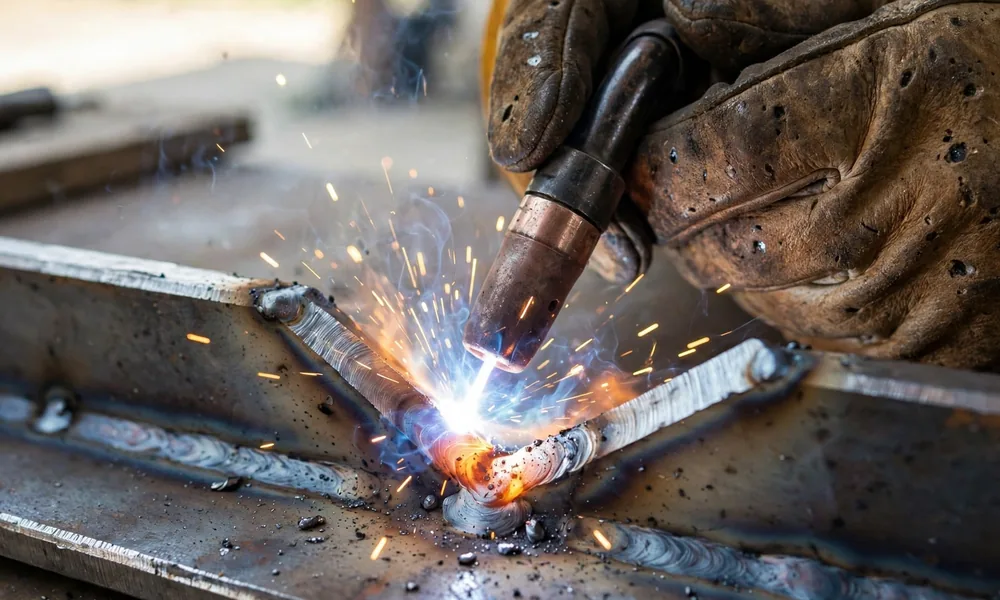
After the root pass, the joint is filled with more passes, each one melting into the last, until the bevel is full. The final pass, called the cap, is laid with a slight crown above the surface of the plates, and its ripples should be even and regular — a neat cap is the visible signature of a skilled welder. On critical structures, the steel is preheated before welding and kept warm between passes, so it cools slowly and does not crack.
Step 5: Cooling, stress relief, and dressing
When the last pass is done, the weld must cool at the right rate. Fast cooling can make the steel beside the weld hard and brittle, so thick or high-strength joints are often wrapped in insulation or put through a stress-relief heat treatment in a furnace, where the whole assembly is heated and cooled slowly to relax the internal stresses welding creates. The joint should look clean and even, with no undercut at its edges and no cracks at its ends.
Step 6: Inspecting and testing the weld
A weld that looks good can still hide a flaw, so critical welds are inspected from the inside. X-rays or ultrasound are used to look through the joint for cracks, porosity, and lack of fusion, and dye penetrant tests reveal surface cracks invisible to the eye. Test pieces welded alongside the real joint are cut open, bent, and pulled apart in a laboratory to prove the weld is as strong as the steel. Only welds that pass every check are accepted, and on ships, bridges, and pressure vessels, every weld is recorded with the name of the welder who made it. Other ways of joining metal use entirely different physics, as shown in electron beam welding specs and in inside friction stir welding production.
| Main materials | Mild, high-strength, or stainless steel, with matching filler wire or electrodes |
| Arc temperature | About 3,500 degrees Celsius at the heart of the arc |
| Main processes | Stick, MIG, and TIG welding, chosen for the steel and the job |
| Shielding | Flux, argon, or carbon dioxide gas keeps oxygen away from the molten metal |
| Joint preparation | Bevelled edges, cleaned surfaces, and a controlled gap between plates |
| Cooling control | Preheating and slow cooling, with stress-relief heat treatment on thick joints |
| Inspection | X-ray, ultrasound, dye penetrant, and destructive testing of sample welds |
| Typical strength | A sound weld is as strong as, or stronger than, the steel around it |
What Does Steel Welding Cost?
Steel welding is priced by the hour and by the joint. A skilled welder’s labour is estimated at roughly $40 to $100 per hour, and a simple steel fabrication job might cost a few hundred dollars, while welding on a bridge, a ship, or a pressure vessel runs into tens or hundreds of thousands of dollars once materials, inspection, and testing are counted. The cost reflects not just the welding itself, but the preparation, the preheating, the X-rays, and the paperwork that proves every joint is sound.
A Rare Fact
Welding was once thought impossible underwater, until engineers discovered that it works there too — with a twist. Underwater welders work in two ways: wet welding, where the arc burns directly in the water inside a bubble of gas made by the electrode itself, and dry welding, where a chamber is sealed around the joint and the water is pumped out. The most remarkable underwater welds are made on the legs of oil platforms and the hulls of ships, hundreds of metres below the surface, by divers in pressurised habitats, welding steel that will never see daylight again — proof that a craft invented for blacksmiths now works in the deep sea.

Steel welding will never be the part of a bridge or a ship that anyone photographs. It hides under paint, inside hulls, and behind cladding, doing its work in silence.


