There is a metal that can be heated until it glows white, squeezed under thousands of tonnes of force, and come out stronger than it went in. It is titanium, and forging it is one of the hardest jobs in all of engineering. Titanium does not behave like steel or aluminium: it grabs the tools that try to shape it, it cools quickly, it reacts with the air when it is hot, and it punishes any mistake with a crack that can scrap a part worth tens of thousands of dollars.
Titanium forging is the art of shaping this stubborn metal while it is hot enough to move but not so hot that it is ruined, pressing it into dies with forces measured in thousands of tonnes. A forged titanium part is stronger than a cast or machined one, because forging aligns the metal’s grain along the shape of the part, like the grain of wood following the curve of a chair leg. This is how titanium forging is made.

How It’s Made
Step 1: Making the titanium billet
Forging starts long before the press, with the billet, a solid cylinder of titanium alloy that will become the part. Titanium is not mined as metal: it is extracted from ore, refined into a sponge-like material, then melted in a vacuum furnace and cast into an ingot, because molten titanium reacts with almost everything it touches, including the air. The ingot is then forged once, roughly, into a billet of the right size, and inspected for defects. The most common alloy is Ti-6Al-4V, six percent aluminium and four percent vanadium, used in everything from jet engine fan blades to racing car parts. Lighter metals follow the same alloy thinking, as our guide to how aluminium forging is made shows, though aluminium forgives far more.
Step 2: Heating the billet
The billet is heated in a furnace to between 900 and 1,000 degrees Celsius, the narrow window in which titanium becomes workable. Too cold and it will crack under the press; too hot and its grain structure coarsens, weakening the finished part, and the surface oxidises into a brittle layer that must be machined away. The heating is monitored constantly, and the billet is moved from furnace to press as fast as possible, because titanium loses heat quickly and the crew may have only minutes to complete the forging before it cools too far.
Step 3: Forging in the dies
The hot billet is placed between two dies, steel blocks machined into the rough shape of the finished part, and the press closes on it with thousands of tonnes of force. The metal flows outward, filling the die cavity, and the part takes shape in a single blow or in a series of blows, with the billet reheated between each one if needed. The dies are coated with a glass-based lubricant that stops the titanium from sticking to the steel and from picking up oxygen, and the whole operation is watched by operators who read the metal’s behaviour from the sound of the press and the colour of the glow. A rushed forging develops folds and laps, seams of metal folded over itself that become cracks in service, so the press moves at the metal’s pace. Our look inside titanium forging production follows this forge floor in more detail.

Step 4: Trimming and cooling
When the forging comes out of the dies, it carries a skirt of excess metal called flash, the material that squeezed out between the dies, and this is trimmed off while the part is still warm. The part is then left to cool slowly and evenly, because rapid cooling can lock in stresses that warp it later. As it cools, a hard, brittle skin of oxidised metal forms on the surface, known as alpha case, and this must be removed by machining or chemical milling before the part can be used, since alpha case cracks easily and a crack in the skin can grow into the part.
Step 5: Heat treatment
The cooled forging is heat-treated to bring out its full strength. It is heated again to a controlled temperature, held there, and then cooled at a precise rate, a cycle that sets the metal’s internal grain structure and determines whether the finished part is hard and strong or tough and resistant to cracking. The exact cycle depends on the alloy and the job the part will do: a fan blade needs different properties from a landing gear beam, and the heat treatment is tuned accordingly. After treatment the part is inspected with ultrasound for internal flaws, and its hardness is tested. A forging that fails inspection at this stage is scrapped, however much work went into it, because a flawed titanium part in a jet engine is not a risk anyone takes.
Step 6: Machining to final shape
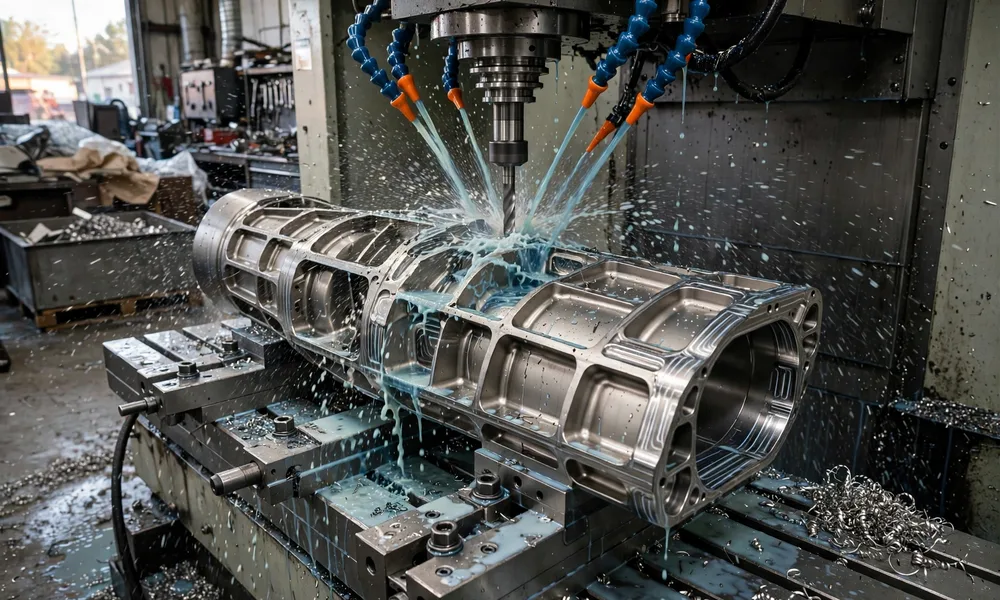
Only now does the forging meet the machine shop. It is machined to its final dimensions, a job that is itself famously difficult, because titanium dulls cutting tools quickly, holds heat at the cutting edge, and springs back after each cut. Machinists use slow speeds, heavy coolant and sharp carbide tools, removing material in small passes until the part matches its drawing to within a fraction of a millimetre. The finished part is then polished or shot-peened, a process that hammers the surface with tiny steel balls to put it into compression and resist fatigue cracking. From furnace to finished part, a single titanium forging can take weeks, with every step documented against its serial number. Our guide to how a titanium exhaust system is made follows the metal from the forge to the car.
Specs
| Specification | Detail (typical Ti-6Al-4V titanium forging) |
|---|---|
| Alloy | Ti-6Al-4V (6% aluminium, 4% vanadium) |
| Forging temperature | Approximately 900 to 1,000°C |
| Press force | Thousands of tonnes, depending on part size |
| Density | 4.43 g/cm³, about 60% of steel |
| Tensile strength | Approximately 900 to 1,100 MPa |
| Melting point | Approximately 1,660°C |
| Key challenge | Reacts with air when hot, cools quickly, wears tools fast |
| Main uses | Jet engines, airframes, spacecraft, hypercars, medical implants |
Price
Titanium forging is expensive because almost everything about it is difficult. The raw metal costs far more than steel or aluminium, the forging needs huge presses and heated dies, and the machining wears out tools at a frightening rate. A single large aerospace titanium forging typically costs from around $10,000 to $100,000 (estimate, based on typical pricing of large aerospace titanium forgings), depending on size and complexity, and the finished machined part can cost several times more.
Rare Fact
Titanium is as strong as steel but 45 percent lighter, and it is completely immune to rust, yet it was almost useless as an engineering metal until the 1940s, because nobody could extract it cleanly. The breakthrough came when scientists learned to melt it in a vacuum, away from the air it loves to react with, and suddenly the metal that had been a laboratory curiosity became the backbone of jet aviation. Today a single wide-body airliner can contain tonnes of forged titanium, every gram of it shaped the hard way, in a forge, at a thousand degrees.


