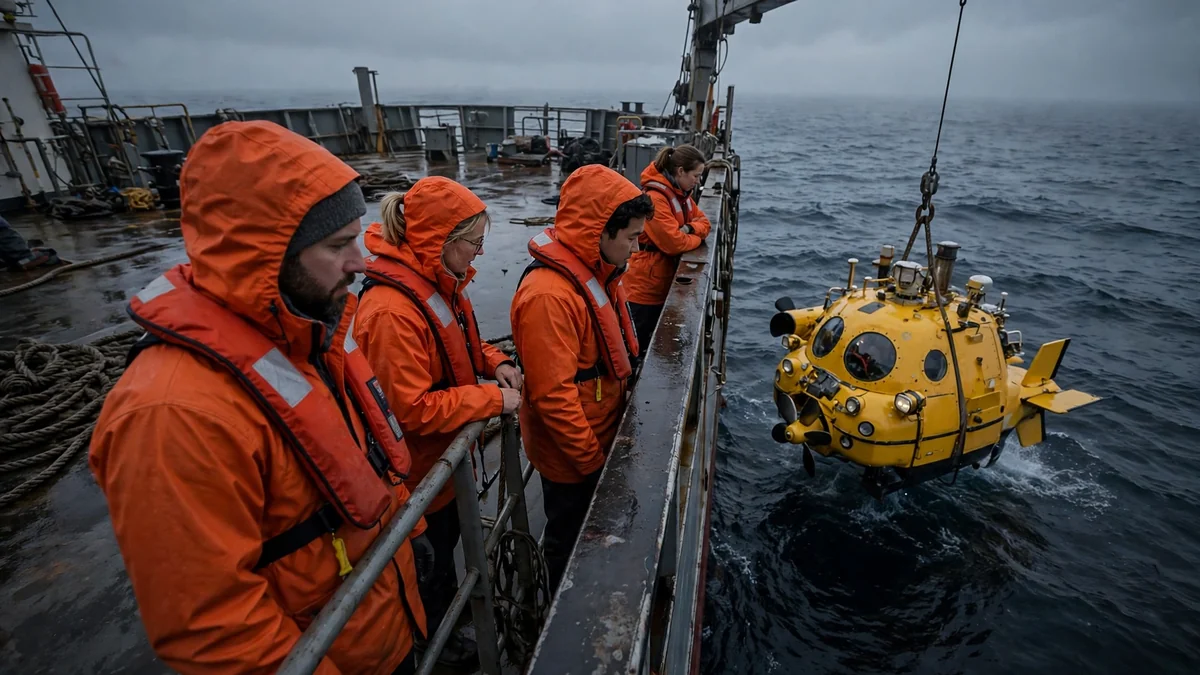
The research ship holds position over a dark patch of ocean, engines humming low, while the science team gathers on the aft deck in the grey light before dawn. The submarine is already in the water, a yellow capsule the size of a van, hanging from the crane with its lights on. A biologist checks the sample boxes one last time. A geologist tapes a laminated map to the inside of the hatch. Then the crane swings the boat out over the side, the water closes over the dome, and the little yellow machine sinks away from the surface, carrying three people down to a part of the planet that no human eye has ever seen.
A research submarine is a laboratory that can dive. Unlike a private submarine, which is built for the view, a research submarine is built for the work: collecting samples, mapping the seabed, filming animals, and measuring water that is colder, darker, and under more pressure than almost anywhere else on Earth. The scientists who use them are not tourists. They plan each dive like a field expedition, with a list of targets, a time budget, and a rule that the boat comes home the moment anything looks wrong.
How It Works
A research submarine works by solving three problems at once: staying intact under pressure, staying alive inside for hours, and doing useful science while it is down there. The systems that solve those problems are simple in idea and exacting in practice, and every one of them has a backup. Here is how the machine works, step by step.
1. The pressure hull keeps the sea out. The crew sits inside a strong hull, usually a sphere of steel or titanium, that resists the crushing pressure of the deep water. At 1,000 metres down, the pressure on the hull is about a hundred times the pressure at the surface, roughly the weight of a small car pressing on every square centimetre. A sphere spreads that force evenly, which is why so many research submarines are built around a round cabin.
2. Ballast controls the dive. The submarine sinks and rises by changing its weight. Small adjustments let the pilot hover at a precise depth, holding station above a coral reef or a rock outcrop while the scientists work. The boat also carries drop weights, heavy blocks that can be released in an emergency to make the submarine rise quickly. The same principle of strong hull construction that protects a steel yacht in heavy weather protects a research submarine at depth, just under far greater forces.
3. Electric thrusters do the moving. The submarine is pushed through the water by electric thrusters, small propellers in pods that can be pointed in different directions. Batteries supply the power, and the pilot steers with a joystick, moving slowly and precisely, because the science happens at walking pace. Speed is not the point: a research submarine rarely goes faster than a brisk walk, and it does not need to, because the seabed is not going anywhere.
4. Life support keeps the crew breathing. Inside the hull, the air must stay breathable for the whole dive, which can last eight to twelve hours. The boat carries oxygen to replace what the crew breathes in, and chemical scrubbers that remove the carbon dioxide they breathe out. Sensors watch both gases constantly, and alarms warn the crew if the levels move out of range.
5. Science tools do the work. The outside of a research submarine is a toolkit. A manipulator arm, worked by the pilot with a second joystick, can pick up rocks, push a probe into the mud, or place a sample box on the seabed. Sonar maps the seabed in the dark, and sensors measure temperature, salinity, and chemistry as the boat moves. The careful shaping of a hull matters here as well: a smooth, quiet boat disturbs the animals it is trying to observe far less than a noisy one.
6. Navigation and communication. Radio does not travel through seawater, so a submerged research submarine cannot talk to the surface the way a ship can. Instead, the boat and the support ship exchange short acoustic messages, sound pulses that travel through the water, carrying position updates and simple instructions. The submarine also tracks its own position with inertial sensors and a Doppler log that measures movement over the seabed. The surface ship follows the boat from above, keeping a fix on its position and standing ready to recover it.
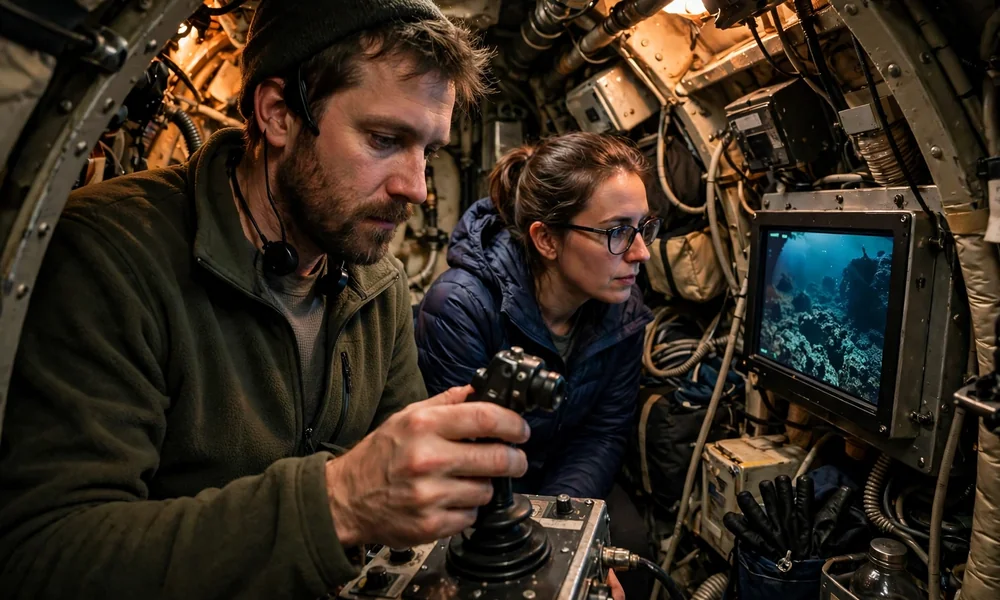
A research dive is planned in the same way as a space mission, with every minute accounted for and every risk discussed in advance. The science team writes a dive plan that lists the targets in order, the time allowed for each, and the point at which the boat must turn for home, whatever is left undone. The pilot has the final say on safety, and can end a dive at any moment. The support ship carries a rescue plan, a medical kit, and a crew trained to recover a submarine quickly, because a boat that surfaces far from the ship in rough weather is a problem that needs solving fast. The organisation behind a cruise ship galley is a useful comparison: a small team, a tight plan, and a routine that has to work the same way every time, because the people depending on it cannot afford a mistake.
Specifications
| Detail | Typical figure |
|---|---|
| Length overall | 6 to 10 metres |
| Crew | 1 pilot and 2 scientists |
| Hull material | Steel or titanium pressure sphere |
| Maximum depth | 1,000 to 6,000 metres |
| Dive endurance | 8 to 12 hours |
| Propulsion | Electric thrusters, battery powered |
| Science payload | Manipulator arm, cameras, sample boxes |
| Top speed | 2 to 3 knots underwater |
Price
A research submarine is estimated to cost roughly $5 million to $30 million to build, depending on its depth rating and its science equipment. These are estimates, not quotes, and the building cost is only part of the picture. The support ship, the crew, and the shore base cost far more over the life of the programme than the submarine itself.
Running a research submarine programme is estimated at roughly $1 million to $3 million a year, covering the support ship’s time at sea, the pilot and engineering team, maintenance, and recertification. A single day at sea with a research vessel can cost tens of thousands of dollars, so dive time is precious and every dive is planned to the minute. Science agencies fund these programmes because there is no other way to reach the deep ocean. Cameras on cables can look, but only a submarine can pick up a rock, place an instrument, and watch an animal behave in its own home.
A Rare Fact
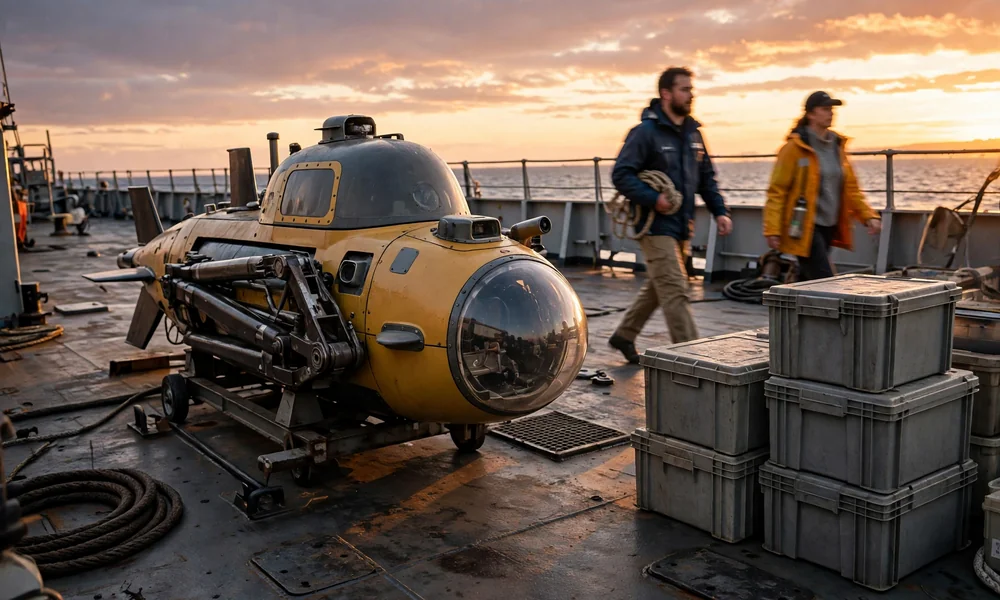
Research submarines have found animals that science did not know existed, including fish that live around volcanic vents where the water is hot enough to scald, and worms that grow beside cracks in the seabed where no sunlight has ever reached. One famous dive in the 1970s found whole communities of creatures living on chemicals from the Earth itself, rather than on sunlight, a discovery that changed how biologists think about where life can survive. The scientists on that dive were in a submarine not much bigger than a small van, looking out of a window the size of a dinner plate, and what they saw rewrote the textbooks.


