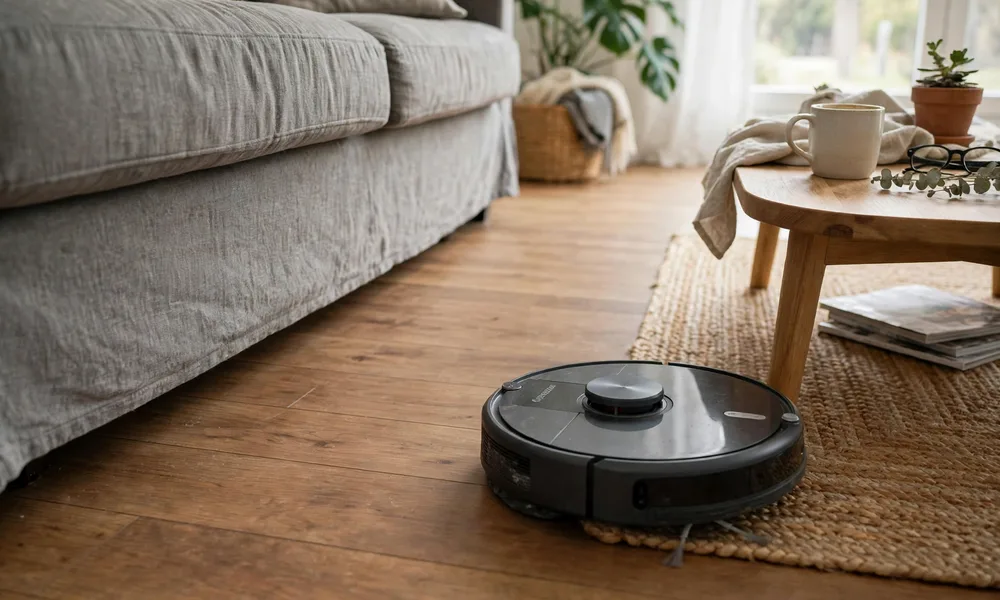
Watch a modern robot vacuum at work and it looks almost thoughtful. It sets off in straight, confident lines, sweeps around chair legs without touching them, and returns to its dock when the job is done, having covered the whole room. It is not guessing. Under a small raised turret on top of the disc, a laser spins hundreds of times a minute, measuring the room and drawing a map the vacuum follows like a sailor follows a chart.
That spinning laser is called LiDAR, short for light detection and ranging, the same basic technology self-driving cars use to see the road. The vacuum fires invisible pulses of laser light, times each round trip to a wall or table leg, and turns those timings into distances. Thousands of measurements a second build a live picture of the room, accurate to a few millimetres, and the vacuum plans its route through it instead of wandering blindly.

How Robot Vacuum LiDAR Works
Step 1: A laser spins and fires invisible pulses
Inside the little turret sits a laser emitter and a receiver, mounted on a motor that spins the assembly several times a second. As it turns, the emitter fires short pulses of infrared laser light out through a small window. Each pulse travels outward at the speed of light, strikes whatever is in its path, and a fraction bounces back to the receiver. The vacuum does this thousands of times every second, sweeping a full circle around itself with every rotation of the turret.
Step 2: Flight time becomes a distance measurement
The core measurement is simple: light travels at a known speed, so the time a pulse takes to go out and come back tells the vacuum exactly how far away the object is. The vacuum’s processor turns each timing into a single point in space, and as the turret spins, those points accumulate into a ring of distances around the machine. A chair leg shows up as a small cluster of close points, a wall as a long straight line, and an open doorway as a gap where the pulses travel further. Spinning sensors that must stay accurate while moving are a challenge in every field, and the way drone cameras stay level while flying is a close cousin of this problem, as the drone gimbal materials guide explains.

Step 3: Thousands of points become a map of the room
One ring of measurements is a snapshot, but the vacuum takes a new one with every spin and stitches them together as it moves. By comparing each new scan with the map it has built, the processor works out where the vacuum is and which floor it has covered. This technique, simultaneous localisation and mapping, is the same one used by warehouse robots and by rovers on other planets. The map is stored in the vacuum’s memory, so on the next run it already knows the shape of your home and can plan a route that covers every reachable patch in neat, overlapping lines.
Step 4: The vacuum plans a route and avoids obstacles
With the map in hand, the vacuum plans its route before it moves, dividing the room into zones and covering each in straight passes, like mowing a lawn. When the LiDAR sees an obstacle ahead, the vacuum slows and steers around it without touching it. Cliff sensors underneath watch for stairs, and a small bumper acts as a last resort for objects too low or dark for the laser to see well, such as black furniture legs that absorb infrared light. The combination means the vacuum rarely gets stuck, rarely misses a corner, and finishes a room far faster than an old random-bounce machine. Tiny motors that must react in milliseconds are the hidden workhorses of modern gadgets, and the way a camera focuses in a fraction of a second uses the same kind of precision, as the camera autofocus motor materials guide shows.
Step 5: It tracks its position and returns to the dock
As the vacuum cleans, it keeps checking its position against the map, correcting for drift from wheels slipping on a rug. When the battery runs low, or the job is finished, it uses the map to drive back to the dock. More advanced models resume after charging, picking up where they stopped, because the map remembers which zones are done. The vacuum can also divide a home into rooms, let you name them in an app, and clean only the kitchen after dinner, all because the map it built on its first run is accurate enough to trust.
Step 6: The map improves with every run
No map is perfect on the first attempt, and the vacuum keeps learning. Each run adds detail: new furniture, a doorway left open, a rug that moved. The software merges new scans with the old map and sharpens the outline of the home over time. Some models also recognise when a room has changed enough to need a fresh exploration, and rebuild the affected area on the next run. The result is a machine that gets better at its job the longer it lives in your home, not worse, which is a rare thing for a household appliance. The optical tricks that let augmented reality glasses paint images onto the real world work on similar ideas of mapping and tracking, as the AR glasses waveguide materials guide explains.
Robot Vacuum LiDAR at a Glance
| Specification | Detail |
|---|---|
| Sensor type | Spinning infrared laser, light detection and ranging |
| How distance is measured | Time of flight of each laser pulse, out and back |
| Scan rate | Typically 5 to 10 full rotations per second |
| Measurement range | Usually up to 6 to 10 metres indoors |
| Mapping method | Simultaneous localisation and mapping, stored between runs |
| Navigation style | Planned straight-line passes, zone by zone |
| Weak spots | Black or very dark objects, mirrors, glass, low obstacles |
| Main advantage | Fast, methodical cleaning with a persistent map of the home |
| Main drawback | Turret adds height, struggles under very low furniture |
What Does It Cost?
LiDAR is the premium navigation option in robot vacuums, and it adds to the price. As rough estimates, a robot vacuum with LiDAR typically costs from around 300 to 900 dollars, depending on suction power, mopping and self-emptying features, while the LiDAR module itself accounts for a meaningful share of the manufacturing cost. Those figures are estimates, not quotes.
A Rare Fact
The laser in a robot vacuum’s turret is completely eye-safe, yet it can measure a wall ten metres away to within a few millimetres, thousands of times a second. And the whole system descends from military technology: LiDAR was developed for surveying and targeting long before it ended up in a disc that cleans under your sofa. The most advanced robot vacuums now combine LiDAR with a camera, so the machine can recognise a stray sock or a pet accident and steer around it, which is something a laser alone could never do.
Robot vacuum LiDAR works because it replaces bumping around in the dark with seeing the room properly. A spinning laser measures the distance to every wall and chair leg, the processor turns those measurements into a map, and the vacuum follows that map in neat lines until the job is done.


