When a ship drops anchor, the anchor itself does surprisingly little of the holding. On a big ship, the anchor is often just a heavy hook at the end of a chain — and it is the chain that does the real work. Paid out across the seabed, hundreds of metres of steel chain lie in a long curve, and its sheer weight holds the ship in place against wind and current.
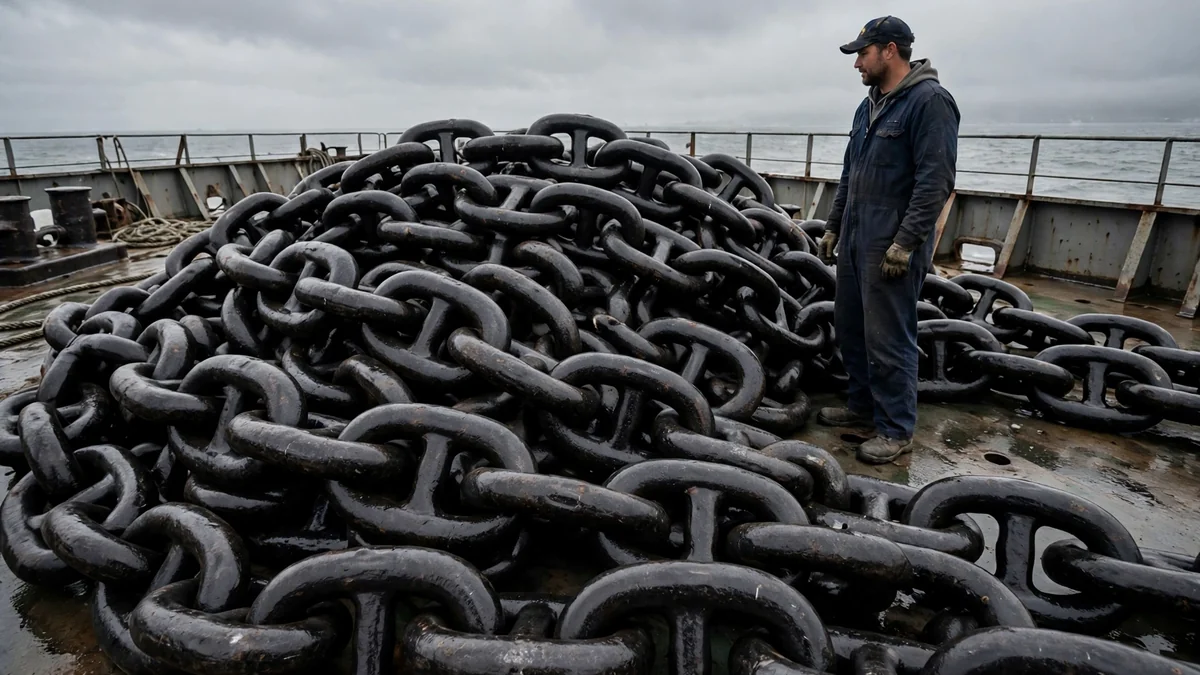
A large ship’s anchor chain is one of the heaviest pieces of equipment on board. Each link can be as thick as a man’s arm and weigh as much as a person, and a full chain can weigh more than a hundred tonnes. It lives in a deep steel compartment called the chain locker, runs over a giant winch called the windlass, and passes through the hawse pipe to the anchor hanging at the bow. Every part of that journey is engineered, because when a storm hits at three in the morning, the chain is the only thing between the ship and the rocks.
How It Works
Step 1: The anchor bites, the chain holds
When the anchor is dropped, it falls to the seabed and its flukes dig in as the ship drifts back. But the anchor alone could never hold a ship of tens of thousands of tonnes. What holds the ship is the catenary — the long, sagging curve of chain lying on the seabed between the ship and the anchor. The weight of that chain resists every pull: when the wind pushes the ship, it first has to lift the chain off the seabed, link by link, and that takes an enormous force.
Step 2: Links built to take the load
Ship anchor chain is not made of ordinary links. Each link is a stud link chain: an oval of steel with a crossbar — the stud — set across its middle. The stud stops the link deforming under load and keeps the chain from kinking and tangling when it is piled in the locker. The links are forged from high-strength steel, welded shut, and then heat-treated to make them tough rather than brittle. The same care that goes into a hull’s structure goes into every link: modular ship construction and chain making share the same obsession with parts that must not fail at sea.
Step 3: The windlass does the heavy lifting
Hauling a hundred tonnes of chain back on board is far beyond human strength, so the work is done by the windlass — a huge powered winch on the foredeck. The chain runs over a grooved wheel called the gypsy, whose pockets grip each link in turn and pull the chain up, link by link, as the wheel turns. The windlass is powered by hydraulics or electricity, and it has a brake that can hold the full weight of the chain and anchor if the power fails.
Step 4: Through the hawse pipe and into the locker
Between the windlass and the sea, the chain passes through the hawse pipe — a heavy steel tube that guides it over the bow and down to the anchor. The hawse pipe is armoured against the constant grinding of the chain, and when the anchor is housed, the pipe is sealed against the sea. On the other side of the windlass, the chain drops down into the chain locker, a deep steel compartment below the foredeck where the chain coils itself into a pile as it comes in.

Step 5: Marking the chain, shot by shot
A crew needs to know exactly how much chain is out, because the length of chain — the scope — decides how well the ship holds. Too little chain and the pull on the anchor is too steep; too much and the ship swings in a wide circle. So the chain is marked at every shot: the links at each 27.5-metre join are painted in a colour, and the number of painted links tells the crew which shot is on deck. Red, white, blue and yellow paint, and sometimes wire wrapped around a link, mark the shots in turn.
Step 6: Maintenance against rust and wear
Chain lives a hard life. It is dragged over rock and sand, soaked in salt water, and slammed against the seabed in storms. Crews inspect it regularly, measuring the links for wear — a link that has worn thin by more than a tenth of its diameter is retired — and checking for cracks at the welds. The titanium pressure sphere of a deep-diving submersible faces the same enemy — the sea itself — and survives it the same way: by being inspected, measured and maintained without compromise.
At a Glance
| Specification | Detail |
|---|---|
| Link type | Stud link chain, forged high-strength steel |
| Shot length | 27.5 metres per shot |
| Typical total length | 10–14 shots, roughly 275–385 metres |
| Link size | Up to 150 mm diameter bar on the largest ships |
| Total chain weight | Often over 100 tonnes on a large vessel |
| Handling machine | Windlass with gypsy wheel and brake |
| Holding principle | Weight of the catenary, not the anchor alone |
What Does It Cost?
Anchor chain is sold by weight, and the numbers add up fast. High-strength stud link chain typically costs in the region of $2,000–$4,000 per tonne, so a full chain for a large ship can cost $200,000–$400,000, and the windlass and associated equipment cost as much again (estimate). Compared with the value of the ship it holds, though, the chain is cheap insurance: a ship that drags its anchor in a storm can end up on the rocks, and no owner wants to explain that a few tonnes of steel were not worth the money.
A Rare Fact
The very end of the chain — the bitter end — is attached to the ship with a link that is deliberately weak. In an emergency, when a ship must leave its anchorage in a hurry and there is no time to haul the chain in, the crew can cut or release the bitter end and simply let the whole chain and anchor fall to the seabed, sacrificing hundreds of thousands of dollars of steel to save the ship. The phrase “to the bitter end” comes from this link: it is the last thing holding the ship, and the thing a captain is prepared to give up.
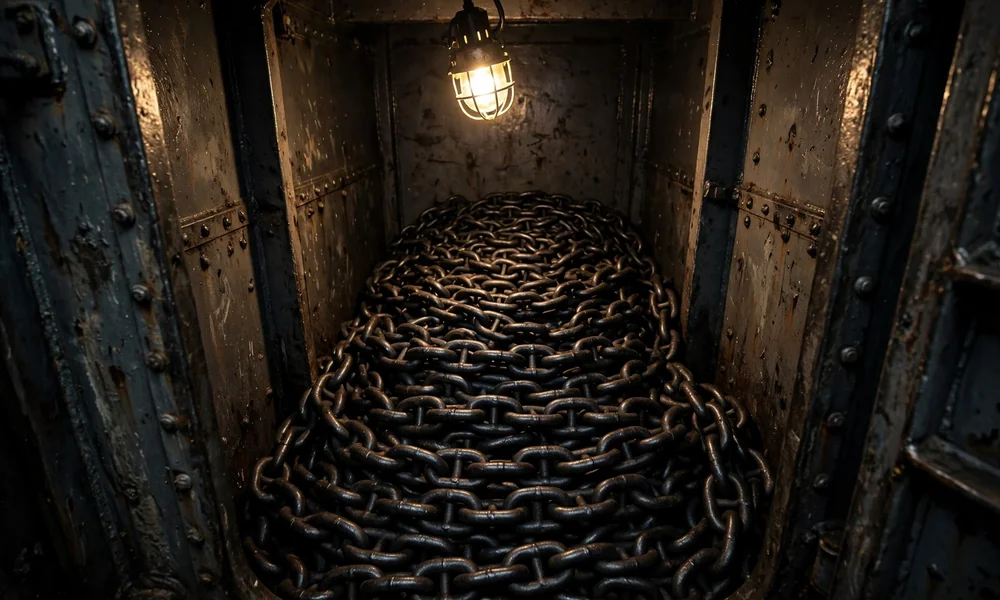
An anchor chain is not glamorous. It is heavy, black, wet and caked in mud, and it spends most of its life coiled in a dark steel box below the deck. But when the wind rises and the ship starts to move, the chain is the argument the sea has to win — link by link, tonne by tonne, across hundreds of metres of seabed.
The same principle of quiet, heavy reliability shows up elsewhere at sea: the yacht anchor system works on a smaller scale, with the same catenary curve doing the same job for a boat that weighs a fraction of a ship. Size changes; physics does not.


