Behind a submarine moving through dark water, something trails for hundreds of metres: a thin, flexible line, invisible from the surface, listening. It hears the ocean the way the submarine itself cannot, because it is far from the boat’s own noise — the pumps, the motors, the hum of the crew’s lives. That line is the submarine towed array, and it is the boat’s long-distance ear.

How a Submarine Towed Array Works
A submarine towed array works by listening from a distance. It is a long cable, filled with sound sensors called hydrophones, that the submarine pays out behind itself on a tow line. Sound travels far underwater, and the hydrophones pick up the faint noises of distant ships, marine life and the sea itself. Because the array trails hundreds of metres behind the boat, it is away from the noise the submarine makes, so it can hear sounds far too quiet for the hull-mounted sensors to catch. The signals travel back up the cable to the boat, where computers turn them into a picture of what is out there.
Step 1: The array is built as a flexible cable
The array itself is a long, slender hose, typically several hundred metres long and only a few centimetres thick, built in sections that are joined together. Inside the hose are the hydrophones — small, sensitive microphones built to work underwater — spaced along the cable, along with the wiring that carries their signals and the strength members that stop the cable from stretching or snapping under tow. The outside is smooth and tough, and the whole cable is neutrally buoyant, so it floats behind the boat rather than sinking or bobbing to the surface.
Step 2: The cable is wound on a winch in the stern
When it is not in use, the array lives wound on a large winch drum inside the stern of the submarine, fed out through a tube in the tail. The winch is a heavy, carefully built machine, because the cable must pay out smoothly at speed and wind back in without kinking or tangling. The crew controls the drum from the control room, watching the tension on the cable. The periscope of a submarine is the boat’s eye above the surface; the towed array is its ear far behind.
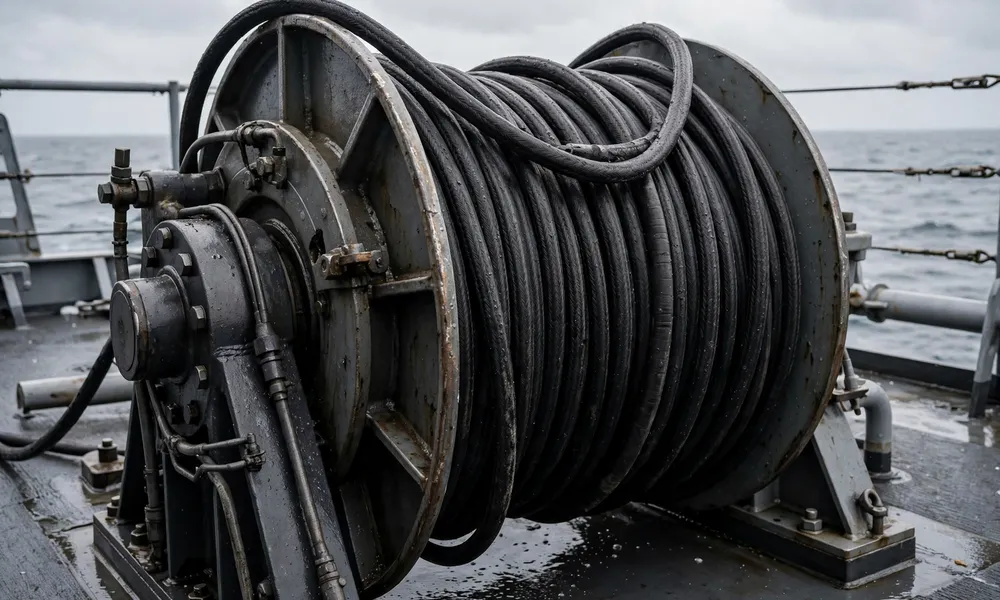
Step 3: The array streams out behind the boat
To use the array, the submarine slows to a steady speed and the winch pays the cable out behind it, metre by metre, until the whole array is streaming in the water. The boat must keep moving to keep the cable straight: if it turns sharply or stops, the cable sags and kinks, and the sensors stop working properly. The crew watches the cable’s depth and tension, adjusting the boat’s speed and the length of cable out until the array is flying level behind the boat. Deploying the array takes time, and once it is out, the boat’s freedom to manoeuvre is limited.
Step 4: The hydrophones listen in all directions
Once deployed, the hydrophones along the cable listen continuously. Each one picks up the same sounds at slightly different times, because the sound reaches the nearer sensors first, and the computers on board use those tiny time differences to work out the direction each sound came from. A distant ship’s propellers, the rumble of a far-off storm, the clicks of marine life — all of it is caught by the line of sensors and sorted by direction and frequency. The communications mast of a submarine handles the boat’s messages; the towed array handles what the boat hears, much further than any hull sensor.
Step 5: The computers build a picture of the sea
The raw sound is only the beginning. Inside the boat, sonar operators and computers turn the hydrophone signals into displays: lines on a screen that show the direction, strength and character of every contact. A trained operator can tell a cargo ship from a fishing boat by the rhythm of its propellers, and can spot the faint, regular beat of a distant vessel long before it is close enough to matter. The computers filter out the ocean’s background noise, so the operators can concentrate on the contacts that count. The array does not see; it listens, and the listening is precise enough to track a contact for hours.

Step 6: The array is recovered before manoeuvring
When the submarine needs to move fast or turn sharply, the array must come back in first. The winch winds the cable back onto the drum, slowly and steadily, while the boat holds a straight course, and the crew watches for tangles or damage. Recovery takes time, and a submarine with its array out is a submarine that cannot sprint or dodge — which is why the decision to deploy it is a tactical one, weighed against the need to move. The cable is inspected as it comes in, and any damaged section is cut out and replaced before the next deployment. Like the anchor chain of a ship, it is wound and stowed with care.
Step 7: The boat listens, decides, and moves on
With the array’s picture of the sea in front of them, the captain and the sonar team decide what to do: follow a contact at a distance, avoid a busy shipping lane, or slip away quietly before being noticed. The array’s great gift is time: it hears things early, from far away. The array is only a cable, but it is the cable that lets the boat hear the ocean before the ocean hears the boat.
| Specification | Typical value |
|---|---|
| Type | Flexible cable with hydrophone sensors |
| Length | Several hundred metres, in joined sections |
| Diameter | Only a few centimetres |
| Sensors | Hydrophones spaced along the cable |
| Buoyancy | Nearly neutral, streams level behind the boat |
| Deployment | Paid out from a winch in the stern |
| Key advantage | Hears faint sounds far from the boat’s own noise |
A submarine towed array is military equipment fitted to the boat, so it is never priced on its own. Estimates put a complete towed array system — cable, winch, handling gear and the processing equipment on board — at roughly 5 to 20 million US dollars, depending on the length, the number of sensors and the sophistication of the processing. Those are estimates, not list prices. The cost is small beside the cost of the submarine itself.
A rare fact: the towed array is so sensitive that it can pick up sounds from tens of kilometres away, and its operators can sometimes identify a distant ship by the unique rhythm of its propellers, almost like a fingerprint. The cable must stay almost perfectly straight to work well, which is why the submarine can only make gentle turns while it is deployed — a sharp turn bends the array and blinds it until it straightens out again.
The submarine towed array works because it puts distance between the listener and the noise. A thin cable and a line of patient sensors hear what the hull alone never could. It is the submarine’s longest sense, and the simplest: a line in the water, listening.


