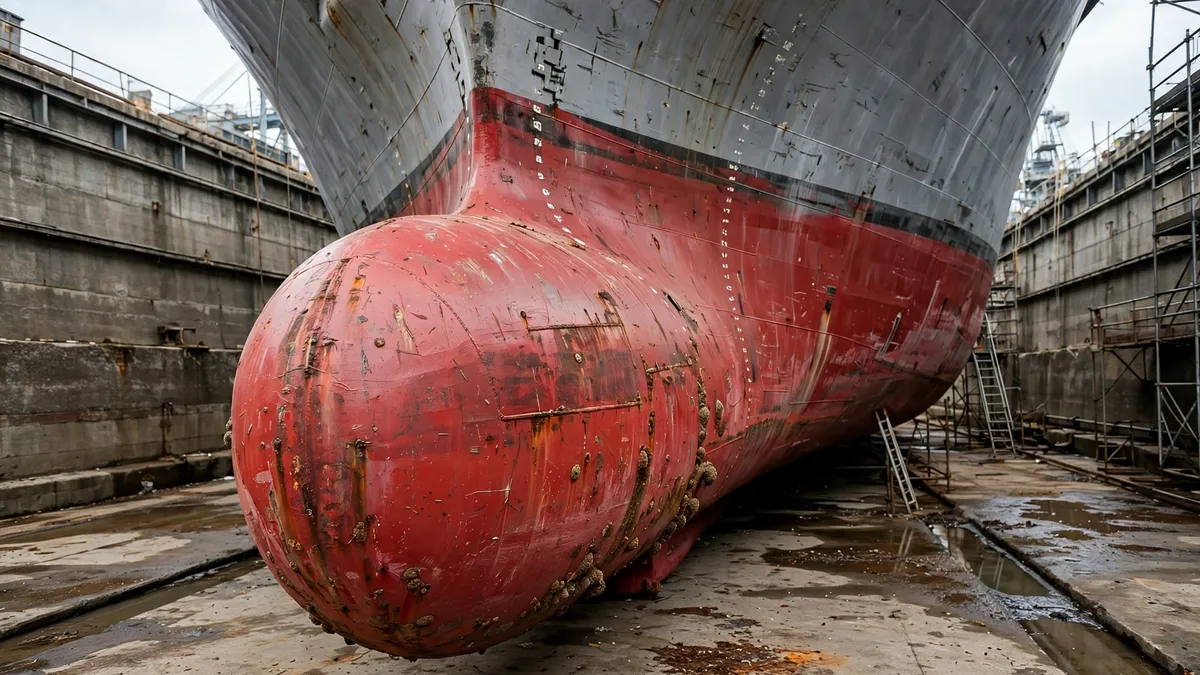
Look at a big ship in dry dock and you will see something odd at the front: a fat, torpedo-shaped bulge sticking out below the waterline, like the ship is growing a nose it does not need. It is not a mistake, and it is not a bumper. That bulge is a bulbous bow, and it is one of the cheapest fuel-saving devices ever fitted to a ship. It looks strange because it is doing something strange: it makes its own wave to cancel the ship’s bow wave.
How a Ship Bow Bulb Works
A ship bow bulb works by cancelling waves. As a ship moves, its bow pushes water aside and builds a wave along the hull, and making that wave costs fuel. The bulb sits just below the surface at the very front of the ship, and as it moves it makes its own smaller wave. If the bulb is the right size and in the right place, its wave arrives out of step with the bow wave: where the bow wave rises, the bulb’s wave falls. The two partly cancel each other, and the engines burn less fuel to hold the same speed.
Step 1: The hull’s wave pattern is measured
Design starts with the ship itself. Naval architects study the hull’s shape, its length, its loaded draft and the speed it will cruise at most often, because the bow wave depends on all of them. They run the hull through computer simulations and then through a towing tank, pulling a scale model through the water and measuring the waves it makes. The goal is to find the wave the bow builds at cruising speed, so the bulb can be tuned to fight exactly that wave.
Step 2: The bulb is shaped and sized
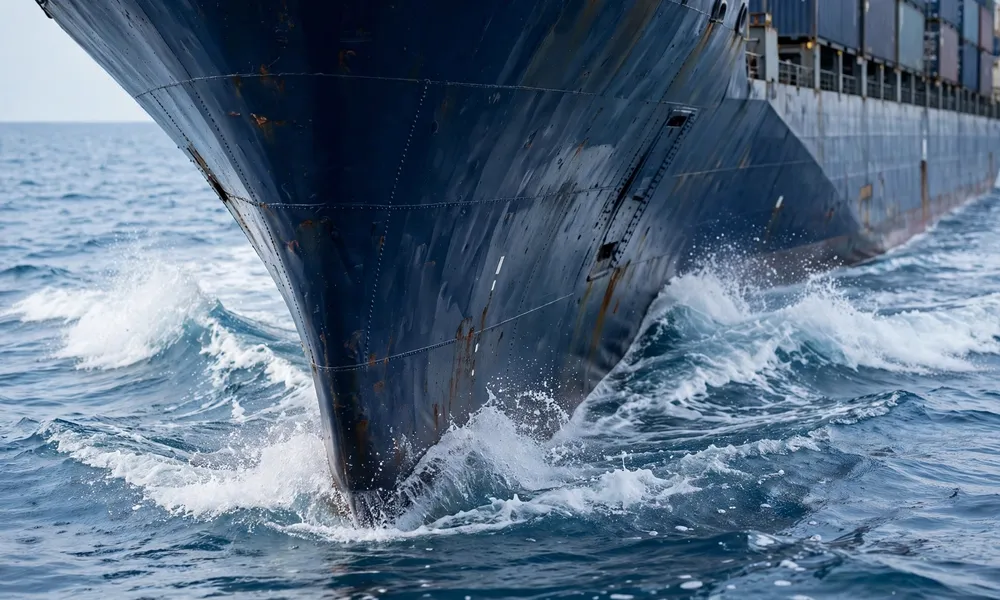
With the wave pattern known, the bulb is shaped. Most bulbs look like a horizontal teardrop or a torpedo, wider at the front and tapering back into the hull, and they are sized as a small fraction of the ship’s length — usually a few per cent. Too fat and the bulb adds more drag than it saves; too thin and its wave is too weak to cancel the bow wave. The bulb’s position matters just as much, because its wave must arrive at the bow at the right moment. The hull of a container ship shows this tuning well, since those ships run the same routes at the same speeds for years.
Step 3: The bulb is built into the bow
The bulb is not bolted on afterwards. It is built as part of the bow itself, from the same steel plates, welded into the hull structure in the shipyard. Inside, the bulb is divided by watertight bulkheads and stiffened with frames, because it takes the full force of the water and the occasional bump from ice or debris. Its tip is reinforced and coated with antifouling paint, since marine growth would spoil the smooth water flow it depends on.
Step 4: The bulb makes its own wave
At sea, the bulb does its work invisibly. As the ship moves, water flows over and around the bulb, and the bulb’s rounded shape pushes the water up and aside in a pattern that forms a wave of its own. That wave travels back along the hull, and because the bulb sits slightly ahead and below the bow, the two waves arrive out of step. Where the bow wave would crest, the bulb’s wave troughs, and the water surface stays flatter than it would have been.
Step 5: The engines feel the difference
The payoff shows up on the bridge, in the fuel gauges. With the wave partly cancelled, the ship’s resistance falls, and the engines need less power to hold the same speed — typically a saving of a few per cent, and sometimes more than ten per cent on ships whose routes and speeds suit the bulb well. The propeller of a ship turns a little easier and the fuel bill drops. The saving is biggest at the ship’s design speed, which is why the bulb is tuned to the speed the ship spends most of its life at.

Step 6: The crew keeps the bulb smooth and clean
A bulb only works if the water flows smoothly over it, so the crew’s job is to keep it that way. In dry dock the bulb is inspected for dents, corrosion and marine growth, and its paint is renewed. A dent changes the shape and weakens the wave, and a rough coat of barnacles adds drag that the bulb was meant to remove. The rudder of a ship gets the same treatment, because the whole underwater hull is one system.
Step 7: The bulb earns its keep for the life of the ship
Once fitted, the bulb needs no power, no crew and no maintenance beyond normal hull care. It works on every voyage, in every sea, for the whole life of the ship — twenty years or more of small, steady savings that add up to thousands of tonnes of fuel. The bulb is a piece of steel that does nothing but sit in the water and make a wave, and it is one of the most cost-effective pieces of engineering on the whole ship.
| Specification | Typical value |
|---|---|
| Shape | Horizontal teardrop or torpedo, tapering into the hull |
| Position | Below the waterline, at the very front of the bow |
| Size | A few per cent of the ship’s length |
| Material | Same steel as the hull, with internal stiffening |
| Fuel saving | Typically a few per cent, sometimes over 10 per cent |
| Best speed | The ship’s normal cruising speed |
| Maintenance | Inspection and repainting in dry dock |
A bulbous bow is part of the ship, so it is never priced on its own. Estimates put the extra cost of building a bulb into a large ship’s bow at roughly 100,000 to 500,000 US dollars, depending on the ship’s size and the complexity of the bow structure. Those are estimates, not list prices. Against that, a large container ship can burn tens of thousands of dollars of fuel in a single day, so the bulb often pays for itself within its first year at sea.
A rare fact: the bulbous bow was first fitted to ships more than a century ago, but it only became common in the second half of the twentieth century, when fuel prices rose and computer simulations let designers tune the bulb properly. Before that, some bulbs actually made ships slower, because a badly sized bulb adds drag instead of cancelling waves. The turning point was the towing tank: once designers could watch the waves on a model and adjust the bulb until they cancelled, the bulb became standard equipment.
The ship bow bulb works because it fights a wave with a wave. It is a lump of steel with no moving parts, no power supply and no crew, and it saves fuel on every voyage simply by being the right shape in the right place. Look for the bulge at the bow of the next big ship you see in dry dock: it looks like a mistake, and it is one of the cleverest things on the ship.


