Deep under the sea, a submarine carries its own atmosphere. There is no fresh air down there, no wind, no open window — only the air the crew brought with them, stored at crushing pressure in steel bottles, cleaned, cooled, and rationed by a system that must never fail. That system is the submarine air system, and it does three jobs at once: breathing air, blowing ballast tanks, and powering tools. Building it means building a network of pipes and bottles that can hold pressure higher than the sea outside, for years, without a single leak.
The air system is mostly invisible. Yet it is one of the most safety-critical systems on the boat: if the high-pressure air fails, the submarine cannot surface in an emergency. Every bottle, valve, and joint is therefore made, tested, and inspected as if lives depended on it — because they do.
This is how a submarine air system is made, from a steel billet to the first dive.

How a Submarine Air System Is Made
The heart of the system is the air flask — a thick-walled steel bottle, usually a metre or two long, built to hold air at 200 to 400 bar, roughly two hundred to four hundred times normal atmospheric pressure. Flasks are made from seamless steel tube, so there is no welded seam along the body to fail under pressure. The neck is machined and threaded for the valve, and the whole bottle is heat-treated to give the steel the right balance of strength and toughness.
1. Forging and testing the flasks
Each flask is proof-tested before it is trusted. It is filled with water and pressurised well beyond its working pressure — a hydrostatic test — while inspectors watch for any bulge, weep, or drop in pressure. The bottle is then dried, inspected inside with a borescope, and stamped with its test pressure, date, and serial number. The discipline matches the pressure work in a deep-sea submersible, where the sea outside is just as unforgiving.

2. Building the compressors
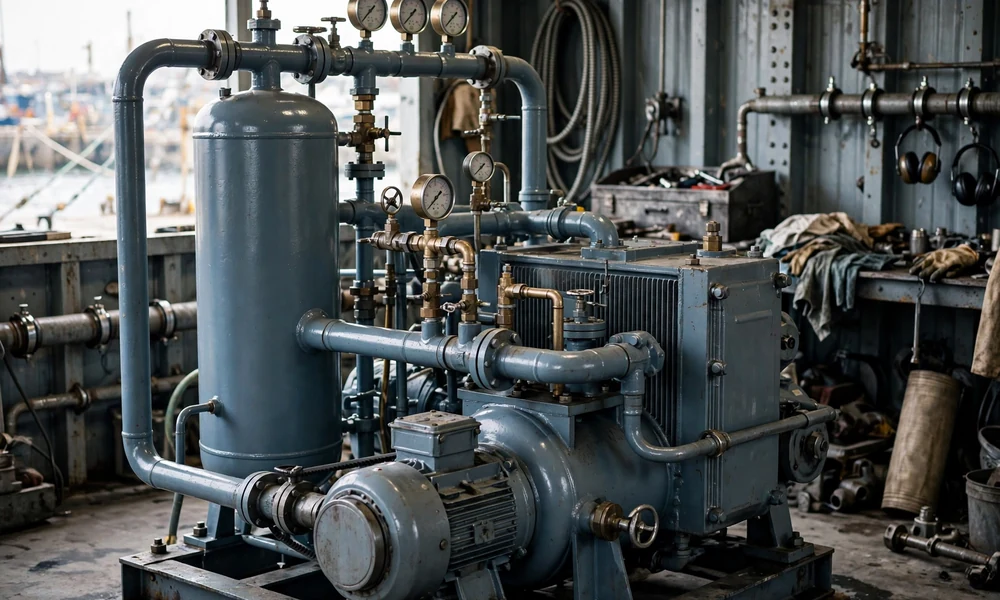
The air in the flasks has to come from somewhere, and on a submarine it comes from high-pressure compressors that squeeze ordinary air up to storage pressure in stages. A compressor is a multi-stage machine: each stage squeezes the air a little more, and between stages the air is cooled, because hot air takes more work to compress and damages seals. Compressors are tested on a bench for hundreds of hours, running up to full pressure again and again, before they are fitted.
3. Piping, valves, and reducers
From the flasks, a network of steel pipes carries the air around the boat. The pipes are bent on a mandrel bender so the bends are smooth and do not thin the wall, and each joint is either welded or fitted with a high-pressure union and a metal seal — no rubber washers, which would blow out at these pressures. Valves are forged steel, built to open and close thousands of times without leaking, and every line is fitted with a pressure-reducing valve that steps the stored pressure down to the gentle pressure the crew breathes, or to the working pressure of a tool. Each section of pipe is pressure-tested and flushed clean, because a speck of dirt in a high-pressure line can jam a valve at the worst possible moment.
4. The ballast blow system
The most dramatic job of the air system is the emergency blow: flooding the ballast tanks with high-pressure air to drive the water out and send the submarine racing to the surface. The blow valves are large, fast-acting valves, often operated by a single lever in the control room, and they must open in a fraction of a second and pass an enormous volume of air. The piping to the ballast tanks is the biggest in the system, and it is routed with care so that a single damaged line cannot take out the whole blow. The system is tested in harbour by blowing the tanks at the surface, and the crew practise the drill until it is muscle memory.
5. Air cleaning and breathing air
Air for breathing is not just compressed air — it is cleaned, dried, and monitored. Filters strip out oil mist from the compressors and dust from the intake, dryers remove moisture that would freeze in the pipes or corrode the flasks, and sensors watch the oxygen and carbon dioxide levels in the boat’s atmosphere around the clock. The cleaning gear is built from stainless steel and fitted with replaceable cartridges, so it can be serviced at sea without shutting the whole system down.
6. Assembly, testing, and sea trials
The final assembly happens inside the submarine, in a space so tight that pipes must be fitted in a precise order, like a puzzle, before the hull sections are joined. Fitters work from drawings, and each connection is made, torqued, and marked. When the system is complete, it is pressure-tested section by section, then as a whole, and the compressors are run to fill the flasks for the first time. At sea, the boat dives, blows its tanks, and surfaces, and the engineers watch the pressure gauges fall and rise exactly as designed. The same staged testing is used on an aircraft carrier flight deck, where the first live test is the moment every builder holds their breath.
Submarine Air System Specifications
| Feature | Typical Value |
|---|---|
| Storage pressure | 200–400 bar |
| Flask volume | 100–500 litres per flask |
| Flask material | Seamless alloy steel |
| Compressor stages | 3–4 stages with intercooling |
| Breathing air pressure | Reduced to near-atmospheric |
| Blow system | High-volume fast-acting valves |
| Pipe material | Steel or stainless steel, welded joints |
| Service life | Life of the submarine with re-tests |
Those figures vary between boats and are often not published in detail, but the pattern is universal: store a lot of air at high pressure, keep it clean, and be able to release it fast when it matters. The materials and sealing logic overlap with the composites world of carbon fibre weave engineering, where the same intolerance of contamination and the same testing discipline decide whether a part survives.
What a Submarine Air System Costs
A submarine air system is sold as part of the submarine, not as a separate item, so its price is rarely broken out. As an estimate, the flasks, compressors, piping, and blow system for a modern conventional submarine can cost several million dollars, with the compressors and the emergency blow gear accounting for the largest share. The cost reflects the seamless flasks, the multi-stage compressors, and the hundreds of hours of testing and certification — and the fact that every component is built in small numbers to a military standard rather than mass-produced.
A Rare Fact
Here is a detail that surprises even engineers: the air a submarine crew breathes at depth is not simply the air from the flasks. The boat constantly recycles its atmosphere — scrubbing out carbon dioxide, adding oxygen, and burning off trace gases — so the same air can be used again and again for weeks. The high-pressure flasks are mostly a reserve and a tool for surfacing. In a real sense, a submarine does not carry its air with it so much as it carries the means to keep one small bubble of air alive, hundreds of metres under the sea.


