There is a moment every cruise passenger knows: the ship rolls, the glasses slide, and for a second the whole floating hotel feels like it might tip. It never does, and the reason is not just the ship’s weight. Hidden below the waterline, a pair of fins reaches out from the hull and pushes back against the sea, flattening the roll before most passengers even feel it. Those fins are ship stabilizers, and each one is a piece of heavy engineering the size of a small aircraft wing, built to work for decades in salt water without ever being seen.
A stabilizer looks simple from the outside — a smooth steel fin, a few metres long, that sticks out of the hull and tilts up and down. The fin has to be strong enough to lift thousands of tonnes of rolling ship, precise enough to move a few degrees at a time, and sealed so perfectly that the sea never reaches the machinery. Building one is a job for a foundry, a machine shop, and a shipyard working together.
This is how a ship stabilizer is made, from molten steel to the first roll-free crossing.
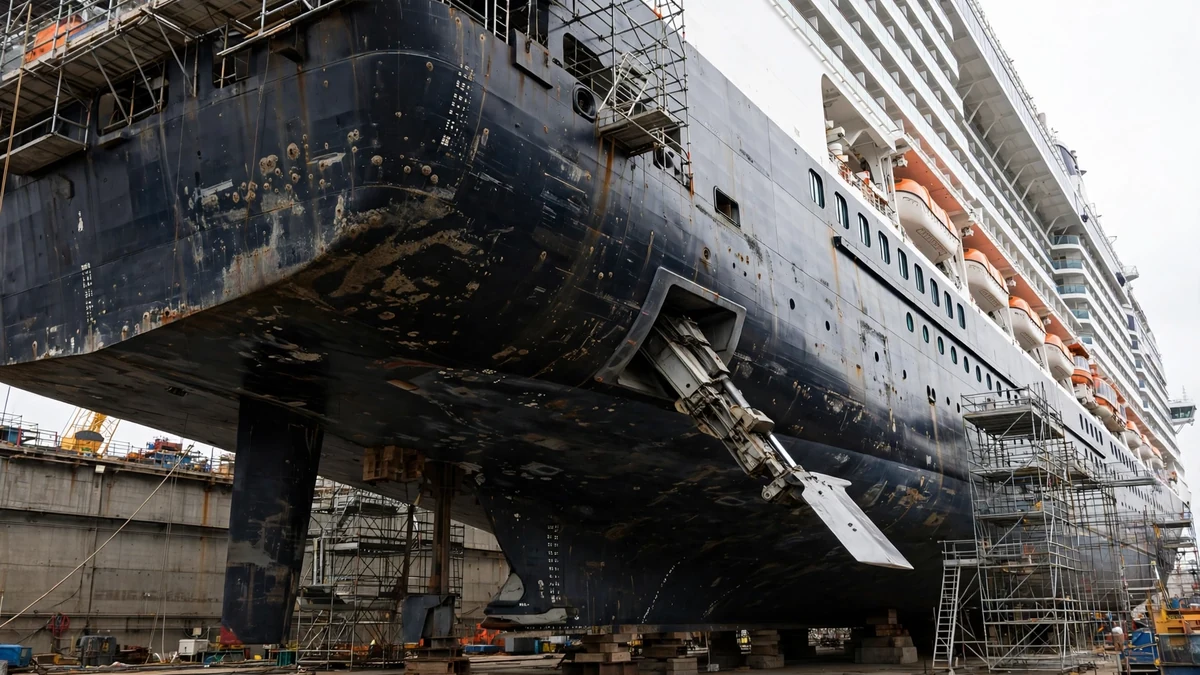
How a Ship Stabilizer Is Made
The fin itself starts in a foundry. Stabilizer fins are usually cast from high-strength steel or a steel alloy, poured into a mould shaped like a wing, with a thick root where it joins the ship and a thin, tapered tip. Casting is chosen over welding plates together because a single casting has no seams to crack under the repeated bending of roll after roll. The molten steel is poured at around 1,500 degrees Celsius, then left to cool slowly.
1. Casting and cooling the fin
Once the pour is done, the fin stays in its mould for hours, sometimes days, while it cools. Rushing the cooling would lock stresses into the steel and could leave hidden cracks that only show up years later, in the middle of an ocean. When the mould is finally broken away, the rough casting is inspected with ultrasound and dye-penetrant tests, which reveal flaws invisible to the eye. The same caution shapes the steelwork of a yacht stabilizer fin, where a smaller fin faces the same endless flexing.

2. Machining the fin to shape
The rough casting goes to a machine shop, where computer-controlled mills and lathes cut it to its final shape. The fin’s cross-section is an aerofoil, like an aircraft wing, and the surface must be smooth to within a fraction of a millimetre — a rough fin would drag, hum, and waste fuel. The root end is machined flat and drilled for the bolts that will join it to the shaft, and the tip is balanced so the fin does not vibrate as it moves through the water. Machining a fin this size can take days.
3. Building the shaft and bearings
The fin is only half the machine. It is mounted on a thick steel shaft that passes through the hull, and that shaft runs in bearings that must carry enormous loads while turning smoothly. The shaft is forged from a single billet of alloy steel, turned on a lathe, and ground to a mirror finish where it meets the seals. The bearings are usually large roller or sleeve bearings, fitted into a housing that is welded into the hull structure itself. The fit is checked to hundredths of a millimetre and the assembly is filled with clean lubricating oil.
4. The hydraulic drive
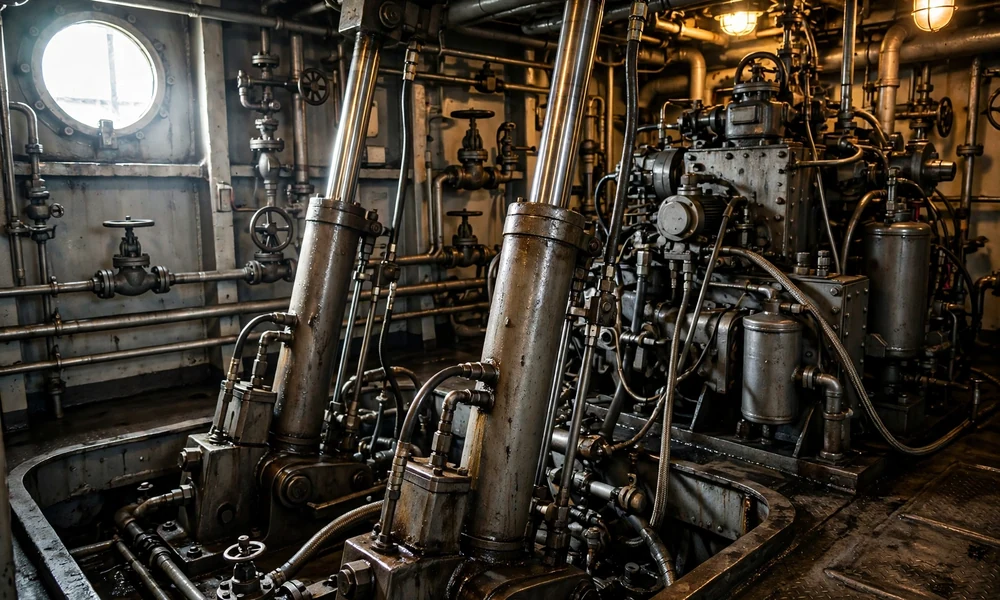
The power that moves the fin comes from hydraulics. Inside the ship, a pair of hydraulic cylinders — sometimes a rotary vane motor — pushes and pulls the shaft, tilting the fin up and down through a range of about thirty degrees each way. The cylinders are built from honed steel tubes with chrome-plated rods, and they run at pressures of several hundred bar, enough to swing a fin weighing many tonnes against the force of the sea in under a second. Hoses, valves, and accumulators are fitted and pressure-tested on a bench, then piped into the ship.
5. Sensors and the control system
A stabilizer that moved blind would be useless, so the system is fitted with sensors that feel the ship’s roll. Gyroscopes and accelerometers, mounted near the ship’s centre, measure the roll angle and speed many times a second, and a controller works out how much lift the fin must produce and which way to tilt it. The electronics are tested in a simulator first, then at sea, with engineers watching the roll trace shrink as the system is switched on.
6. Fitting, sealing, and sea trials
The final step happens in the shipyard. The hull is opened where the fin will sit, the bearing housing is welded in and aligned, and the fin and shaft are lifted into place by crane. The shaft passes through a set of seals — usually a stack of lip seals and a pressurised oil barrier — that keep the sea out and the lubricating oil in. The fin is bolted on, the hydraulics are connected, and the whole assembly is tested in the dry dock, moving the fin through its full range while divers or cameras check for leaks. The engineering discipline is the same as in a cruise ship engine room, where a single failed seal can end a voyage.
Ship Stabilizer Specifications
| Feature | Typical Value |
|---|---|
| Fin length | 3–8 metres per fin |
| Fin area | 5–20 square metres |
| Fin material | Cast high-strength steel or steel alloy |
| Movement range | About ±30 degrees |
| Hydraulic pressure | 200–350 bar |
| Roll reduction | Typically 50–85 percent |
| Retraction | Fins fold into hull pockets in port |
| Service life | 25+ years with bearing and seal changes |
Those figures vary with ship size — a small ferry carries fins a person could lift, while a large cruise ship’s fins weigh as much as a truck. The design logic is shared with the running gear described in yacht propeller engineering, where the same salt water and the same loads decide every material choice.
What a Ship Stabilizer Costs
A pair of fin stabilizers for a large cruise ship, including fins, shafts, hydraulics, and controls, is a serious shipyard item. As an estimate, a full system can cost from around $1 million to more than $5 million, depending on ship size and whether the fins retract. Smaller systems for ferries and yachts cost far less, from tens of thousands of dollars upward. The price is driven by the casting and machining of the fins, the hydraulic power units, and the days of shipyard labour to fit and align them — and by the fact that a stabilizer that fails at sea cannot be fixed until the next dry docking.
A Rare Fact
Here is a detail few passengers ever learn: the first ship stabilizers were not fins at all but giant gyroscopes — huge spinning flywheels mounted inside the hull that resisted rolling by their own momentum. They worked, but they weighed hundreds of tonnes and took up whole compartments. Fins replaced them because a small fin in moving water can do the work of an enormous flywheel, and the gyroscope idea quietly vanished from shipbuilding — except in a few museum ships, where the old wheels still sit, rusting, as a reminder of how the problem was first solved.


