A submarine that cannot surface is every submariner’s worst fear. The boat is intact, the crew is alive, but the sea above them is a wall they cannot climb. Submarine escape systems exist for that day. They are the equipment and the methods that give a trapped crew a way out: a way to leave the boat, a way to reach the surface alive, and a way for rescuers to reach them if they cannot leave on their own.
These systems are not one device. They are a chain of parts that have to work together: the escape trunk that lets people out, the suits that keep them alive on the way up, and the rescue vehicles that can dock onto the boat from outside. Each part covers a different situation, and each has limits that no amount of engineering has removed. This is a general explanation of how the system fits together, not a manual for using it.

The Escape Trunk: The Way Out
The way out of a submarine is the escape trunk, a small chamber built into the hull with a hatch at each end. One hatch opens into the boat, the other opens to the sea. The trunk is only big enough for one or two people at a time, which means escape is slow by design, and a full crew may take hours to get out, one small group at a time.
Using the trunk means flooding it. The crew climb in, close the inner hatch, and let seawater in until the pressure inside the trunk matches the pressure outside. Only then can the outer hatch open. This equalisation is the central fact of submarine escape: the deeper the boat, the higher the pressure, and the harder everything becomes. At shallow depths it is manageable; at great depth it becomes the limiting factor for the whole system.
Once the outer hatch opens, the escapers leave one at a time and ascend. They do not swim up in the ordinary sense. They rise with the air in their lungs and their suits, controlling the ascent so they do not rise too fast. The trunk is then drained, the next group climbs in, and the process repeats. It is slow, orderly work, carried out in the dark, in cold water, by people who are frightened and running out of air. The design accepts that slowness because there is no faster way to move people through a small chamber against high pressure.
The Escape Suit: Staying Alive on the Way Up
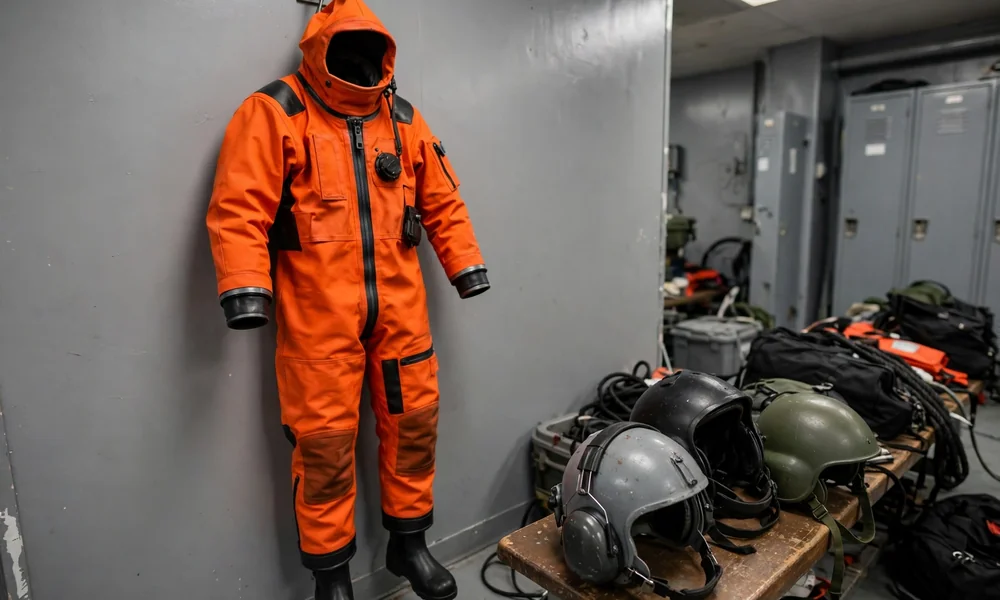
The suit is what makes the ascent survivable. A modern submarine escape suit, such as the Submarine Escape Immersion Equipment used by several navies, is a full-body suit with a hood, a life jacket built in, and a small air supply. It keeps the wearer warm in cold water, keeps them afloat on the surface, and protects them from the pressure changes of the ascent. It is put on inside the boat, before entering the trunk, and it is the escaper’s only protection once they leave.
The suit’s depth limit is a hard one. Escape suits are generally rated to depths of around 180 metres, and beyond that the pressure makes a free ascent too dangerous. The air in the lungs compresses on the way down and expands on the way up, and the body can only cope with so much change. The suit helps, but it does not remove the physics. A boat lying deeper than the suit’s limit cannot be escaped this way, and the crew must wait for rescue from outside.
Rescue From Outside: The Rescue Vehicle
When the crew cannot escape on their own, the rescue must come to them. The main tool is the rescue vehicle, a small submersible carried by a surface support ship. The best-known type is the deep-submergence rescue vehicle, which is lowered to the seabed, finds the disabled boat, and docks onto its escape hatch, forming a seal. The crew then climb from their boat into the rescue vehicle, which detaches and carries them to the surface.
Docking is the hard part. The rescue vehicle must find a hatch less than a metre across, in the dark, in current, on a boat that may be lying at an angle on the seabed. It uses sonar, cameras and thrusters to manoeuvre precisely, and once the seal is made, the pressure between the two vessels is equalised so the hatch can open.
Several navies share these systems. NATO’s Submarine Rescue System, for example, is held ready to fly to wherever it is needed, because only a handful of countries operate rescue vehicles and a boat in trouble may be far from its own navy’s ship. Submarine rescue vessels are the ships that carry this equipment to the scene, with cranes, decompression chambers and medical facilities aboard, and the whole operation depends on them arriving in time.
The Air Problem
Everything in submarine escape is a race against the air supply. A disabled boat has a finite amount of breathable air, and every hour that passes uses some of it. Carbon dioxide builds up, oxygen falls, and the crew’s ability to think clearly and work the escape equipment degrades. Escape and rescue are both planned around this clock, and it is the reason rescue forces move as fast as they can.
The boat’s own systems can stretch the time. Emergency air supplies, carbon dioxide scrubbers and careful rationing of effort all help, and how a submarine’s air system works shows the equipment that manages the air in normal operation. But these are measures of hours, not days. A rescue that arrives a week later is no rescue at all, which is why navies keep rescue systems on short notice and practise deploying them quickly.
Decompression is the other clock. People who have been under pressure, whether inside the boat or during an ascent, carry dissolved gas in their blood. Coming up too fast can cause decompression sickness, the bends, which can be disabling or fatal. Escapees who reach the surface need medical checks and, often, time in a decompression chamber. The rescue is not over when someone reaches the surface; it is over when they are safely back to normal pressure.

What the Systems Cannot Do
The honest limits are stark. Escape suits work only to a certain depth, and a boat lying deeper than that cannot be escaped by free ascent. Rescue vehicles can only dock if the hatch is undamaged and accessible, and a boat lying on its side or buried in silt may have no usable hatch. Bad weather can keep the support ship from working over the site, and the whole rescue depends on knowing where the boat is, which is not guaranteed in the open ocean.
None of this makes the systems pointless. They have saved lives, and they give a crew in trouble something better than no chance at all. But they are a last resort with narrow limits, not a guarantee. A submarine escape system is a set of carefully designed compromises between physics, time and the size of a hatch, and its real purpose is to turn a hopeless situation into a difficult one, and a difficult one into a survivable one.
The hatch itself is a story of its own. How the submarine escape hatch works explains the mechanism that the whole system depends on, from its seals to the way it opens under pressure. Without that one hatch working, neither the suits nor the rescue vehicles have anywhere to go.


