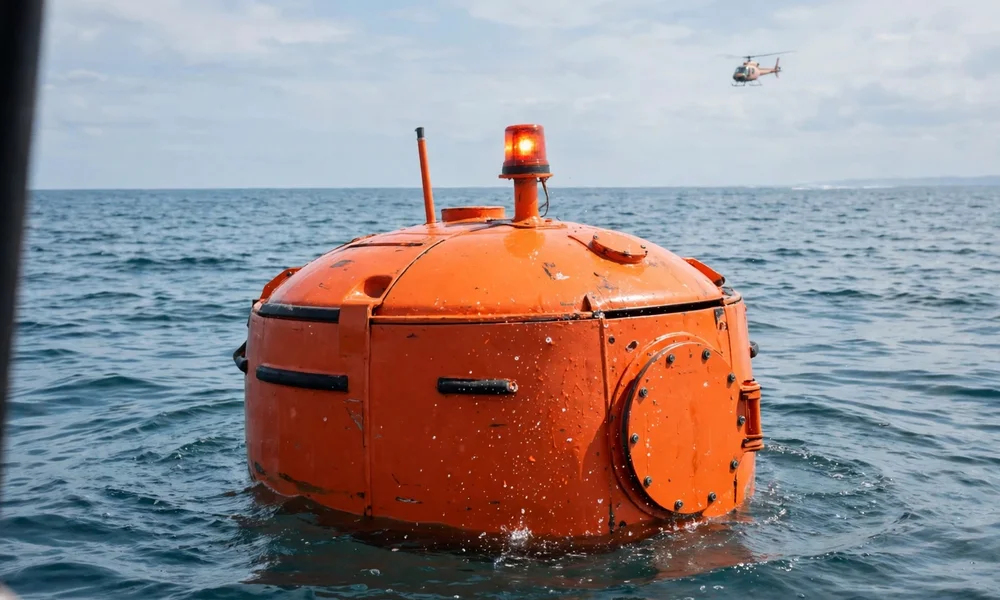
If a submarine is disabled on the seabed and cannot surface, the crew needs a way out. For most of the history of submarines, that way out was the escape trunk: a small chamber the crew flooded, opened, and swam out of, rising to the surface in a life jacket. It was brave, dangerous, and it only worked from shallow water.
A submarine escape pod is a different answer. It is a small, sealed capsule, built into the submarine, that carries the whole crew — or a large part of it — to the surface in one go. The crew climbs inside, the hatch seals, the pod detaches from the submarine, and it floats up to the surface like a bubble, where it waits to be found. This guide explains how it works, from the moment the alarm sounds to the moment the pod breaks the surface.

Why an escape pod exists
A submarine is a sealed steel tube, and that is its strength and its danger. If it floods, loses power, or settles on the seabed beyond the reach of a rescue vessel, the crew is trapped. A rescue submarine can dock with a disabled boat, but it takes time to arrive, and time is what a crew in a damaged submarine does not have.
An escape pod is designed to be immediate. It needs no outside help, no rescue vessel, and no waiting. The crew boards, seals the hatch, and leaves. It is a self-contained lifeboat that happens to be built into the submarine itself, and it turns a situation that would be a slow disaster into a controlled ascent.
The pod itself: a small pressure hull
The pod is, in engineering terms, a second pressure hull. It is usually a sphere or a short cylinder, built from the same high-strength steel as the submarine, and it is designed to withstand the pressure at the submarine’s maximum operating depth. A sphere is the strongest shape for pressure, which is why many pods are round, like a giant steel ball with a hatch.
Inside, the pod is cramped by design. It has seats or straps for the crew, a small supply of oxygen, carbon dioxide scrubbers to keep the air breathable, and emergency rations and water. There is no engine and no propeller. The pod is a passive capsule: it goes up because it is buoyant, and it stays up because it floats.
How the pod is held to the submarine
In normal operation, the pod sits in a recess on the top of the submarine, flush with the hull, sealed by a hatch that opens from inside the submarine. The crew can reach it from the control room or the accommodation spaces, usually by climbing a short ladder. The hatch between the submarine and the pod is a normal pressure hatch: it opens inwards, it seals with a ring of rubber, and it is dogged shut with a wheel or a lever.
The seal between the pod and the submarine must do two opposite jobs. It must be watertight while the submarine is under way, and it must release cleanly in an emergency, without jamming. Designers test this obsessively, because a pod that will not detach is worse than no pod at all. How submarine escape systems work covers the wider set of escape arrangements, and the pod is the most self-contained of them.
The launch sequence, step by step
First, the crew gathers at the pod and climbs in, in a set order, the most vulnerable first. The seats are numbered, the straps are fastened, and the crew leader checks that everyone is in. Then the hatch is closed and dogged from the inside, and the crew checks the seal.
Then the release is fired. On most designs this is a manual lever or a set of explosive bolts, triggered from inside the pod. The latches let go, the pod lifts off the hull, and the submarine falls away below. There is no countdown and no drama in the design: the whole point is that it works when the crew is frightened, in the dark, and possibly in a flooding compartment.
The ascent: buoyancy does the work
Once free, the pod rises. It is positively buoyant, which means it displaces more water than it weighs, so the water pushes it up. The ascent is fast but not violent: a pod from a few hundred metres down might reach the surface in a couple of minutes, rising at a controlled rate set by its shape and its drag.
The pressure change is the danger here. As the pod rises, the pressure outside it falls, and the air inside expands. The pod vents the excess through a valve, keeping the internal pressure safe. The crew inside feel their ears pop and the air grow thinner, but they are inside a pressure hull, not exposed to the water, which is the whole advantage over swimming out.

On the surface: waiting to be found
When the pod breaks the surface, it floats like a buoy, with most of its hull above the water. The crew can now open a vent to let in fresh air, and if the sea is calm they can open the top hatch. But the first job is to be found, and the pod is built for that.
Life support inside the pod is designed for the wait. Oxygen and carbon dioxide scrubbers typically last for at least a day, and often longer, and there is water and a small amount of food. The pod is also insulated, so the crew does not freeze in cold water, and it is stable enough to ride out rough weather. Submarine rescue vessel specs, explained covers the ships that would come to collect them, and the pod’s job is to keep the crew alive until they arrive.
Escape pods versus escape trunks
The older method, the escape trunk, is still fitted on many submarines, and it is worth comparing. In a trunk escape, a small group of crew enters a chamber, the chamber floods, the outer hatch opens, and they swim out one by one, rising to the surface in life jackets. It is simple, it needs no special capsule, and it works.
The pod solves all three. It works from any depth the submarine can reach, it takes the whole crew at once, and it keeps them dry and warm. The price is weight, space, and complexity: the pod is a large, heavy piece of equipment that must be carried on every patrol, and it takes up room that could be used for something else. How a submarine escape hatch works explains the trunk and hatch system in detail, and the two methods are often fitted side by side.
Testing, training, and the limits
But within those limits, the escape pod is one of the most humane pieces of engineering on a submarine. It is a piece of the boat that exists only to save the people inside it, and it does its job by being simple: a sealed steel ball, full of air, that floats. The crew climbs in, the hatch closes, and the sea itself carries them home.