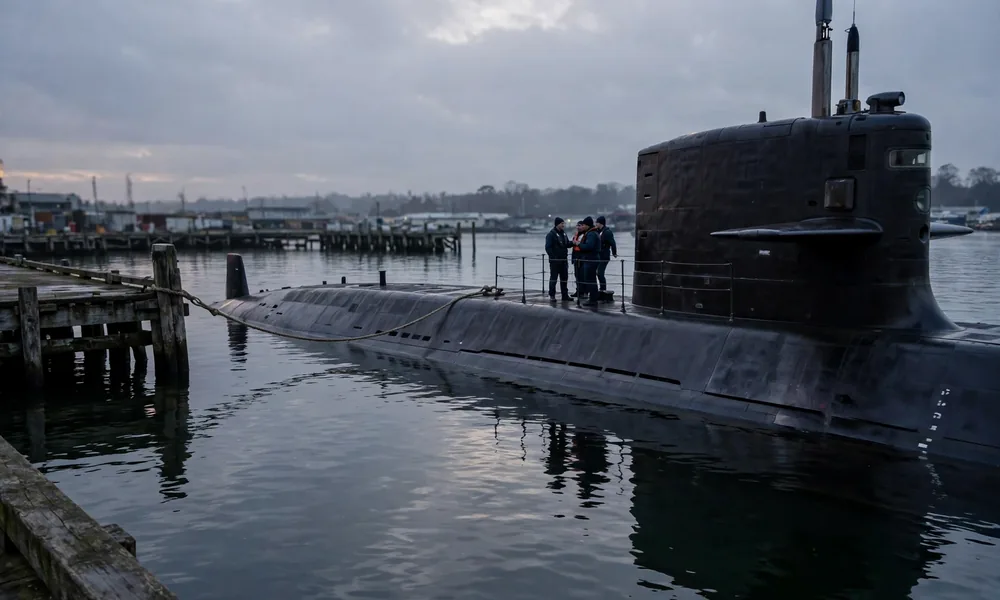
Fire on a submarine is a different emergency from fire anywhere else. There is no way out, no fire brigade to call, and no fresh air to open a window to. The boat is sealed, the crew is sealed in with it, and the smoke has nowhere to go. A fire that would be a nuisance in a building can kill a submarine crew in minutes.
That is why a submarine’s fire suppression system is built as a whole-boat discipline, not a single device. Detection, extinguishants, and compartment isolation work together, and the crew trains on them constantly. This guide explains how the system works, from the first wisp of smoke to the moment a compartment is sealed and the fire is out.

Why fire is the submarine’s worst enemy
A submarine carries everything a fire needs. There are electrical systems running at high power, hydraulic oil under pressure, cooking equipment, and batteries that store enormous energy. A short circuit in a cable, a burst hydraulic line spraying oil onto a hot surface, or a fault in a battery cell can all start a fire, and once it starts, the enclosed space works against the crew.
Smoke is the first killer. In a sealed steel tube, smoke fills a compartment in seconds and spreads through any open hatch or duct. It blinds the crew, chokes them, and carries toxic gases from burning insulation and paint. The second killer is heat, which builds fast in a small space and can damage equipment in neighbouring compartments. The third is the loss of the air itself: a fire consumes oxygen, and a submarine’s air supply is finite.
Detection: finding the fire first
The first part of the system is detection, and it is deliberately sensitive. Smoke detectors sit in every compartment, often several per space, watching for the first particles of smoke. Heat detectors watch for a rapid rise in temperature, and some boats carry detectors that sniff for the gases given off by overheating electrical insulation before it actually catches fire.
When a detector trips, the alarm sounds throughout the boat and the control room gets the exact location. The crew does not wait to confirm it by eye: the alarm sends a fire party to the compartment while the rest of the crew goes to their stations. False alarms happen, and they are treated as training, because the cost of a slow response is far higher than the cost of a false one.
Extinguishants: what puts the fire out
Once a fire is found, the crew reaches for the right extinguishant, and the choice matters. Water is the workhorse for ordinary fires, sprayed as a fine mist that cools the flames and wets the fuel, and submarines carry hoses connected to a seawater or fresh water main running the length of the boat. A fine mist also has a second benefit: it scrubs smoke from the air.
Electrical fires get a different treatment. Spraying water onto a live electrical panel is dangerous, so the crew uses carbon dioxide or a clean-agent gas, which smothers the fire by displacing oxygen and leaves no residue on the equipment. Some compartments have fixed flooding systems that release the gas automatically or on command from the control room, filling the space and starving the fire. The crew must be out of the compartment first, because the same gas that starves a fire starves a person.
Compartment isolation: sealing the fire in
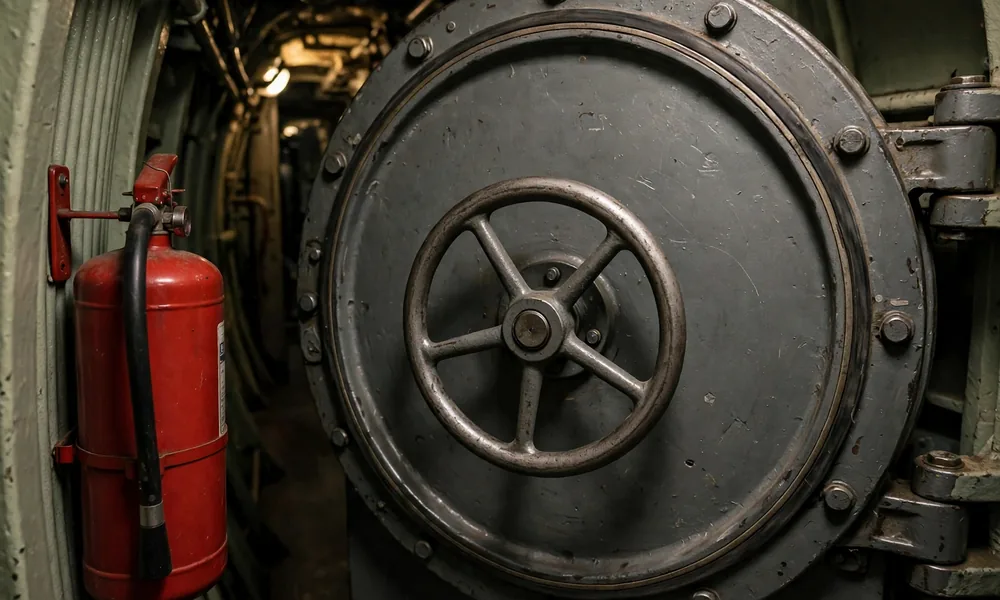
The most important part of submarine fire suppression is not the water or the gas, but the doors. A submarine is divided into watertight compartments, each sealed by heavy doors and hatches, and closing those doors turns a boat-wide emergency into a local one. The fire is trapped in one compartment, the smoke is trapped with it, and the rest of the crew can keep working.
Isolation is a drill the crew practises until it is automatic. On the alarm, the crew closes the watertight doors on either side of the affected compartment, shuts the valves in the pipes that pass through it, and secures the ventilation to that space. The fire party then fights the fire from the boundary, cooling the doors and the bulkheads from the outside while the extinguishant does its work inside. It is a cold, disciplined way to fight a fire, and it is the only way that works in a sealed boat.
The battery and reactor spaces
Some compartments need special treatment. The battery compartment holds the boat’s main batteries, which can release hydrogen gas and burn fiercely if damaged, so it has its own detectors, its own ventilation, and strict rules about what can be taken inside. A battery fire is fought with water mist and by isolating the compartment, and the crew monitors the hydrogen level constantly while they work.
The reactor compartment on a nuclear submarine is different again. The crew cannot enter it freely, and a fire there is fought from outside the compartment, by isolating it and flooding it with extinguishant on command. How a submarine nuclear reactor works explains the compartment itself, and the fire plan for it is built around the same principle as the rest of the boat: seal it, starve it, and keep the crew safe on the other side of the door.
The fire party and the drill
The people matter as much as the equipment. Every submarine carries a fire party, a trained team with breathing apparatus, hoses, and thermal cameras, and every member of the crew has a station and a job when the alarm sounds. Some close doors, some man the hoses, some watch the boundaries, and the control room coordinates the whole response.
The drill is practised constantly, because a real fire gives the crew no time to think. They run through it in port, at sea, and in the dark, until closing a door and donning breathing apparatus is muscle memory. The escape systems are the last resort, and how a submarine escape pod works covers the way out if the boat itself cannot be saved. But the fire plan is built on the belief that the boat can be saved, and that a fast, disciplined crew with the right equipment can put a fire out before it ever gets that far.
After the fire is out
Putting the fire out is only half the job. The compartment is full of smoke and toxic gas, and it cannot be opened until the air is safe. The crew ventilates the space carefully, monitoring the air as it clears, and checks the damaged equipment before anything is switched back on. A cable that shorted once can short again, and a compartment that looks safe can hide a smouldering fire behind a panel.
The final step is learning from it. Every fire, and every false alarm, is written up and shared, because the fleet learns from each boat’s experience. The systems that keep a submarine’s trim and depth are part of the same discipline, and how submarine ballast control works shows how the boat’s other systems are built to keep working through an emergency. Fire suppression is the same idea applied to the worst emergency of all: detect early, seal fast, and fight with everything the boat has.