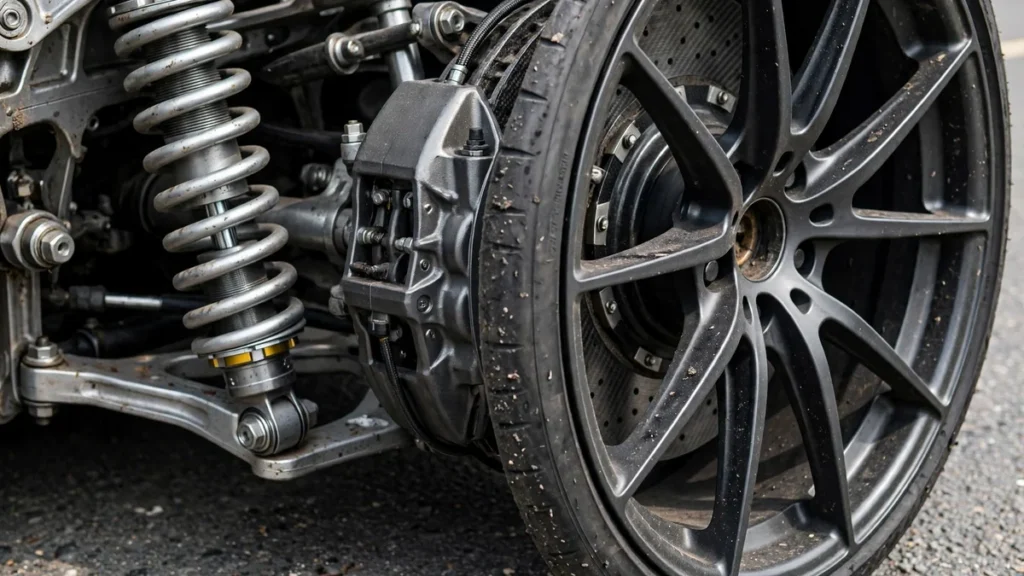
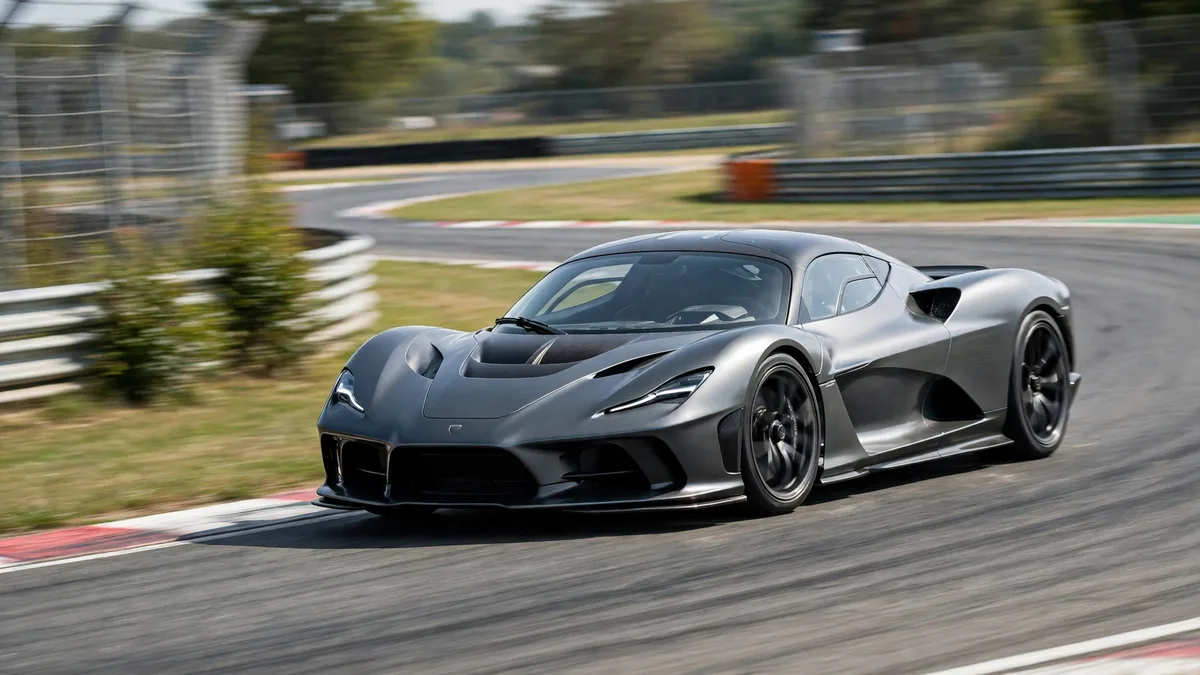
Watch a hypercar attack a corner at speed and you will see something strange: the body barely leans, barely dives, barely rolls, as if the car were pinned to the road by invisible hands. The driver is not fighting the car. The car is doing the fighting for them, adjusting itself dozens of times a second. The part doing that work is the suspension, and in a hypercar it is a piece of engineering so elaborate that it can cost more than an entire family car.
A hypercar suspension is not a set of springs and dampers bought off a shelf. It is a system of wishbones, pushrods, hydraulic actuators, sensors and computers, built from exotic materials and tuned for a single car, and it must keep tyres the size of dinner plates in contact with the road at speeds where a bump is a launch ramp. That is why it costs so much.
Why It Costs So Much
Reason 1: The materials are from aerospace, not the car park
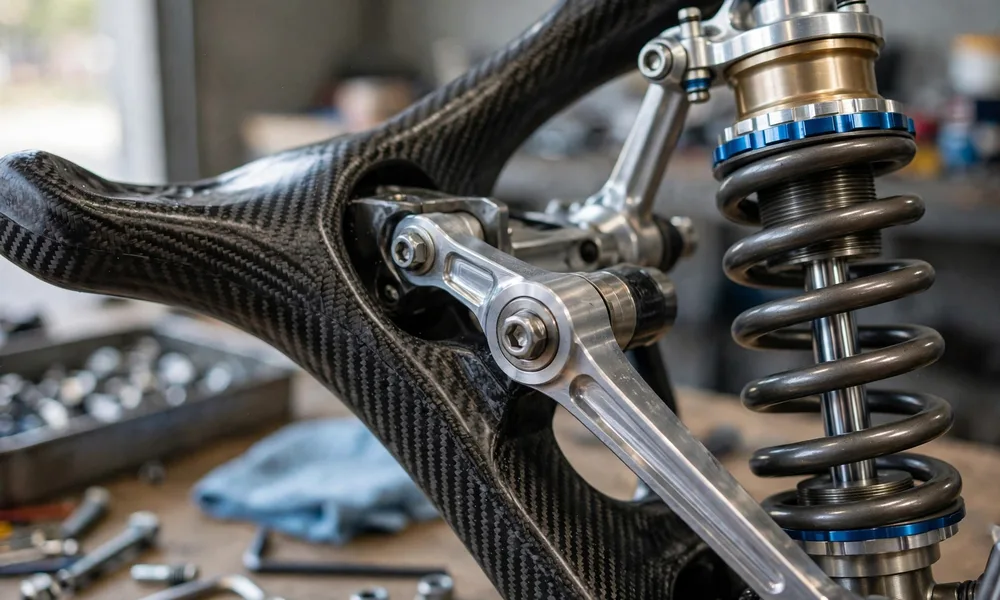
Hypercar suspension parts are made from materials chosen for strength and lightness in equal measure: titanium, carbon fibre, aluminium alloys and high-strength steels that are also used in aircraft and racing cars. A single wishbone may be machined from a solid block of aluminium, or laid up in carbon fibre by hand, layer by layer, then cured in an autoclave. These materials are expensive to buy, hard to machine and unforgiving to work with, and a part that fails at 200 miles per hour is not a warranty issue but a disaster. Every component is therefore tested, inspected and documented, and the cost of that testing is built into the price. The materials themselves are covered in hypercar suspension materials engineering.
Reason 2: It is active, not passive
An ordinary car suspension is passive: a spring compresses, a damper slows it down, and that is all. A hypercar suspension is active, which means it can change its behaviour in real time. Hydraulic actuators lift and lower each corner, sensors measure the road, the body movement and the steering, and a computer decides, many times a second, how stiff each damper should be and how high the car should ride. That turns the suspension into a system of pumps, valves, accumulators and electronics, all of which must work together flawlessly. The hardware alone is costly, and the software that controls it is developed and calibrated over thousands of test miles. How the finished system behaves is explained in how hypercar suspension works.
Reason 3: The geometry is bespoke to one car
No two hypercars have the same suspension geometry, because no two hypercars have the same weight, shape, tyres or aerodynamics. Engineers design the wishbones, the pushrods and the mounting points from scratch for each model, using computer simulation to predict how the car will behave at every speed and every corner. Then they build prototypes, test them on a track, and change the geometry again, sometimes many times. That design work is done by a small team of specialists, it takes months, and its cost is spread over a production run that may be only a few hundred cars. A family car spreads its suspension development over millions of vehicles; a hypercar spreads it over a few hundred, and each car carries a far larger share.
Reason 4: The dampers are instruments, not parts
The dampers on a hypercar are among the most sophisticated components on the car. Some use magnetorheological fluid, which changes thickness in milliseconds when a magnetic field is applied, letting the damper go from soft to firm almost instantly. Others use hydraulics linked across the car, so that a bump at one wheel can be countered by an adjustment at another. These dampers are built by specialist firms, assembled in clean rooms, and tested individually before they are fitted. A single damper can cost thousands, and a car needs four of them, plus spares for testing. When a damper is that precise, it is closer to a scientific instrument than to a car part, and it is priced like one.
Reason 5: It must work with the aerodynamics
At high speed, a hypercar is held to the road as much by its wings and underbody as by its tyres, and the suspension is part of that aerodynamic system. As speed rises, downforce grows, pressing the car down; the suspension must lower the car to keep the aerodynamic floor at the right height, while still absorbing bumps and keeping the tyres in contact with the road. If the ride height is wrong by a few millimetres, the downforce can change dramatically, and the car can lose grip without warning. The suspension and the aerodynamics are therefore developed together, tested in wind tunnels and on tracks, and tuned as one system. That integration is a cost no ordinary car ever pays. The build behind it is covered in how hypercar suspension is made.
Reason 6: Low volume, high labour, no shortcuts
Hypercar suspension is assembled by hand, by technicians who fit each part, torque each bolt to a precise value, and check the alignment on equipment that measures to fractions of a degree. There is no production line turning out thousands a day; there is a small workshop, a small team, and a car that may take weeks to build. The tooling, the jigs, the test rigs and the track time are all paid for by a tiny number of cars, and there is no cheaper version to fall back on. When something wears out, the replacement part must be made to the same standard, by the same people, at the same cost. That is the price of building a car in the hundreds rather than the hundreds of thousands.

Hypercar Suspension at a Glance
| Specification | Detail |
|---|---|
| Layout | Double wishbone, pushrod actuated |
| Materials | Titanium, carbon fibre, aluminium alloys |
| Damper type | Active hydraulic or magnetorheological |
| Adjustment rate | Dozens of adjustments per second |
| Ride height control | Hydraulic lift, adjustable on the move |
| Typical production run | A few hundred cars per model |
| Main advantage | Flat cornering, stable at speed, comfortable when cruising |
| Main drawback | Extremely expensive to build, service and repair |
What Does It Cost?
As rough estimates, a full hypercar suspension system typically costs around $50,000 to $150,000 to build, and a single replacement damper can cost $5,000 to $15,000 before labour. Those figures are estimates, not quotes, and they vary with the model, the technology and the manufacturer. The suspension alone can cost more than a well-equipped family car, which is one reason hypercars are priced in the millions rather than the hundreds of thousands.
A Rare Fact
Some hypercars can raise and lower themselves at the touch of a button, lifting the nose to clear a speed bump and then dropping back down for the motorway. The system that does this was borrowed from Formula 1, where suspension has been actively controlled for decades, and from military aircraft, where hydraulic actuators move control surfaces at enormous speed. A hypercar suspension is, in that sense, a racing and aviation system that has been taught to behave politely on a public road.
A hypercar suspension costs so much because it is not a suspension in the ordinary sense at all. It is a computer-controlled, aerospace-built, aerodynamically integrated system that keeps a thousand-horsepower car glued to the road while its driver barely notices it is there. When it works, the car feels like it is on rails. That feeling is the product, and it is priced accordingly.