A submarine is a warship that spends most of its life hiding, and hiding makes talking very hard. Radio waves, the medium every other vehicle uses to communicate, barely travel through seawater. A submarine that wants to send or receive a message must come close to the surface, put an antenna above the water, or use a method that works underwater. Submarine communication is the set of systems that solves that problem, balancing the need to stay in contact with the need to stay undetected.
Seawater absorbs radio waves, and the higher the frequency, the faster they are absorbed. The ordinary radio frequencies used by ships, aircraft and mobile phones die within a few metres of the surface. Only very low frequencies penetrate to any useful depth, and they carry information very slowly. A submarine therefore cannot simply have a radio conversation while submerged at depth; it must plan its communications around the water itself.
Very low frequency radio: messages from shore
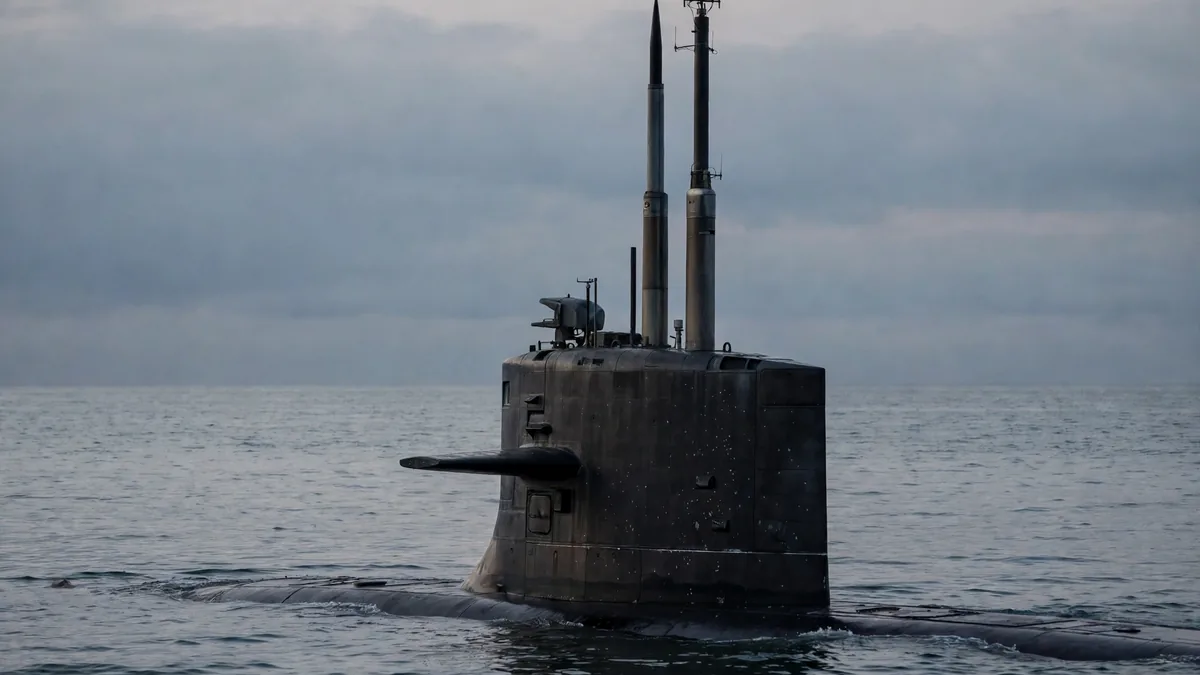
The main way a shore command reaches a submerged submarine is very low frequency radio, known as VLF. VLF signals, between roughly 3 and 30 kilohertz, can penetrate tens of metres into seawater, far deeper than any other radio band. A submarine at shallow depth can trail a long wire antenna behind it, or raise an antenna to just below the surface, and pick up a VLF broadcast. The signal is one-way: the shore station transmits and the submarine listens, because transmitting at VLF needs an enormous antenna and huge amounts of power that no submarine can carry.
VLF is slow. A message may take minutes to send, and the data rate is measured in tens of characters per minute rather than megabits per second. Shore stations therefore send short, coded messages: orders, position updates, and instructions to come to a shallower depth or raise a mast for a faster link. The submarine’s crew decodes the message and acts on it. It is a thin line of contact, but for a boat that may spend weeks submerged, it is the line that keeps it part of the fleet rather than alone in the ocean.
Extremely low frequency and the deep listener
Even lower frequencies, called extremely low frequency or ELF, penetrate deeper still, reaching submarines at greater depths. ELF stations are rare, because they need antennas tens of kilometres long and enormous transmitters, and the data rate is slower still, just a few characters per minute. An ELF message is typically a short code telling the submarine to come up to VLF depth for a full message. ELF is a bell, not a telephone: it rings, and the submarine comes to the surface to hear the rest.
Most navies rely on VLF as the main broadcast channel, with ELF as a backup for boats operating too deep for VLF. Both are one-way by design, and both require the submarine to slow down and come shallow, which costs time and some stealth. The balance between staying deep and staying in contact is one of the constant calculations of submarine command, and communication schedules are planned as carefully as patrol routes.
Coming to the surface: masts and satellite links
When a submarine needs to send a real message, it comes to periscope depth, around 15 to 20 metres, and raises a mast above the surface. The submarine communications mast carries antennas for satellite communication, high-frequency radio and other systems, and it is raised only for as long as needed, because a mast above the surface can be seen by radar and by eye. The crew sends and receives its traffic in a short burst, then lowers the mast and returns to depth.
Satellite links are the fastest channel a submarine has. Through a mast antenna, a submarine can exchange emails, download orders and send reports at speeds that would be familiar on land, though the window is short and the mast must stay above water for the whole session. Modern submarines also use buoyant antennas, cable-linked buoys that float to the surface while the boat stays deeper, letting it communicate without exposing its sail. The buoy trails behind on a long cable, and when the session is over it is reeled back in.
Talking underwater: acoustic communication
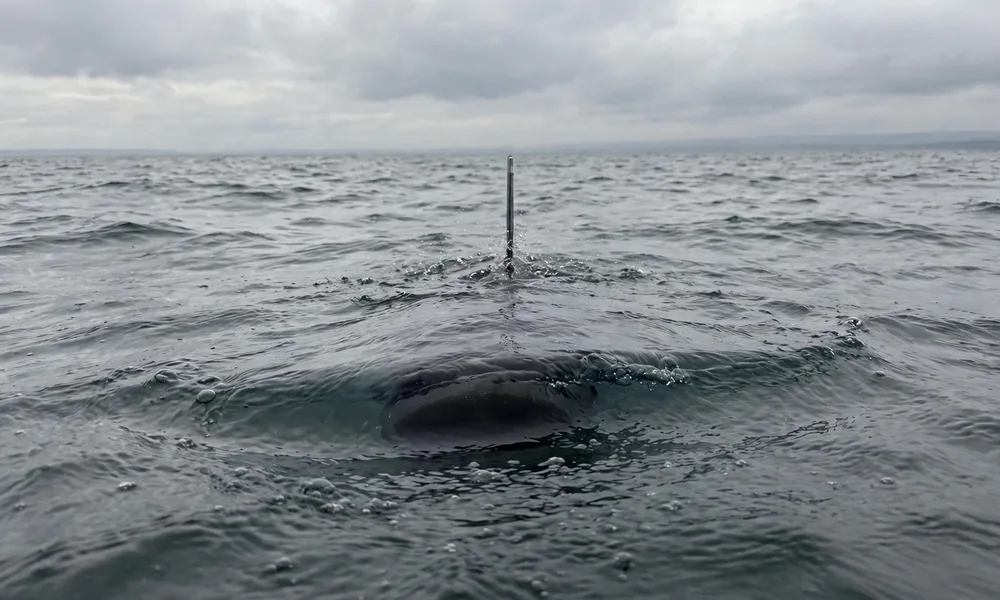
Underwater, sound travels far better than radio, and submarines use it to talk to each other and to other vessels. Acoustic communication works like an underwater modem: a transducer converts digital data into sound pulses, the pulses travel through the water, and another transducer on the receiving vessel turns them back into data. The range can be several kilometres in good conditions, and the data rate is modest, enough for short text messages and position reports.
The problem with acoustic communication is that it gives the submarine away. Sound in water travels a long way, and any vessel listening with sonar can hear a transmission. A submarine therefore uses acoustic links sparingly, usually for short messages to a friendly vessel nearby, and often in coded bursts that are hard to intercept. This is different from sonar itself, which is listening rather than talking. The submarine sonar array is how a boat hears what is around it, while acoustic communication is how it speaks, and the two are kept carefully separate in the crew’s mind.
Buoys, expendables and emergency contact
A submarine that cannot or will not come to the surface has another option: send a messenger. Communication buoys are small, buoyant capsules that the submarine releases, which float to the surface and transmit a message by radio or satellite before scuttling themselves. They let a submarine send a report or a distress call while staying deep and silent, at the cost of revealing its approximate position to anyone who intercepts the buoy’s transmission.
Emergency communication is a special case. A submarine in distress needs to be found, and it will use every channel it has: acoustic signals, emergency buoys, and surfacing to transmit on every frequency. In normal operations, though, the rule is the opposite: communicate as little as possible, as briefly as possible, and only when the message is worth the risk of being heard.
Inside the boat: the communications team
All of this is run by the submarine’s communications team, who manage the radios, the cryptographic equipment, the masts and the buoys. Messages are encrypted before they are sent and decrypted when they arrive, and the crew works to a strict schedule of broadcast times, so the boat is only listening when a message is expected. The radio room is one of the most secure spaces on the boat, because the messages it handles include the submarine’s orders, its position, and the intentions of its commanders.
The technology has changed over the decades, from morse code on VLF to satellite email, but the underlying problem has not. A submarine must be reachable and invisible at the same time, and every communication system is a compromise between those two demands. The submarine periscope shows the same compromise in visual form: a brief look above the surface, then back down into the dark.

Why it matters
Submarine communication matters because a submarine that cannot be contacted cannot be controlled. The systems described here, VLF broadcasts, ELF bells, masts, satellites, acoustic links and buoys, form a layered network in which each layer covers the gaps of the others. Together they let a vessel that spends its life underwater remain part of a fleet on the surface, and like most things about submarines, they work best when nobody notices them at all.


