Steel has a limit. Take a steel submarine deep enough, and the pressure of the ocean will crush its hull like a paper cup. For decades, that limit set how deep a submarine could go, and navies that wanted to dive deeper had to find a different metal. The answer was titanium: a metal as strong as steel but almost half the weight, immune to rust, and able to survive pressures that would destroy any other hull. Only a handful of countries have ever built a submarine from it, because working titanium is one of the hardest jobs in all of shipbuilding.
A titanium hull is not just a steel hull made from a different metal. Titanium cannot be welded in open air, it catches fire if it is machined wrong, and it costs many times more than steel. Building one means sealing an entire workshop against oxygen, welding in argon gas, and checking every seam with ultrasound, because a single flaw at depth is fatal. This is how a submarine titanium hull is made, from raw metal to a cylinder that can dive where steel cannot follow.
How It’s Made
Step 1: Making the titanium
Titanium starts as ore, refined into a silvery sponge metal, then melted in a vacuum furnace and alloyed with aluminium and vanadium to make a grade strong enough for a submarine. The molten metal is cast into ingots, then forged and rolled into plates up to fifty millimetres thick, each plate checked for cracks and impurities. The plates are expensive and hard to make: a titanium plate costs many times more than the same plate in steel, and the yard orders them years ahead, because only a few mills in the world can roll plate to submarine standard. Every plate is tracked from the mill to the hull, with its own certificate.
Step 2: Rolling the rings
The hull is built from rings, each one a short cylinder rolled from a single plate. The plates are heated and fed through enormous rollers that bend them into a perfect circle, then the ends are joined and the ring is checked for roundness to within a few millimetres. Titanium springs back after bending more than steel does, so the rollers must over-bend the plate, and the operators work from experience as much as from instruments. A ring that is not round will not mate with its neighbours, and a hull made of crooked rings will never hold pressure evenly.

Step 3: Welding in argon
Titanium’s great weakness is oxygen: at welding temperature, it absorbs oxygen from the air and turns brittle, so every weld must be made in a shield of argon gas. The welders work inside sealed chambers or under trailing argon shields, wearing full protective suits, and the weld zone is flooded with argon until the metal has cooled. The welding itself is slow and precise, with the arc kept steady and the filler metal fed by hand, and each weld is made in a single pass where possible, because re-welding titanium weakens it. It is the most demanding welding in shipbuilding, and only a small number of welders in the world are qualified to do it.
Step 4: Joining the rings into a hull
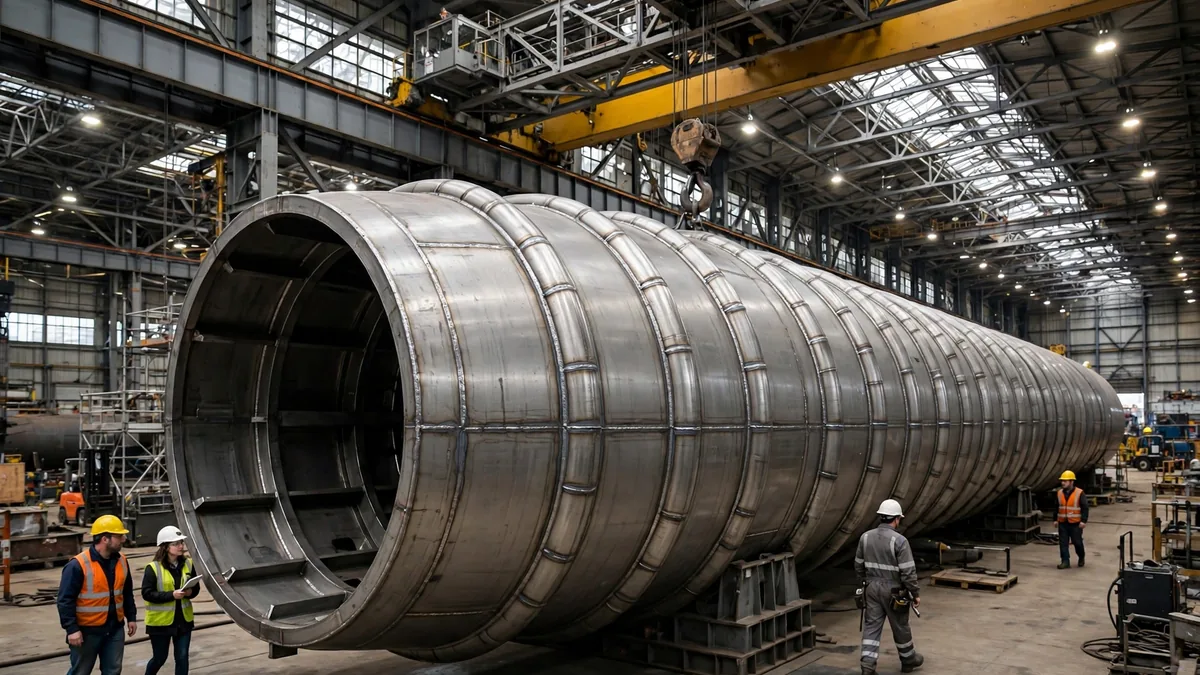
Once the rings are welded, they are joined end to end to form the long cylinder of the pressure hull. Each ring is lifted by crane, aligned with its neighbour using laser measurement, and welded around its full circumference in argon, a joint that can take days to complete. Internal frames, ring stiffeners that give the hull its resistance to pressure, are welded in as the hull grows, and each compartment is checked for roundness after every joint. The work is done in a clean, climate-controlled hall, because dust and moisture are as dangerous to titanium as oxygen, and the hull is kept covered whenever work stops.

Step 5: Testing every weld
When the hull is complete, every weld is tested. Ultrasound and X-ray inspection look inside the metal for hidden flaws, and dye-penetrant tests check the surface for cracks too small to see. Any weld that fails is cut out and re-welded, a costly and slow process that can take weeks for a single joint. The hull is then pressure-tested, flooded with water and taken to pressures beyond its design depth, while engineers measure it for any sign of movement. A titanium hull that passes this test is certified to dive deeper than any steel submarine, and the certificate is the most valuable document the yard will ever issue.
Step 6: Fitting out and launching
Finally, the pressure hull is fitted out: the bow and stern sections are added, the sail is welded on, and the inside is filled with the submarine’s machinery, much of it built from titanium too, to avoid corrosion where different metals meet. The hull is painted with a special coating, not for looks but to protect it from marine growth, and the submarine is launched. Its first dive is a careful, measured descent, with the crew listening for every sound, because a titanium hull at depth is silent until it is not. When it returns, the yard knows it has built something almost no one else on earth can build.
Specs
| Specification | Typical figure |
|---|---|
| Hull material | Titanium alloy, aluminium and vanadium |
| Plate thickness | Up to 50 mm in the pressure hull |
| Hull diameter | About 9–10 metres for a large submarine |
| Weight advantage | About 45 percent lighter than steel |
| Corrosion | Immune to seawater rust |
| Welding method | Argon-shielded, in sealed chambers |
| Test depth | Beyond 600 metres for titanium designs |
| Build time | Several years from first plate to launch |
Price
A titanium submarine hull is never sold on its own, but it is the most expensive part of the most expensive machine a navy can buy. As an estimate, a titanium-hulled attack submarine typically costs roughly $1 billion to $2 billion complete, with the hull itself accounting for a large share — these are estimates, and the real figure is classified and varies by country, class, and yard. The titanium alone costs many times more than steel, and the welding, inspection, and testing take years of the most skilled labour in shipbuilding. Only a few navies have ever paid that price.
A Rare Fact
Titanium is so hard to work that the country which built the most titanium submarines had to invent new ways of building them. The Soviet Union’s Alfa-class submarines, built from titanium in the 1970s and 1980s, could dive deeper and faster than any Western submarine of their time, and their hulls were welded in vast argon-filled halls, with welders working in sealed suits like astronauts. The submarines were so fast and so deep that NATO had to design new torpedoes just to catch them. The hulls were masterpieces, and the cost of building them helped bankrupt the programme that made them.
From ore to a cylinder that dives beyond steel’s reach, the titanium hull is the rarest achievement in shipbuilding, and it builds on the same pressure-hull science as how a submarine pressure hull is made. Its power comes from the machinery described in how a submarine nuclear reactor is made, and its metal is shaped by the same skills as titanium forging. Strong, light, and almost impossible to build: that is the titanium hull.


