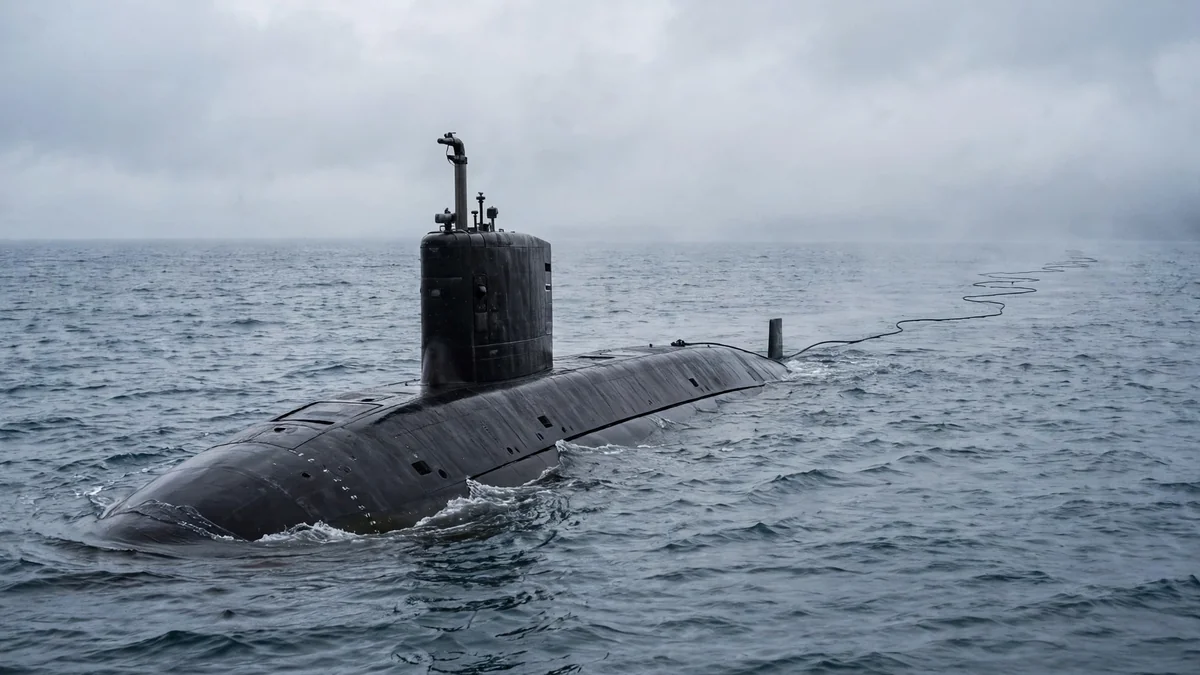
Two kilometres behind the submarine, invisible in the dark water, a thin cable trails through the sea like a fishing line. At its end, hanging in the water column, is a string of listening devices longer than the submarine itself. The boat’s own sonar can hear what is ahead of it — but the towed array can hear what is behind, beside, and far away, in the quiet water the hull’s own noise never reaches.
A towed array is the submarine’s longest ear. It is a hose, a few centimetres across and up to a kilometre or more long, filled with hydrophones — underwater microphones — spaced along its length. As the submarine moves, the array streams out behind it, straight and level, far from the rumble of the propeller and the machinery. The sounds it picks up are fed back up the cable to the control room, where computers turn them into a picture of the ocean around the boat.
The numbers of a towed array are strange ones: a cable kilometres long, hydrophones counted in the hundreds, and a listening range measured in tens of kilometres. Getting those numbers right matters, because a submarine that cannot hear cannot hide — and a submarine that can hear first can choose whether to fight, to follow, or to slip away. The towed array works alongside the boat’s own hull-mounted sensors, and the listening skills it demands are close kin to the submarine sonar array built into the bow. Here is what the specifications mean.
How It Works
Step 1: The cable and the hydrophones
The array itself is a flexible hose, usually a few centimetres in diameter, with hydrophones — small pressure sensors — mounted inside it at regular intervals. Each hydrophone converts the tiny pressure changes of a sound wave in the water into an electrical signal. Because the hydrophones are spread along a line hundreds of metres long, the array can tell not just that a sound exists, but where it is coming from, by comparing the tiny time differences as the sound reaches each sensor.
Step 2: Deploying the array
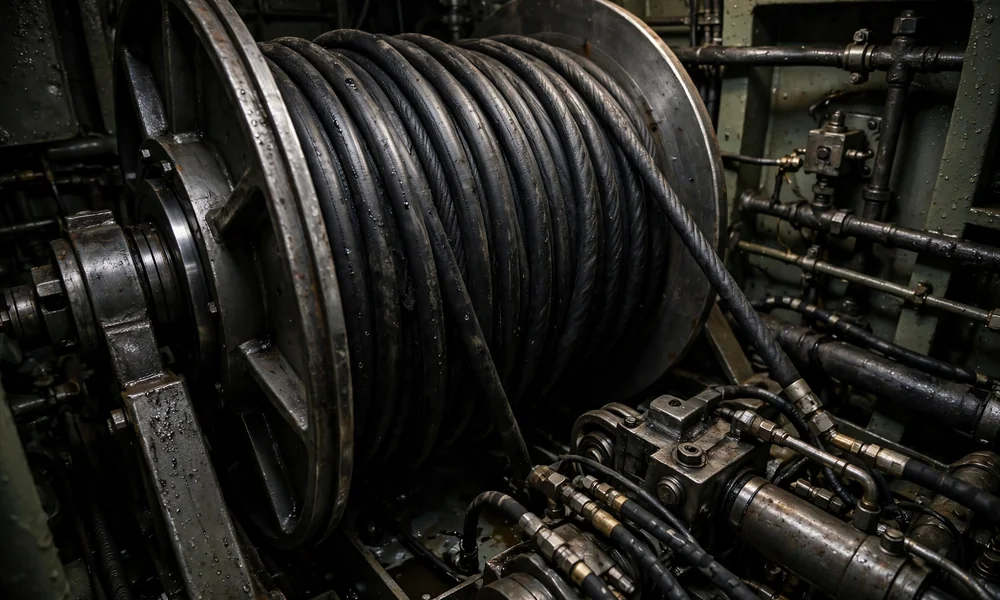
When the submarine wants to listen, it slows down and pays the array out through a tube in the stern, using a winch and a handling system in a special compartment. The cable unreels smoothly behind the boat until the full length is streaming, straight and stable, in the water. Deployment takes tens of minutes and must be done carefully — a kinked or tangled cable can put the array out of action for the rest of the patrol.
Step 3: Towing straight and level
Once deployed, the array trails behind the submarine at a depth set by the tow speed and the cable’s buoyancy. The boat must steer a steady course: every turn bends the array, and a bent array cannot tell direction properly. Submarines towing an array therefore sail in long, straight legs, turning only when they must, and waiting for the array to straighten out again before they trust what it hears. The same quiet-water logic drives the boat’s other sensors, from the submarine communications mast to the periscope.
Step 4: Listening in the quiet
The point of towing the sensors far behind the boat is to escape the submarine’s own noise. A hull-mounted sonar must listen through the rumble of the propeller, the pumps, and the flow of water over the hull. The towed array sits in undisturbed water, sometimes a kilometre astern, where the loudest thing is the ocean itself. In those conditions it can pick up the faint throb of a distant ship’s propeller or the hum of another submarine from tens of kilometres away.
Step 5: Processing the signals
The signals from hundreds of hydrophones travel up the tow cable to the submarine’s sonar room, where computers combine them — a technique called beamforming — to sharpen the listening direction, like cupping a hand behind an ear. Operators watch waterfall displays of sound against time and bearing, learning to recognise the signature of each contact: a merchant ship’s steady drone, a warship’s machinery tones, the whisper of another submarine. It is as much an art as a science, and the best operators train for years.
Step 6: Hauling the array home
Before the submarine can sprint, dive deep, or enter harbour, the array must be hauled back in. The winch winds the cable home, the hydrophone hose is coiled into its stowage, and the stern tube is sealed. A damaged array — cut by a fishing trawler, snagged on the seabed, or simply worn out — is a serious loss, because without it the boat is half deaf. Spare arrays are carried, but changing one at sea is slow and difficult work — a reminder that every system the boat carries, from its periscope to its towed array, must be built to survive months at sea.
Submarine Towed Array Specs
| Specification | Typical range |
|---|---|
| Array length | About 200 to 1,000 metres, sometimes more |
| Array diameter | About 5 to 10 cm |
| Number of hydrophones | About 50 to 300, spaced along the array |
| Tow cable length | About 500 to 2,000 metres including the tow cable |
| Operating depth | About 50 to 400 metres, set by tow speed |
| Maximum tow speed | About 10 to 15 knots for effective listening |
| Frequency range | About 10 Hz to 5 kHz for the main listening band |
| Detection range | Tens of kilometres in good conditions |
| Deployment time | About 20 to 60 minutes to stream the full array |
| Array weight | About 1 to 5 tonnes including cable and winch |
What Does a Submarine Towed Array Cost?
A complete towed array system — the hydrophone hose, the tow cable, the winch and handling gear, and the processing electronics — is estimated to cost roughly $10 million to $30 million per submarine, with replacement array hoses estimated at $1 million to $5 million each. Prices are estimates only and vary by length, sensor count, and the sophistication of the processing system.
A Rare Fact
A towed array can be longer than the submarine towing it — sometimes several times longer. The first towed arrays were tried in the 1960s, when navies realised that the quietest place to listen was not on the submarine at all, but a kilometre behind it. Today, some arrays are so long that the submarine must plan its turns around them: a sharp turn can take the array minutes to follow, and during those minutes the boat is listening through a bent ear. The longest arrays in service stretch for well over a kilometre, a thread of sensors trailing through the dark.

Next time you picture a submarine, do not just picture the steel tube. Picture the thread it trails behind it — a kilometre of listening, turning the whole ocean into something the boat can hear.