A ship rolls. It always has, and it always will — the sea pushes, and the hull answers, leaning to one side and then the other in a slow, heavy rhythm. On a calm day the roll is gentle, almost soothing. In a storm it becomes violent: furniture slides, plates smash, passengers fall, and cargo breaks loose. For a century, shipbuilders have fought that motion with a piece of engineering that is almost invisible — the stabilizer.
Look over the side of a large ship at the waterline and you may see nothing at all. The stabilizers hide below the surface, wings of steel that reach out from the hull and push against the water as the ship rolls. They are not always working — in calm seas they sit folded away, doing nothing — but when the sea gets up, they come alive, tilting and twisting hundreds of times an hour to hold the ship level.
The specifications of a stabilizer system read like a riddle: fin area in square metres, roll reduction in percent, response times in fractions of a second. Yet those numbers decide whether a cruise ship’s passengers eat dinner in comfort or in their cabins, and whether a warship can launch a helicopter in a storm. The same battle against rolling shapes the fins fitted to smaller craft, as explained in the guide to yacht stabilizer fins. Here is what the stabilizer numbers mean.
How It Works
Step 1: Feeling the roll
Everything starts with sensors. Gyroscopes and accelerometers mounted deep in the ship measure the roll angle and the roll rate — how far the ship is leaning, and how fast it is leaning — many times a second. Those measurements go to a control computer, which works out exactly how much counter-force is needed, and in which direction. A modern system reacts in well under a second, fast enough to catch a roll before it builds.
Step 2: The fins bite the water
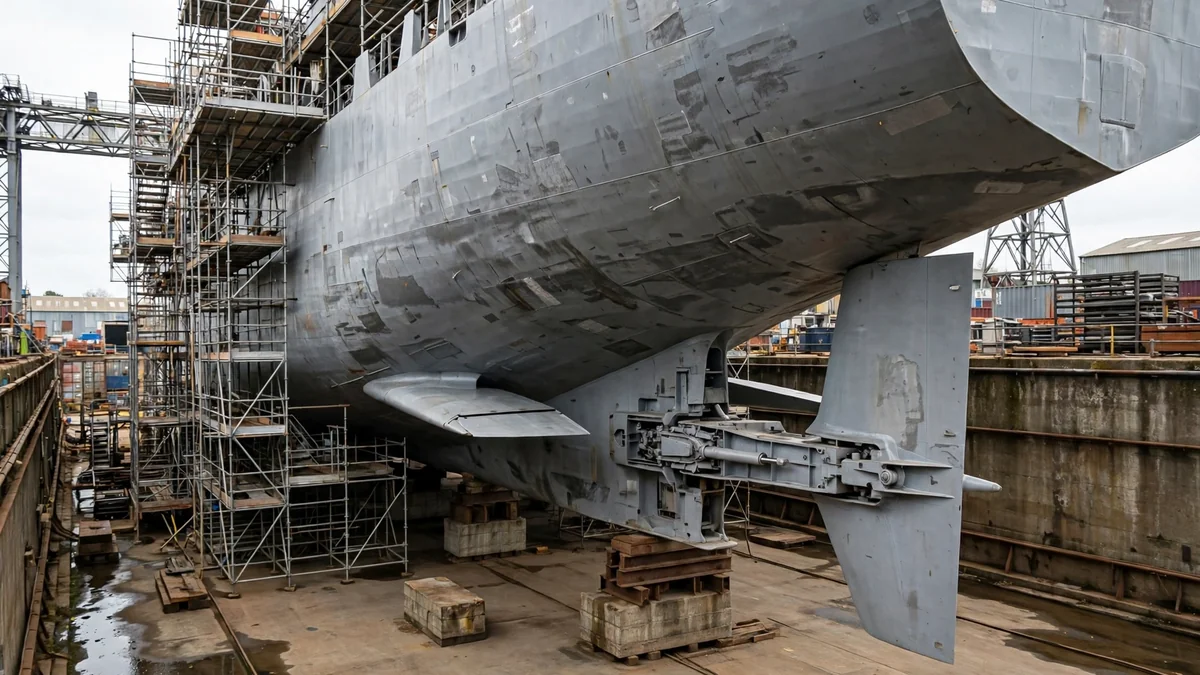
The most common stabilizer is the fin: a wing-shaped blade, typically a few square metres in area, mounted on each side of the hull near the turn of the bilge, just above the keel. As the ship rolls one way, the fins tilt the other, and the water flowing past them generates lift — just as an aeroplane wing generates lift in air. That lift pushes the hull back towards level. Because the fins work on lift, they need the ship to be moving; a ship at anchor gets almost nothing from them.
Step 3: Hydraulics do the heavy lifting
Moving a fin against the force of the sea takes enormous power, so the fins are driven by hydraulic rams — pistons fed by high-pressure oil pumps. A large fin can demand hundreds of kilowatts of hydraulic power, and the rams must swing the fin through its full range in about a second. The hydraulic plant is one of the hardest-working systems on the ship, and it is sized for the worst storm the ship is expected to meet, not the average day.
Step 4: Gyroscopic stabilizers for ships at rest
For ships that must stay steady while stopped — a yacht at anchor, a survey ship holding station — fin stabilizers are useless, because there is no water flowing past the fins. The answer is a gyroscopic stabilizer: a heavy flywheel spinning at thousands of revolutions per minute inside a vacuum housing. When the ship rolls, the gyroscope resists, and its precession — the slow turning of its axis — is harnessed to push the ship back level. Gyros are silent, need no water flow, and work at zero speed.
Step 5: Anti-roll tanks as a quiet alternative
Some ships fight roll with water itself. Anti-roll tanks are U-shaped tanks mounted high in the hull, partly filled with water that sloshes from side to side. Tuned to the ship’s natural roll period, the water arrives on the high side just as the ship starts to roll, and its weight pulls the ship back. Tanks have no moving parts and use almost no power, but they are slower than fins and take up valuable space. Many large ships carry both: tanks for gentle seas, fins for the rough ones.
Step 6: Retracting and protecting the fins
When the ship enters harbour or shallow water, the fins retract into recesses in the hull, flush with the plating, so they cannot strike the bottom or a quay. The fin housings are sealed against the sea, the hydraulic lines are protected, and the whole system is inspected in dry dock every few years. A fin that jams extended is a serious problem: it can be torn off by the seabed, and a torn fin leaves a hole in the hull. The same care applies to the yacht rudder, the other appendage that must survive contact with the sea. Retraction is not a convenience — it is a safety system.

Ship Stabilizer Specs
| Specification | Typical range |
|---|---|
| Fin area (per fin) | About 2 to 15 square metres |
| Number of fins | 2 (one per side); 4 on very large ships |
| Roll reduction | About 70 to 90 percent at cruising speed |
| Maximum fin angle | About 25 to 35 degrees each way |
| Fin slew rate | About 15 to 25 degrees per second |
| Hydraulic power | About 100 to 500 kW per fin pair |
| Effective speed range | About 8 knots and above for fin stabilizers |
| Gyroscopic stabilizer weight | About 1 to 10 tonnes depending on ship size |
| Anti-roll tank capacity | About 50 to 500 tonnes of water |
| Service life | About 20 to 30 years with regular overhaul |
What Does a Ship Stabilizer Cost?
A pair of retractable fin stabilizers for a large ship is estimated to cost roughly $500,000 to $5 million installed, depending on fin size and the hydraulic plant, while a gyroscopic stabilizer for a yacht or small ship is estimated to cost roughly $50,000 to $500,000. Anti-roll tanks are the cheapest option, since they are mostly steel and water, but they cost space that could otherwise earn money. Prices are estimates only and exclude dry-docking and installation time.
A Rare Fact
Fin stabilizers were first fitted to ships in the 1930s, and one of the earliest installations was on the Italian liner Conte di Savoia, which crossed the Atlantic with gyro-controlled fins that cut her rolling dramatically. The idea was so successful that within a decade, every major liner had them — yet the fins of the 1930s were driven by technology borrowed from torpedoes and gun turrets, and they were so unreliable that engineers joked a stabilizer was the one piece of equipment guaranteed to break down in the first storm it was needed for. Modern fins, with computer control and hydraulic power, are the descendants of that brave, temperamental experiment.
Next time you walk across a ship’s deck in rough weather without staggering, remember the wings below the waterline — tilting, pushing, and holding the ship level, hundreds of times an hour, without ever being seen.


