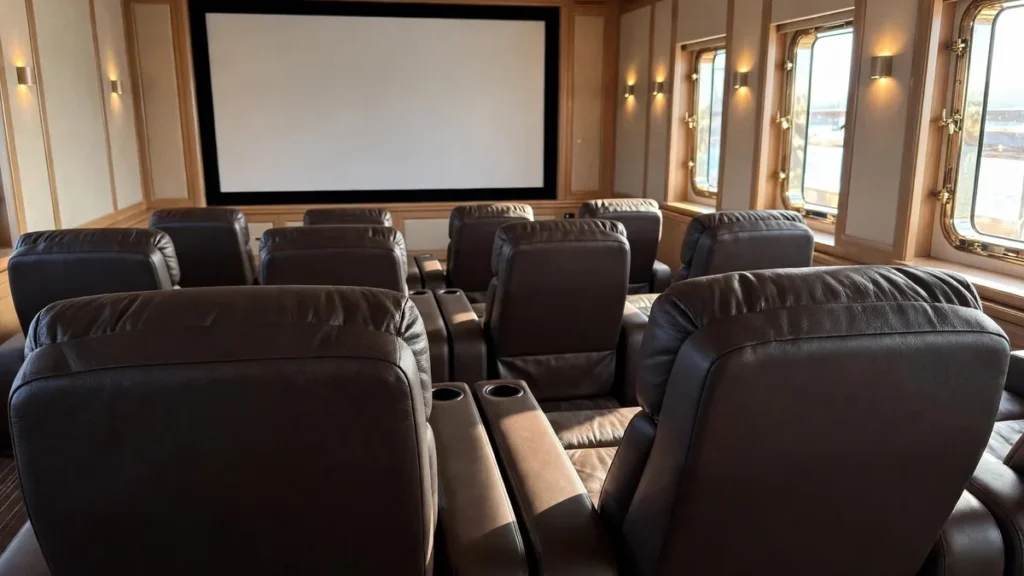
The lights went down, the screen glowed, and for two hours the yacht might as well have been a cinema in London. Nobody on board heard the engines, felt the swell, or noticed the air conditioning. That is the whole trick of a superyacht cinema room: it has to be a perfect little theatre, floating on a steel hull that rolls, hums, and breathes salt air. Building one is less like fitting out a room and more like building a sealed box inside a moving ship, where every wall, speaker, and seat is engineered to disappear.
A cinema room on a superyacht is a serious piece of engineering. It sits deep in the hull or on the lower deck, where the motion of the sea is smallest, and it is built as a room within a room, floated on rubber mounts so the vibration of the engines never reaches the audience. Get it right and guests forget they are at sea. Get it wrong and every swell becomes a reminder.

How a Superyacht Cinema Room Is Made
The build starts long before the yacht is launched, because the cinema room is designed into the vessel from the first drawings. It cannot be added as an afterthought; the space, the power, the cooling, and the soundproofing all have to be planned while the steel is still being cut.
Step 1: Choosing the space and designing the shell
Naval architects pick a spot low and near the middle of the yacht, where the rolling motion is gentlest and the hull is widest. The room is typically five to eight metres long, with a slightly raked floor so the back row can see over the front. Designers then draw a self-contained shell: a steel or aluminium box with its own walls, floor, and ceiling, separated from the yacht’s structure by a gap of a few centimetres.
Step 2: Soundproofing the room within a room
The shell is lined with layers of dense acoustic board, mineral wool, and resilient channels that stop sound travelling through solid material. The floor floats on rubber isolation pads, and the walls are built double, with a dead air space between the two skins. Doors are heavy, sealed with magnetic gaskets, and often double, so you pass through a small lobby before you reach the seats. The target is silence: when the room is finished, the noise of the engines and the sea should measure below the level of a quiet library.
Step 3: Installing the screen and projection
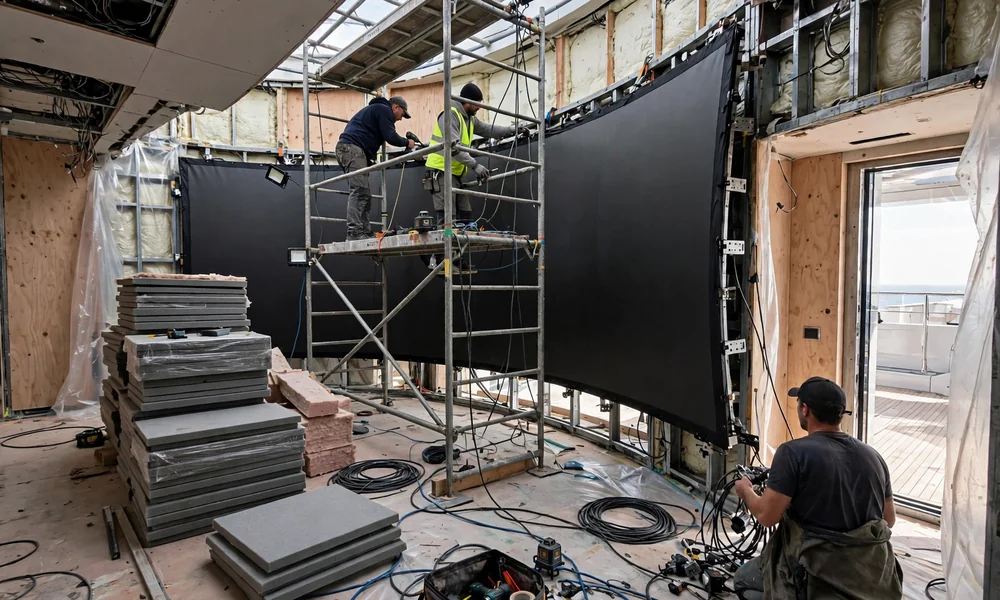
Most superyacht cinemas use a large projection screen, often three to five metres wide, with an acoustically transparent fabric that lets the centre speakers sit directly behind it. The projector is a laser unit, mounted in a separate ventilated booth behind the audience so its fan noise never reaches the seats. The screen is carefully curved and tensioned, because a wrinkle in the fabric shows up on every bright scene. Calibration comes later, but the geometry is fixed now, and a millimetre of error at this stage means a crooked picture forever.
Step 4: Fitting the sound system
A cinema needs speakers everywhere, and a yacht cinema is no different. The standard is a surround system with speakers hidden behind fabric panels in the walls and ceiling, plus subwoofers built into the floor or the front wall. Each speaker is aimed and mounted on its own isolated bracket, so it cannot rattle the panelling. The wiring is run in trunking behind the acoustic lining, and the amplifiers live in a cooled rack outside the room. When it is done, the sound should feel like it comes from the picture itself, not from a box on the wall.
Step 5: Seating, lighting, and interior finishing
Then the joiners take over. The seats are usually two or three rows of wide leather recliners, bolted to the floating floor and spaced so every seat has a clear view. The walls are finished in fabric-covered acoustic panels, the ceiling gets a starfield of tiny fibre-optic lights, and the woodwork is matched to the rest of the yacht. Lighting is all dimmable and hidden, so the room can go from bright to pitch black with one touch. The same craft that builds a superyacht beach club goes into this room, and how a superyacht beach club is built shows the level of joinery a yard is expected to deliver.
Step 6: Cooling, calibration, and sea trials
A room full of people, a laser projector, and a stack of amplifiers makes a lot of heat, and it has to go somewhere without making a sound. The cinema gets its own quiet air conditioning, with air delivered through large, slow ducts so there is no whistle or draught. How superyacht air conditioning is made explains the silent cooling that keeps the whole vessel comfortable. Finally, acoustic engineers calibrate the room with microphones and test tones, tuning every speaker to the exact shape of the space. The room is tested again at sea, because a cinema that sounds perfect in the shipyard can change once the yacht is rolling, and the engineers want to hear it both ways.
Superyacht Cinema Room Specs
| Specification | Typical figure |
|---|---|
| Room size | 5–8 m long, 4–6 m wide |
| Seating | 6–12 recliners in 2–3 rows |
| Screen | 3–5 m wide, laser projection |
| Sound | 7.1.4 surround, hidden speakers |
| Noise level | Below 25 dB with engines running |
| Cooling | Dedicated silent air conditioning |
| Lighting | Dimmable, fibre-optic star ceiling |
| Build time | 3–6 months of fitting |
The glass and glazing skills of a yacht yard matter here too. A cinema needs total darkness, so blackout blinds and sealed doors are as important as the projector, and how a superyacht observatory is made shows how the same yards handle glass, light, and precision in a very different room.
How Much Does a Superyacht Cinema Room Cost?
A superyacht cinema room typically costs an estimated $500,000–$2 million to build, depending on size, screen, sound system, and the level of interior finish. The projector and audio system alone can cost an estimated $150,000–$400,000, and the custom joinery, acoustic treatment, and seating make up most of the rest. On a yacht that costs tens of millions, the cinema is a modest line item, but owners judge it harshly, because it is the room they use most on a rainy evening at anchor.
Running costs are small: a few hundred dollars a year in lamps and filters, plus the electricity for the projector and cooling. The real cost is space. Every square metre given to a cinema is a square metre that cannot be a cabin or a gym, so the room has to earn its place by being used constantly.
A Rare Fact
Some of the largest superyachts carry a second, outdoor cinema on the sun deck, with a screen that rises from the deck and speakers hidden in the furniture. Guests watch films under the stars while the yacht is at anchor, and the crew has to wait for a calm night, because even a small swell makes a projected picture wobble. It is the only cinema in the world where the weather forecast decides what is showing.
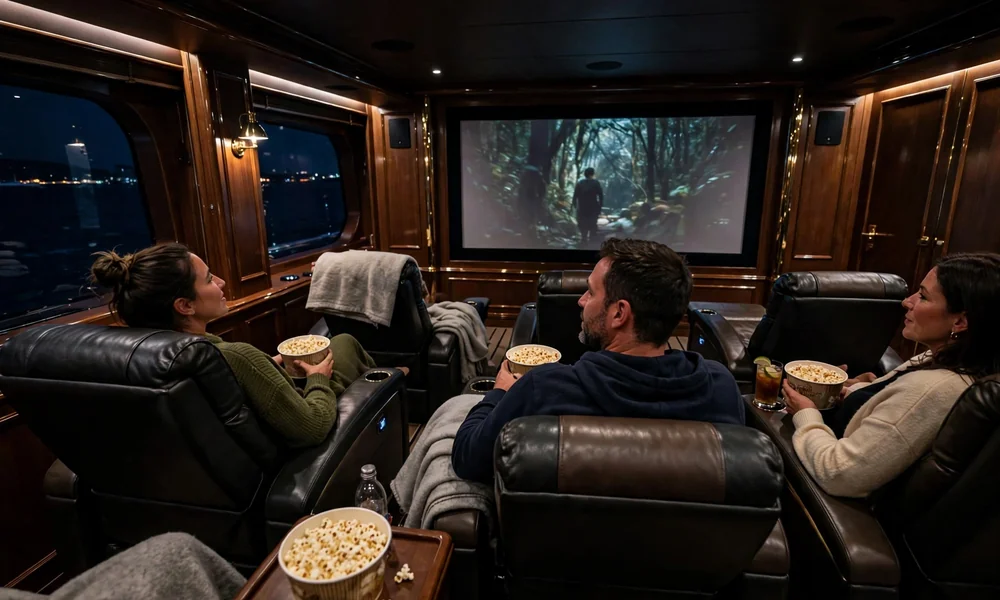
When the credits roll and the lights come up, the audience is back on a yacht, in the middle of the sea, with the engines a distant murmur below. The cinema room did its job by making them forget that for two hours. It is a room built like a recording studio, finished like a lounge, and hidden inside a ship, and the fact that it works at all is a small marvel of naval engineering.