On a still August afternoon in the Mediterranean, the air on a superyacht feels like a cool spring morning. Outside, the sun bakes the teak deck to a temperature that would burn bare feet, and the sea glitters white under a cloudless sky. Inside, guests in linen shirts sip cold drinks in a saloon held at a steady twenty-two degrees, the air dry, silent, and perfectly still. Nobody on board thinks about how that happens. That is the whole point of a superyacht air-conditioning system: it is the largest, hardest-working machine on the yacht, and it must be completely invisible.
A superyacht is not cooled the way a house is cooled. A house has a few rooms and a garden to dump its heat into. A superyacht is a steel box floating in warm seawater, packed with glass, engines, galleys, and people, and it must stay cool in the tropics while making almost no noise and using as little power as possible. The system that does it is a chilled-water plant, built in a shipyard, tested like a piece of marine engineering, and tuned cabin by cabin until the whole floating hotel breathes as one machine.
How It’s Made
Step 1: Calculating the heat load
Before a single pipe is cut, naval architects calculate how much heat the yacht must remove. Every cabin, window, light, galley appliance, and guest adds heat, and the sun pouring through a wall of saloon glass adds more than all of them. Engineers work out the cooling load for each space, often several hundred kilowatts for a large yacht, and size the chillers to match. The calculation also decides where the cold air will go: a sunlit owner’s suite needs far more cooling than a shaded crew cabin, so the system is drawn as a map of zones, each with its own target temperature.
Step 2: Building the chillers
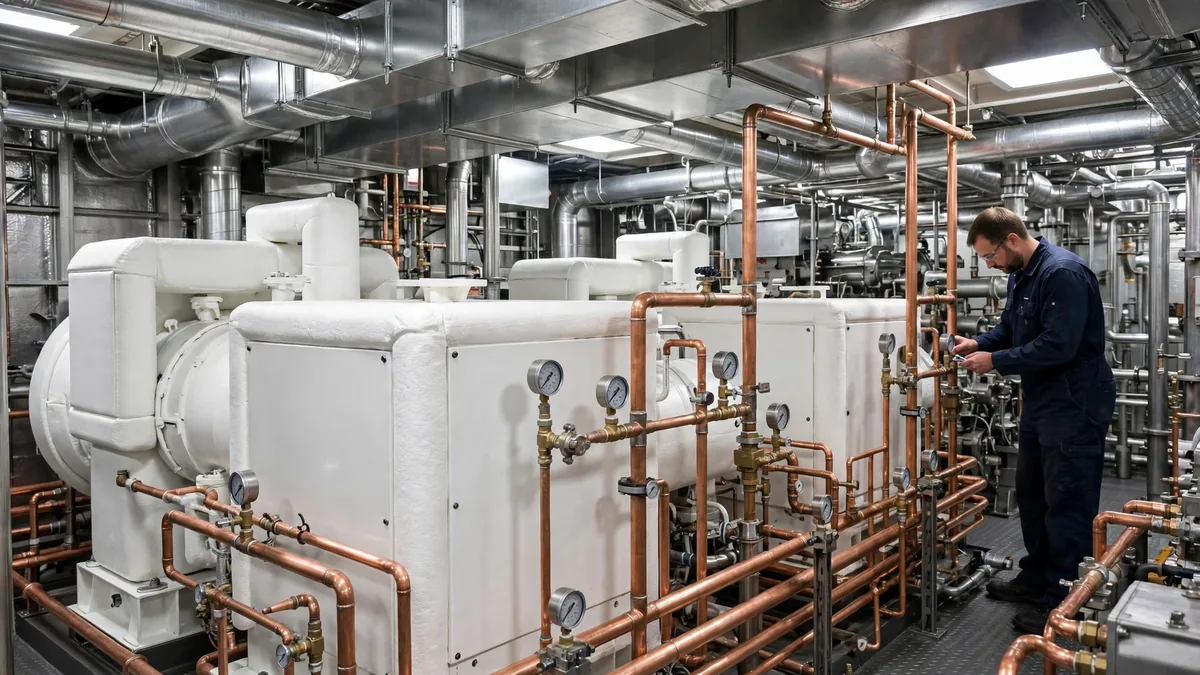
At the heart of the system sit the chillers, usually two or three large units in the engine room. Each chiller is a compressor, a condenser, and an evaporator in one steel cabinet, and it works by pumping a refrigerant around a closed loop, squeezing it hot and letting it expand cold. Seawater cools the condenser, carrying the yacht’s heat overboard through a heat exchanger, while the evaporator chills a loop of fresh water down to about seven degrees. The chillers are built on anti-vibration mounts and wrapped in acoustic insulation, because a chiller that hums through the deck at night has failed, however cold it makes the air.
Step 3: Running the chilled-water loop
From the chillers, insulated pipes carry the cold water through the yacht in a loop, up through the decks and along the corridors, with a pump keeping it moving at all times. The pipework is a quiet masterpiece of planning: it must reach every cabin without crossing a watertight bulkhead in the wrong place, and every joint must be welded or brazed to survive years of vibration at sea. Expansion joints absorb the movement of the hull in a seaway, and the pipes are lagged with thick insulation so the cold water does not sweat condensation onto the joinery. A leak here would drip into a guest cabin, so the loop is pressure-tested long before the interior goes in.
Step 4: Fitting the air handlers
In each zone, the chilled water flows through a fan-coil unit, a compact box hidden behind a panel or above a ceiling. A fan blows cabin air across the cold coil, cooling and drying it, then sends it back into the room through a slim slot or a discreet grille. The fan-coils are chosen for silence: a good one is quieter than a whisper, and the air moves so gently that curtains do not stir. Thermostats in each cabin let guests set their own temperature, and the system answers by speeding up or slowing down the fan and opening or closing a valve on the water flow, zone by zone.

Step 5: Ducting and balancing the air
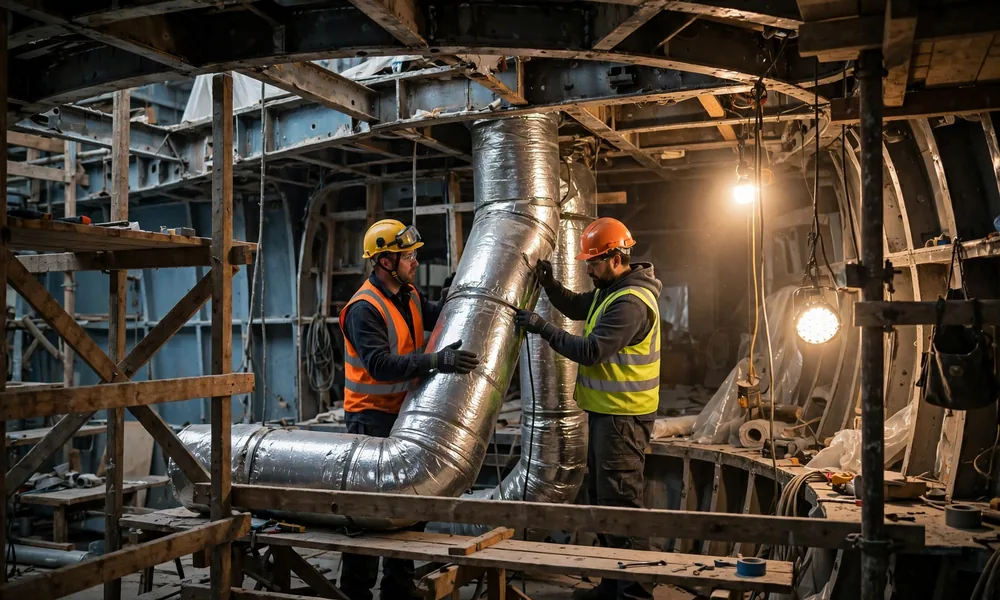
Where fan-coils are not enough, ductwork takes over. Large insulated ducts carry conditioned air from central air-handling units to the saloon, the dining room, and the beach club, with dampers that throttle each branch until the airflow matches the design. Balancing is slow, skilled work: a technician with an anemometer walks the yacht, measuring the air at every grille and adjusting dampers until no cabin is stuffy and no corridor is a wind tunnel. The same care that shapes a superyacht steel hull goes into this invisible plumbing, because a draught across a dining table is a defect, not a detail.
Step 6: Commissioning and sea trials
Finally, the whole system is commissioned. Engineers run it at full load in the yard, checking that every chiller starts, every pump holds pressure, and every cabin reaches its set temperature within minutes. Then the yacht goes to sea, and the real test begins: the system must hold its temperatures while the sun beats on one side of the hull and the engines run at full power. Refrigerant levels, seawater flow, and humidity are logged and tweaked until the yacht stays cool, dry, and silent in tropical heat. Only then is the air-conditioning signed off, a machine the owner will never see and the guests will never notice.
Specs
| Specification | Typical figure |
|---|---|
| System type | Chilled-water plant with fan-coil units |
| Cooling capacity | 200–600 kW for a 50–80 metre yacht |
| Chilled-water temperature | About 7°C supply, 12°C return |
| Chiller count | Two or three, for redundancy |
| Condenser cooling | Seawater through a heat exchanger |
| Cabin temperature | 21–23°C, individually controlled |
| Noise target | Below 35 dB in guest cabins |
| Build and commissioning time | Several months within the yacht build |
Price
A superyacht air-conditioning system is never sold on its own, but it is one of the most expensive systems aboard. As an estimate, the air-conditioning plant on a 50-metre superyacht typically costs roughly $500,000 to $1.5 million installed, with larger or more complex yachts running well beyond that — these are estimates, and the final figure depends on size, the number of zones, and the yard. Most of the money goes into the chillers and the thousands of metres of insulated pipe and ductwork, plus the long, skilled job of balancing every cabin by hand.
A Rare Fact
A superyacht’s air conditioning does more than cool the air: it protects the yacht itself. The system constantly dehumidifies, pulling moisture out of the sea air before it can condense on cold steel and start rust, or settle into the joinery and warp a million dollars of woodwork. On a yacht in the tropics, the air-conditioning is quietly running even when nobody is aboard, drying the ship from the inside out. Turn it off for a week in humid heat, and the yacht begins to sweat.
Cool, dry, and silent, the chilled-water plant is the yacht’s invisible heart, and it shares its engine-room home with the rest of the machinery described in superyacht engine-room engineering. The comfort it creates is finished by the craftsmen behind superyacht interior joinery, whose panels hide every grille and fan-coil from view. Cold air, it turns out, is one of the hardest things a shipyard builds.