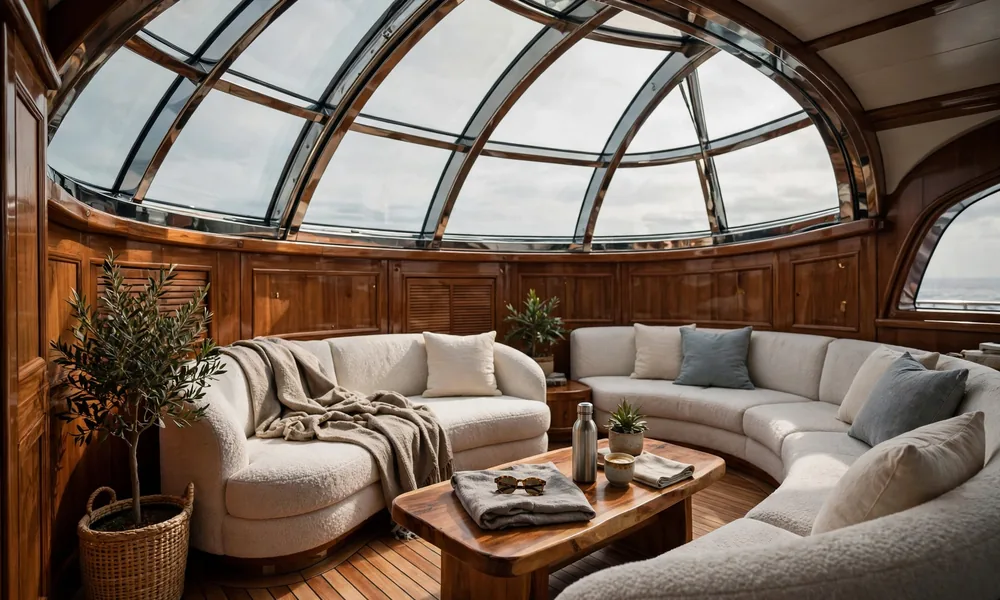
At the top of a superyacht, above the bridge and above the owner’s deck, there is sometimes a room that has no real job at all. It is not a cabin, not a lounge, and not a wheelhouse. It is a glass dome, a bubble of curved panels and polished wood, built to sit under the stars and watch the sea go by. The superyacht observatory is the most romantic room on the water, and also one of the hardest to build.
A dome of glass on top of a moving ship must survive storms, salt, sun, and the constant flexing of the hull beneath it, without leaking a single drop. The glass must be strong enough to take a wave over the bow, clear enough to see the horizon through, and curved to a shape that no flat sheet of glass can make. The frame that holds it must be light, stiff, and invisible from inside, and the room below must stay cool in the tropics and warm in the Arctic. This is how a superyacht observatory is produced.
Inside the Factory
Step 1: Designing the dome and its frame
Production begins long before any glass is cut, with the naval architects and the interior designers agreeing on the shape of the dome. The dome is usually a shallow curve, a segment of a sphere, because a sphere spreads loads evenly, but the exact curve is a compromise between the view from inside and the wind resistance from outside. The frame is drawn as a network of slim steel or aluminium ribs, each curved to match the dome, with joints where the glass panels will meet. Every rib is checked in a computer model for the loads it will carry: the weight of the glass, the wind at full speed, and the flexing of the hull in a seaway. Only when the model shows the frame holding its shape does the design go to the workshop.
Step 2: Bending and tempering the glass
The glass for an observatory is not ordinary window glass. Each panel is cut from laminated glass, two or more sheets bonded with a clear plastic layer, so that if one sheet breaks, the pieces stay stuck to the plastic. The panels are then bent to their curve in a furnace, heated until the glass softens and sags onto a mould of exactly the right shape. After bending, the panels are tempered, heated again and cooled rapidly with jets of air, which makes the glass several times stronger than it was. Each panel is inspected for distortion by looking through it at a grid, and any panel with a visible flaw is rejected and remade.

Step 3: Building the frame and fitting the glass
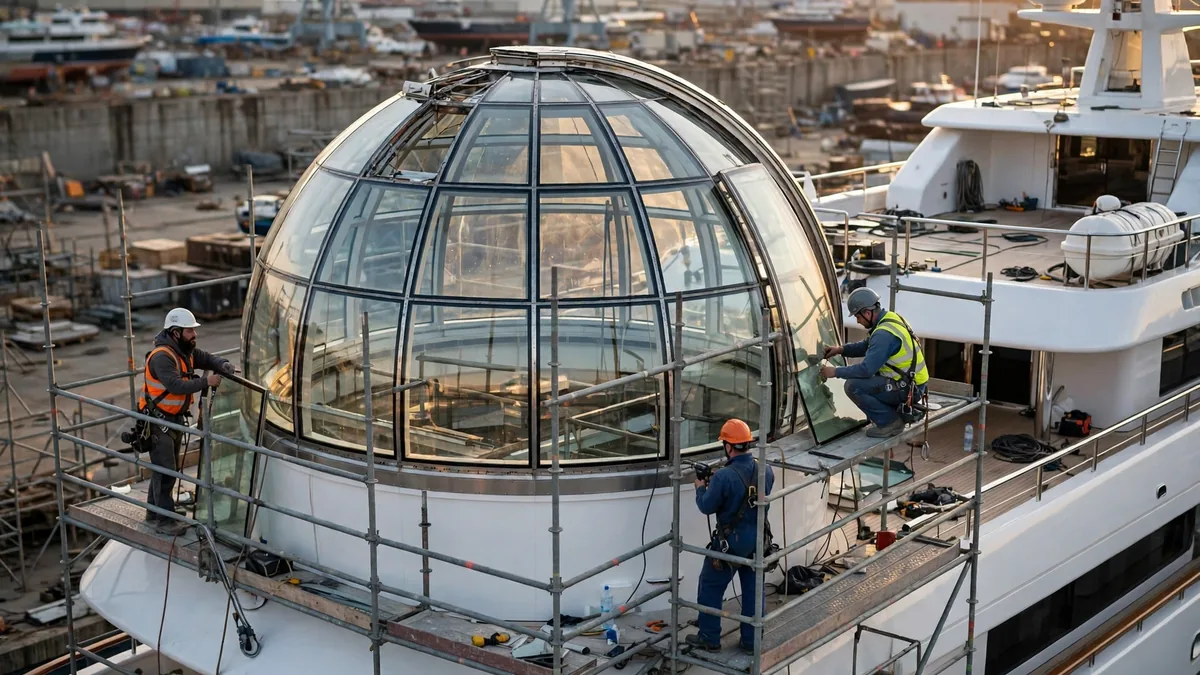
While the glass is being made, the frame is built in the shipyard’s metal shop, where the ribs are bent, welded, and machined, then clad in stainless steel so they will not corrode in salt air. The frame is assembled on the yacht’s top deck, levelled with lasers and bolted to the deck structure through reinforced pads. The panels are then lifted into place one at a time, using suction lifters and a small crane, and set into rubber gaskets. Each panel is clamped and bolted through its frame, and the joints are sealed with a marine-grade compound. The full story of how the room is built from steel to finished dome is told in how a superyacht observatory is made, and the fitting of the glass is the stage where a millimetre of error in the frame becomes a panel that will not sit.
Step 4: Sealing, glazing, and weather testing
Once the glass is in, the dome is tested as if it were already at sea. The seals are sprayed with high-pressure water from every angle, while an inspector inside watches for the smallest drip, and any leak is marked, dried, and resealed. The dome is then checked for wind noise, because a gap in a gasket will whistle at speed, and the ventilation is tested to make sure the glass does not fog on a cold night. The observatory must be as watertight as the hull and as quiet as a library, and both are proven before the yacht leaves the yard.
Step 5: Fitting out the room below
With the dome sealed, the room below it is fitted out. The floor is laid in teak or stone, the walls are panelled in polished wood or leather, and the seating is built in a curve that follows the dome. A telescope, if the owner has ordered one, is mounted on a pier that runs down through the deck to the hull, so it does not shake when someone walks across the room. Lighting is fitted in coves and under the seats, dim enough to protect night vision, and the star charts, bookshelves, and drinks cabinet are built in by the yard’s joiners.
Step 6: Final trials and handover
The last stage is the sea trial, where the observatory is tested in real conditions for the first time. The yacht is taken out in rough weather, and the crew check the dome for leaks, for flexing, and for noise, while the owner’s team sit inside and watch the horizon through the glass. Any rattle is traced and fixed, any seal that weeps is resealed, and the telescope is aligned and tested on a real star. Back in the yard, the glass is cleaned inside and out, the joinery is polished, and the room is handed over with its own manual. The observatory is then ready for its first night at anchor, under a sky full of stars.
Specs
| Specification | Typical figure |
|---|---|
| Glass type | Laminated and tempered, bent to curve |
| Dome shape | Shallow segment of a sphere |
| Frame material | Steel or aluminium ribs, stainless clad |
| Panel size | Roughly 1 to 2 metres across each panel |
| Weather testing | High-pressure water spray from every angle |
| Telescope mount | Pier through the deck to the hull structure |
| Interior finish | Teak, stone, polished wood, leather |
| Build time | Several months from design to handover |
Price
An observatory is never sold on its own, so its cost is estimated as a share of the yacht, which is estimated at roughly $50 million to $200 million for a large superyacht. The observatory itself, including the bent and tempered glass, the frame, the sealing, and the fitted interior, is estimated at roughly $1 million to $5 million, depending on the size of the dome and whether a telescope and its pier are included.
A Rare Fact
Some observatories are built with glass that can be heated, with a nearly invisible electrical layer inside the laminate that warms the panels on cold nights. The heating stops condensation from forming on the inside of the dome, so the stars stay clear even when the air outside is freezing.
An observatory is the quietest room on a superyacht, and the craft behind it is shared with how superyacht glass is made, while how a superyacht aluminium superstructure is made explains the structure the dome is bolted to. The next time you see a glass bubble glowing at the top of a yacht at anchor, remember the furnace, the gaskets, and the pier beneath it.