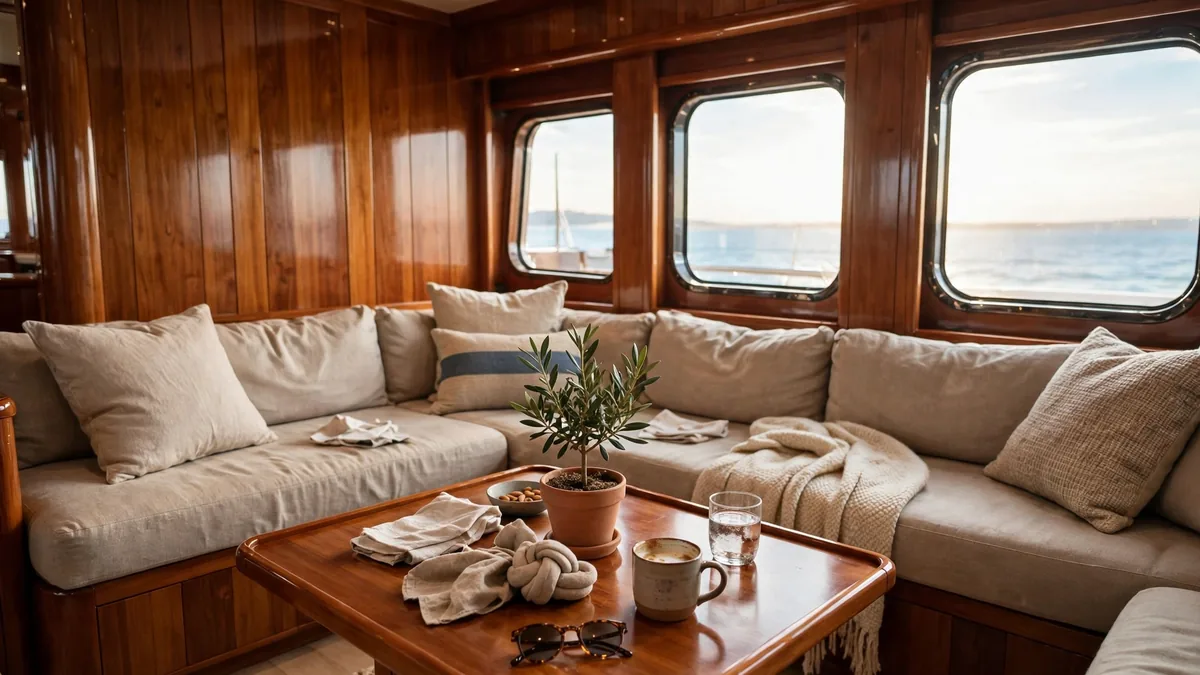
The superyacht is at anchor in a flat calm, and the owner walks through the main saloon in bare feet. There is no creak underfoot, no rattle from a panel, no line in the woodwork that is even a hair out of place. The walls curve gently, the ceiling flows into the bulkheads, and every drawer slides shut with the same soft sigh. It feels less like a boat and more like a penthouse that happens to float.
That silence and precision is the work of the joiners, the craftsmen who build a yacht’s interior from timber, veneer, and lacquer.
A single superyacht interior can take tens of thousands of hours to build, and the best joinery is the kind nobody notices, because nothing is ever wrong with it. Here is how it works.
How It Works
Step 1: Designing around the curve of the hull
No superyacht interior starts with a straight line. The hull curves in every direction, the decks camber, and the bulkheads lean, so the interior is designed in three dimensions from the start. Designers draw every cabin, corridor, and staircase on computer, and the joiners build full-size templates and mock-ups of the trickiest corners before a single board is cut. This planning is what separates yacht joinery from house joinery: nothing is assumed straight, and every piece is made for exactly one place on one boat.
Step 2: Choosing the timber
The wood is chosen as carefully as the design. Teak, walnut, oak, and eucalyptus are prized for their grain and stability, and the veneer for a single saloon is often sliced from one log, so the grain matches from panel to panel like pages in a book. The timber is dried slowly and kept at a controlled humidity for months, because wood that still holds moisture will shrink, crack, and pull its joints apart once it is installed at sea. Every board is inspected for knots, splits, and colour, and only the best pieces become visible surfaces. The rest is used for the hidden structure behind them, where strength matters more than beauty.
Step 3: Cutting, shaping, and veneering
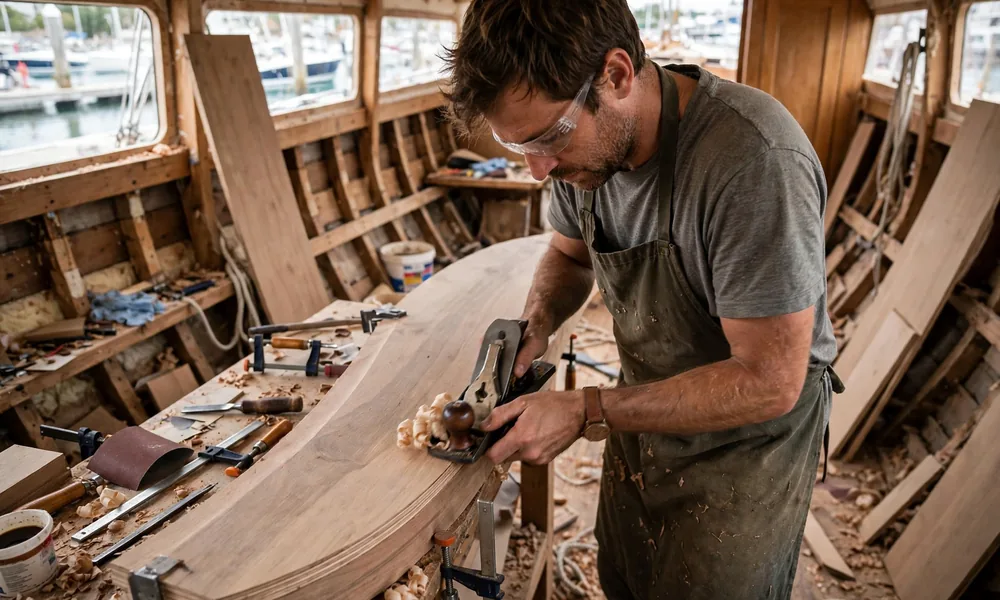
The panels are cut on computer-controlled machines that follow the designer’s drawings to a fraction of a millimetre, and then finished by hand. Curved panels are pressed in moulds, edges are shaped with planes and sanders, and veneer is glued onto a stable core board under pressure, so the thin face of precious wood is backed by a core that will not warp. The veneer must be laid with the grain running in the same direction across a whole room, a discipline called book-matching, where consecutive slices from the log are opened like a book so the pattern mirrors itself.
Step 4: The invisible engineering behind the beauty
Behind every polished surface is a structure built to move. The hull of a superyacht flexes in a seaway, so the joinery cannot be rigidly fixed to it, or it would crack and squeak. Panels are mounted on flexible fixings, joints are left with tiny gaps that open and close with the hull, and the cabinetry is built in sections that can shift a fraction of a millimetre without showing it. Fire rules shape the work too: the core boards, the glues, and the finishes must meet strict marine fire ratings, and hidden fire barriers sit behind the prettiest panels. The whole interior is an engineering system dressed as furniture, and its making is described in how superyacht interior joinery is made.
Step 5: Finishing to a mirror shine
Once fitted, the wood is finished with layer after layer of lacquer, each coat sanded back before the next is applied. A high-gloss superyacht finish can take a dozen coats, and the final surface is polished until it reflects like glass, deep enough to see the grain beneath as if it were under water. The finish is not only for looks. It seals the wood against humidity, salt air, and the spills of daily life at sea, and it is the layer that the crew will maintain for years with wax and careful cleaning.
Step 6: Installing aboard, and the silence test
The finished pieces are carried aboard and installed in sequence, from the largest panels to the smallest trims, and each one is adjusted by hand until it fits its place exactly. Then comes the silence test: the yacht goes to sea, and the joiners listen. A creak, a tick, or a buzz means a panel is touching something it should not, and the offending piece is taken out and refitted. The workshop that builds these interiors is shown in inside superyacht interior joinery production.
| Main materials | Teak, walnut, oak, and eucalyptus veneer on stable marine core boards |
| Veneer matching | Book-matched slices from a single log for a continuous grain |
| Tolerances | Fractions of a millimetre on visible joints and panel gaps |
| Finish | Up to a dozen coats of lacquer, sanded between coats, polished to gloss |
| Fire rating | Marine-rated cores, glues, and finishes throughout the interior |
| Mounting | Flexible fixings that let panels move with the flexing hull |
| Humidity control | Timber dried and stored at controlled humidity before and after fitting |
| Build time | Tens of thousands of hours for a large superyacht interior |
What Does Superyacht Interior Joinery Cost?
The joinery in a large superyacht is estimated at roughly $5 million to $20 million, depending on the size of the yacht and the extravagance of the materials, and it is estimated to be one of the largest single costs in the whole build. A single owner’s cabin can be estimated at several hundred thousand dollars in joinery alone, and rare veneers, hand-carved details, and mirror finishes push the price higher still. The cost is mostly time: thousands of hours of skilled handwork, much of it invisible once the yacht is finished. Owners pay it because the interior is where they live, and because the difference between good joinery and great joinery is something they feel every day, in the silence and the fit.
A Rare Fact
The finest yacht joinery is built to be taken apart. Every panel is designed so the crew can remove it without damage, because behind the wood sit the pipes, cables, and air conditioning that keep the yacht alive, and engineers need to reach them. The panels are held by hidden clips and secret fixings, and a trained crew member knows exactly where to press and lift. It is a strange discipline: build something to look permanent, and engineer it to come apart in minutes. The teak decks outside the saloon are built to a similar standard of quiet perfection, as how yacht teak deck works explains.

A superyacht interior is a piece of furniture the size of a house, built to survive the sea and to stay silent while it does so. The joiners who build it are part cabinetmaker, part engineer, and part musician, tuning wood and lacquer until the whole room holds still. When it is done well, nobody notices the joinery at all, and that is the highest compliment the craft can receive. The work is invisible, the silence is the proof, and the yacht feels less like a machine than like a home.