Step into the main salon of a superyacht and the first thing you notice is not the size of the room, or the view through the windows, or even the furniture. It is the wood. Walls of walnut so dark they look almost black, curved panels that flow around corners without a single visible join, a dining table whose grain runs like a river across its whole length. Nothing in the room is flat, nothing is square, and nothing was bought off a shelf. Every panel was cut, shaped, and polished by hand in a joinery workshop — a place that is part factory, part furniture studio, and part art school.
Superyacht joinery is the most labour-intensive craft on the boat. A single yacht can carry more than a thousand square metres of wood panelling, and the best workshops spend months on one interior, with dozens of craftsmen working on a single room. The wood itself is extraordinary: rare veneers, some costing thousands of dollars per square metre, matched grain to grain so that two panels side by side look like one tree. The work is slow, quiet, and exact — and a mistake made in the workshop can be impossible to fix once the yacht is at sea.
This is a look inside the joinery shop, and how a pile of timber becomes a floating palace.
How Superyacht Interior Joinery Is Made
Step 1: Choosing and matching the veneer
Everything starts with the veneer — sheets of wood sliced as thin as paper from a single log. The workshop buys whole logs or matched veneer packs, so that every panel in a room comes from the same tree and the grain flows continuously from one panel to the next. The most prized veneers are walnut, teak, ebony, and rare burls, whose swirling grain looks almost like marble. The veneer is laid out on a table and arranged by hand, book-matched — folded open like a book so the grain mirrors itself — until the pattern is perfect. Only then is it cut.
Step 2: Building the panels
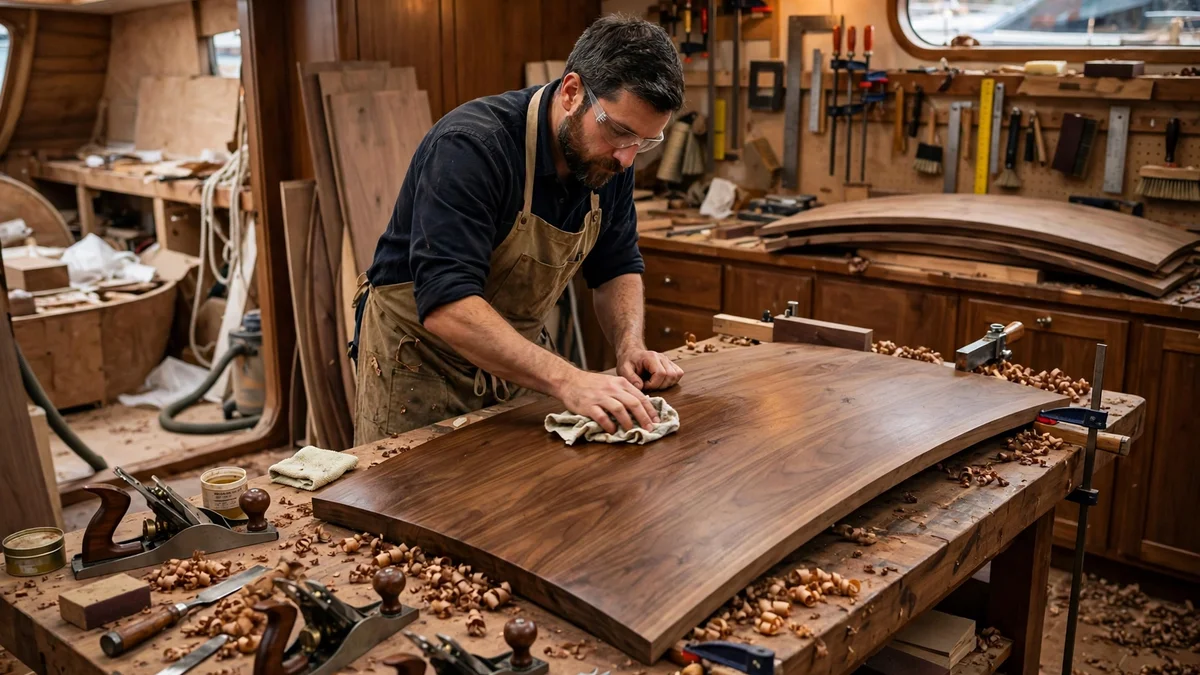
Each veneer sheet is glued onto a lightweight core, usually a marine plywood or a honeycomb panel, using a vacuum press that squeezes out every air bubble. The result is a panel that looks like solid wood but weighs a fraction as much — weight matters enormously on a yacht. The panels are then trimmed on computer-controlled saws, but the final shaping is done by hand: edges are planed, corners are rounded, and curves are sanded until they feel seamless to the touch.
Step 3: Shaping curves and furniture
Almost nothing in a superyacht interior is a straight line. Walls curve, ceilings sweep, and furniture is built to fit the hull’s shape. Craftsmen bend thin layers of wood around moulds, gluing them layer by layer until the curve holds its shape — a technique called cold moulding. Tables, cabinets, and bed frames are built the same way, with hidden joints and drawers that must open smoothly even when the yacht is rolling in a swell. Every piece is dry-fitted in the workshop before it ever goes near the boat.
Step 4: Inlay, marquetry, and detailing
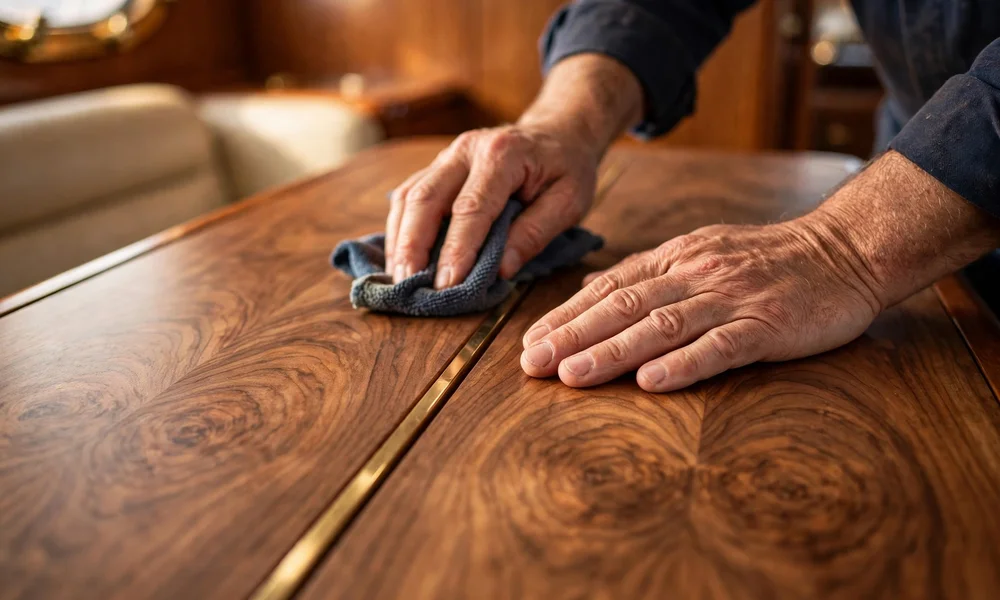
The details are what separate a good interior from a great one. Thin strips of brass, mother-of-pearl, or contrasting wood are inlaid into panels to make borders and patterns, cut with fine saws and set by hand. Some yachts carry marquetry pictures — entire scenes made from hundreds of tiny pieces of coloured wood, fitted together like a jigsaw. Door handles, hinges, and catches are made from polished brass or stainless steel, and they are fitted so precisely that a door closes with a soft click and no rattle, even in rough seas.
Step 5: Finishing — the part you can feel
Finishing is the longest step of all. Each panel is sanded through progressively finer grits, sealed, then coated with multiple layers of lacquer, sanded between every coat. A high-gloss finish can take ten or more coats, each one left to cure before the next. The aim is a surface so smooth and deep that it looks like glass, and so tough that it can survive salt air, sunlight, and years of use. The final polish is done by hand with soft cloths, and the craftsman checks the surface by touch as much as by sight — a good finish feels cool and perfectly flat.
Step 6: Trial assembly and installation
Before the yacht is finished, the whole interior is trial-assembled in the workshop or in a mock-up of the hull, room by room, so every panel, door, and piece of furniture can be checked for fit. Then it is taken apart, labelled piece by piece, carried aboard, and reassembled inside the hull — often through hatches barely wider than the panels themselves. The final fitting is done on board, where the joiners work alongside electricians and plumbers, adjusting panels to fit around wiring and pipes. A single interior can take a team of joiners several months to install.
Superyacht Interior Joinery Specs
| Specification | Typical range |
|---|---|
| Veneer thickness | About 0.6 millimetres |
| Panel core | Marine plywood or honeycomb, 12 to 25 mm |
| Wood per yacht | About 1,000 to 2,000 square metres of panelling |
| Lacquer coats | About 6 to 10, high-gloss finishes |
| Craftsmen per interior | About 20 to 60 joiners |
| Build time, one interior | About 6 to 18 months |
| Common veneers | Walnut, teak, ebony, burr wood |
| Fire standard | Marine-rated, low smoke and flame spread |
What Does Superyacht Joinery Cost?
Joinery is one of the biggest single costs in a superyacht interior. The interior of a 50-metre superyacht is estimated to cost roughly $10 million to $25 million in total, with the joinery alone often accounting for a large share of that figure; rare veneers can cost thousands of dollars per square metre, and the labour runs to tens of thousands of hours. Prices are estimates only and vary enormously by yacht size, materials, and the yard. The hull it all sits inside is a story of its own, told in how a superyacht steel hull is made, and the craftsmanship continues on deck in how a yacht teak deck is made — teak laid one plank at a time. For the structure that holds the whole vessel together, see superyacht hull construction.
A Rare Fact
The world’s most famous yacht interiors hide a secret: many of them are not solid wood at all. The panels that look like massive slabs of walnut are often a paper-thin veneer over a honeycomb core, because solid wood of that size would weigh tonnes and would crack as it dried. The trick is so good that even experts cannot tell by looking — the grain, the colour, and the depth are all real wood, just a fraction of a millimetre thick. And the rarest veneers come from trees that no longer exist in commercial quantities: some of the most sought-after burr walnut is cut from stumps and roots of trees felled a century ago, so every sheet used today is, in a real sense, irreplaceable.
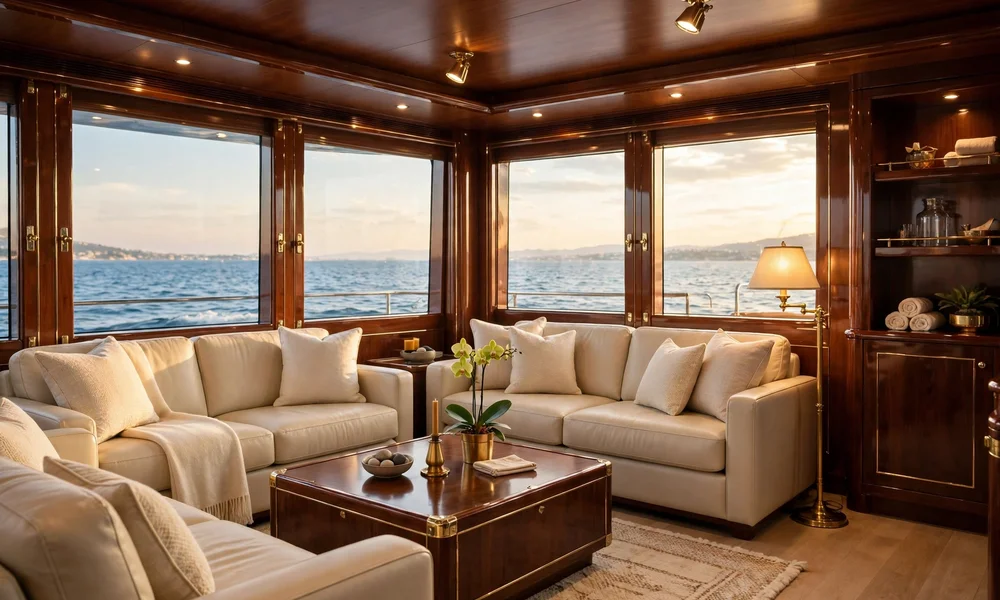
A superyacht interior is the opposite of everything modern manufacturing is supposed to be: slow, manual, and built from a material that changes with the weather. But that is exactly why it works. The wood is alive in a way that plastic and metal never are, and the joiners who shape it are doing something no machine can do — making a room that feels warm, quiet, and human, in the middle of the sea.


