Step aboard a superyacht and the first thing you notice is not the size of it, but the silence of the wood. The walls are seamless, the doors close with a soft click, and the grain of the walnut flows around a corner as if the tree grew in the shape of the room. There is not a visible screw, not a gap, not a joint you can find with your fingertip. It looks less like a boat and more like a fine hotel that happens to float.
That finish is the work of joiners, craftspeople who spend months building the interior of a yacht in a workshop on land, panel by panel, then carry it aboard in pieces and fit it into a steel or aluminium hull that flexes, vibrates, and moves with the sea. Their work has to be beautiful enough for a billionaire and tough enough for a storm.
This is how superyacht interior joinery is made.

How It’s Made
Step 1: Choosing the timber
Joinery starts in a timber yard, where the wood is chosen board by board. Walnut, teak, oak, and rare veneers are selected for grain, colour, and figure, and boards from the same tree are kept together so the grain matches across a whole room. The timber is dried slowly, sometimes for months, until its moisture content is low and stable; wood that is fitted while still damp will shrink at sea and open gaps in the panelling. Each board is marked with its place in the room it will become, and the most beautiful pieces are saved for the places the owner’s eye will fall first.
Step 2: Cutting veneers and matching the grain
Most of what you see aboard a superyacht is veneer, a slice of fine wood less than a millimetre thick, glued to a stable core board. The veneers are cut on a slicer, laid out on a table, and matched by hand: book-matching, where two slices are opened like a book so the grain mirrors itself, is the classic technique, and it turns a plain wall into a symmetrical pattern. The matched veneers are taped together, pressed onto their core, and trimmed.
Step 3: Building the panels and furniture
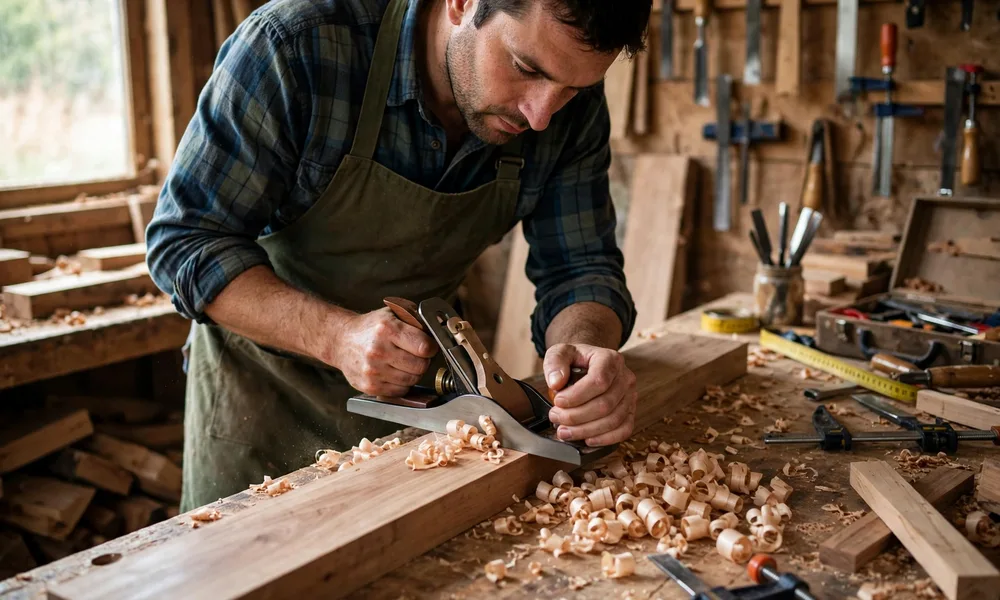
With veneers ready, the joiners build the room itself: wall panels, ceilings, doors, cabinets, tables, and beds, all made in the workshop on full-size jigs that copy the curve of the hull. The panels are built up in layers for strength, edged with solid wood, and fitted with hidden fixings so no screw ever shows. Doors are hung and adjusted on the jig, drawers are fitted until they slide silently, and every edge is rounded and polished by hand. The furniture is built to be taken apart, because it must fit through a hatch and be reassembled inside the hull. The hull that all of this fits into is itself a major build, described in how superyacht steel hull is made.
Step 4: Finishing, polishing, and lacquering
The finish is what makes superyacht joinery different from ordinary woodwork. Each piece is sanded through finer and finer grades, sealed, and lacquered in a dust-free spray booth, often with ten or more coats, each one sanded back before the next. The result is a deep, mirror-like gloss that shows the grain as if it were under glass. Some owners ask for a matt oil finish instead, which is rubbed in by hand and feels like bare wood. Either way, the finish must survive salt air, spilled drinks, and years of sun through the windows, so test pieces are left in the sun and soaked in salt water before the finish is approved.
Step 5: Fitting out aboard the yacht
When the hull is ready, the finished joinery is carried aboard, piece by piece, and installed by the same joiners who built it. The panels are fixed to the hull on flexible mounts that let the steel move without cracking the wood, and the gaps between panels are scribed by hand to follow the hull’s curves. Doors are re-hung, drawers are re-fitted, and the whole interior is adjusted until it is silent: no rattles, no creaks, no doors that swing with the roll of the ship. The factory that builds this joinery, from timber yard to finished room, is described in inside superyacht interior joinery production. Fitting out can take months, and the joiners are often the last tradespeople aboard before the yacht is handed over.
Step 6: The final polish and the sea trial
Before handover, every surface is inspected in raking light, which shows every scratch, every dust speck in the lacquer, and every joint that is not perfectly flush. Faults are polished out or re-lacquered, and the whole interior is cleaned and polished by hand. Then the yacht goes to sea, and the joinery is tested the only way that matters: at speed, in a swell, with the engines running. Anything that rattles or moves is fixed. The teak decks outside get a similar level of care, as how yacht teak deck is made shows. Only when the interior is silent at sea is the yacht signed off.
| Main material | Matched veneers of walnut, teak, and oak on stable core boards |
| Veneer thickness | Often less than a millimetre, sliced and book-matched by hand |
| Finish | Ten or more coats of lacquer, or hand-rubbed oil |
| Fixing | Hidden fixings on flexible mounts that let the hull move |
| Drying | Timber dried for months to a low, stable moisture content |
| Workshop build | Full-size jigs copying the curve of the hull |
| Manufacturing time | Many months from timber selection to final fit-out aboard |
| Testing | Raking light inspection and a sea trial at speed in a swell |
What Does Superyacht Interior Joinery Cost?
The interior joinery of a large superyacht is estimated at roughly $5 million to $20 million, and on the biggest yachts it is estimated at far more. The price reflects the rare timber, the months of hand work, and the fact that every panel is bespoke. A single matched-veneer wall can cost tens of thousands of dollars, and a dining table in rare burl wood can cost as much as a house. Owners pay for the silence, the seamless grain, and the knowledge that no other room in the world looks quite like theirs.
A Rare Fact
Superyacht joiners keep a secret store of timber aboard the yacht itself. Spare veneer from the same trees used in the interior is stowed in a locker, so that if a panel is ever damaged, it can be repaired with wood that matches the grain and the age of the rest of the room. Without that store, a repair would stand out forever, because new wood from a different tree will never match. Some yachts carry enough spare veneer to rebuild a whole cabin, and it is one of the most valuable cargoes aboard.
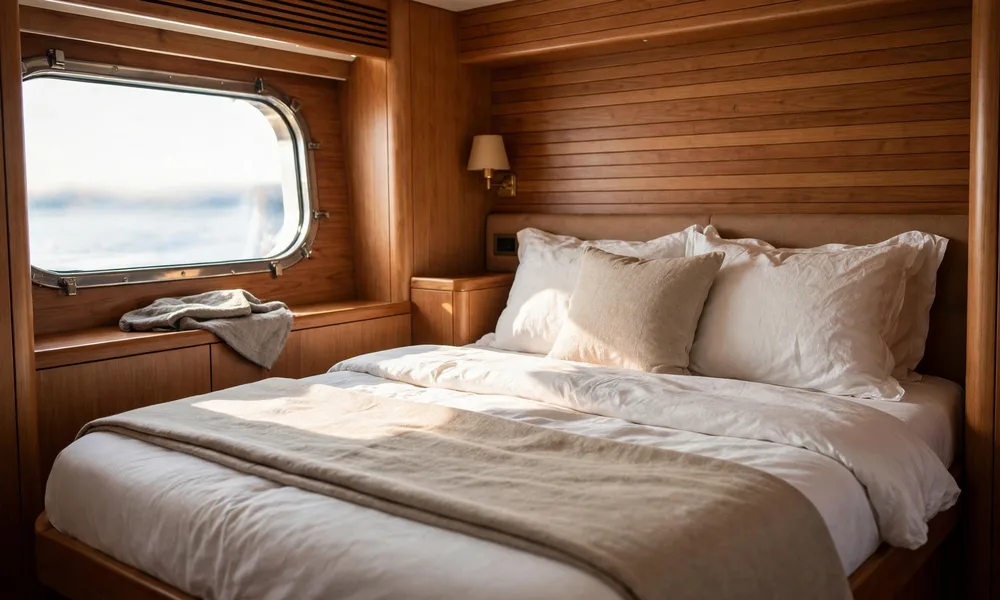
Long after the engines are forgotten, it is the joinery that a guest remembers. The way a door closes, the way the grain runs around a corner, the silence of a room at sea. It is wood, cut and fitted by hand, polished until it shines like glass, and built to survive the ocean. A superyacht is a machine, but its interior is a craft, and it is made one panel at a time.