From the dock, a superyacht looks like a floating hotel, all glass and white paint and teak decks. Under the waterline, though, it is a steel machine, a hull of welded plates that has to carry hundreds of tonnes of luxury through storms, groundings and decades of salt water. The steel hull is the part nobody photographs and the part everything else depends on. It is not just a shell; it is a structure, a tank, a foundation and a shield, all welded into one.

How a Superyacht Steel Hull Works
A steel hull works by turning a thin skin into a rigid structure. On its own, a steel plate a centimetre thick would buckle under the weight of the yacht, but welded to a skeleton of frames, girders and bulkheads, it becomes a box girder, a hollow beam stronger than the sum of its parts. The hull carries the engines, the fuel, the water, the crew and the guests, it keeps the sea out, and it gives the yacht its shape, its stability and its motion through the water. Every plate, weld and frame is part of that one job.
Step 1: The design sets the shape in the computer
Before any steel is cut, naval architects model the hull in a computer, testing its shape against waves, speed and stability. The hull form decides everything: how the yacht rides in a swell, how much fuel it burns, how it turns, and how much space there is inside. The design also places the centre of gravity low, so the yacht rights itself after a roll, and the computer checks all of it before a single plate is ordered.
Step 2: Plates are cut and shaped
Steel plates arrive at the yard in standard sizes, usually marine-grade steel with a low carbon content for weldability, and are cut by plasma or laser to the shape of each hull section. Curved sections are rolled or pressed into shape, sometimes over a wooden or steel former, until they match the design within millimetres. The plates for the bottom are thicker, often 10 to 12 millimetres, because they take the knocks, while the topsides can be 8 millimetres or less. Each plate is marked, numbered and tracked, so the yard knows exactly where it belongs. The hull of a container ship is built the same way at a much larger scale, plates and frames repeated hundreds of times down a hull three football fields long.
Step 3: Frames and bulkheads build the skeleton
The skeleton comes next. Transverse frames, curved ribs spaced about half a metre apart, run from keel to deck, and longitudinal girders run fore and aft, crossing them like the stringers in a wooden boat. Watertight bulkheads divide the hull into compartments, so a leak or a grounding in one section does not flood the whole yacht. Welders fit these pieces together on a building berth, checking the shape with lasers as they go.
Step 4: Welding joins the plates into a skin
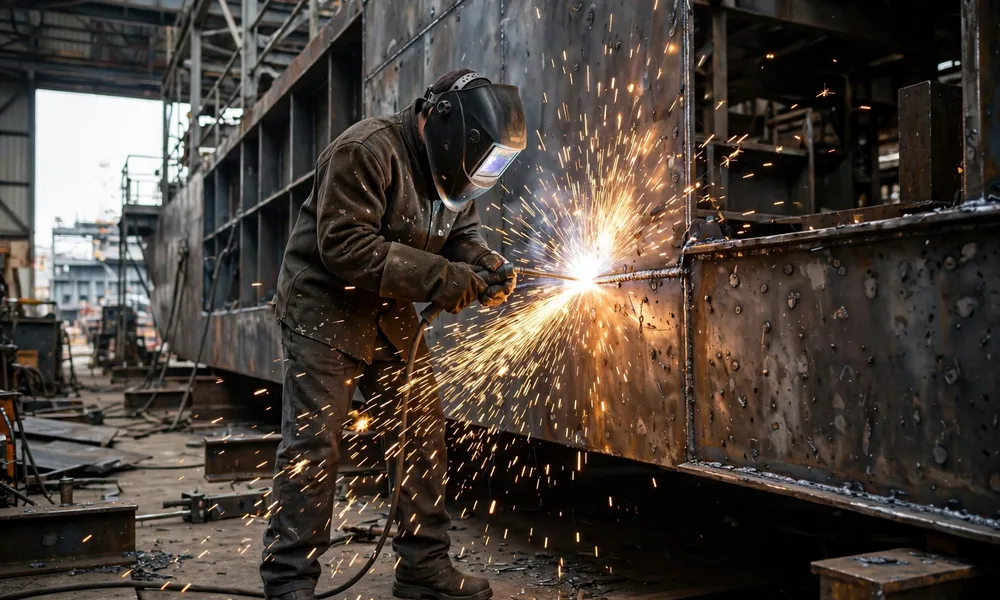
Welding is where the hull becomes one piece. The plates are tacked in place, then welded with submerged arc or flux-cored wire, in passes that melt the edges together into a joint as strong as the plate itself. A superyacht hull can contain kilometres of weld, and every metre is inspected, often with ultrasound or X-rays on the critical joints, because a bad weld under the waterline is a leak waiting to happen. The carbon mast of a sailing yacht shows the opposite approach to the same problem, a structure built from fibres rather than welds, but the goal is identical: stiffness without weight.
Step 5: Coating and cathodic protection fight rust
Steel rusts in salt water, so the hull is protected twice over. First it is blasted clean and painted with epoxy primers and antifouling paint, a coating that stops marine growth sticking to the bottom and slowing the yacht. Then sacrificial zinc anodes are bolted to the hull below the waterline. These lumps of zinc corrode instead of the steel, because zinc gives up its electrons more readily, and they are replaced at every haul-out.
Step 6: Tanks, engines and systems fill the hull
Once the shell is watertight, the hull is filled. Fuel tanks, water tanks and holding tanks are built into the double bottom, the space between the outer skin and an inner floor, where they also add strength. The engine room sits low and amidships, its engines bolted to girders that spread their weight and vibration into the hull, and the shafts run aft through sealed stern tubes to the propellers. The paint system of a superyacht is the final layer over all of this, the mirror finish that hides a working steel ship underneath.

Step 7: Launch, test and survey keep it honest
The finished hull is launched, usually sideways down a slipway or lifted by a travel lift, and then it is tested. A stability test measures how the yacht rolls and rights itself, sea trials check speed, noise and vibration, and surveyors inspect the hull for defects before the yacht is handed over. A well-kept steel hull can last fifty years or more, outliving several generations of interior fashion above it.
| Specification | Typical value |
|---|---|
| Hull material | Marine-grade mild steel, low carbon |
| Bottom plate thickness | 10 to 12 millimetres |
| Topsides plate thickness | 8 to 10 millimetres |
| Frame spacing | About 500 to 600 millimetres |
| Typical yacht length | 50 to 80 metres for a steel superyacht |
| Hull weight | Several hundred tonnes of steel |
| Service life | 40 to 50 years with proper maintenance |
Price is measured in steel and hours rather than a catalogue figure. Estimates put the hull steel and construction for a 60-metre superyacht at roughly 8 to 15 million US dollars, a substantial share of a total build cost that can run to 50 million or more. The steel itself is only a small part of that; the cost is in the cutting, fitting, welding and fairing, thousands of skilled hours in the yard. Those are estimates, not quotes, and they vary with the yard, the design and the market, but they explain why steel yachts are built by a handful of specialist yards in the Netherlands, Germany and Italy.
A rare fact: a steel superyacht hull is magnetic enough to disturb a compass, and it can also hide a surprise. The welding process leaves the hull with a permanent magnetic field, so the yacht’s compasses are compensated and the navigation systems are calibrated to ignore it. Some yards even demagnetise the hull after construction, running a coil around it to wipe the field clean.
The steel hull works because it does the quiet, heavy jobs and never asks for praise. It carries the weight, keeps the sea out, and gives the yacht its strength and its shape, while the glass and teak above it get all the attention. That is the honest division of labour on a superyacht: beauty lives on deck, and the steel below the waterline makes the beauty possible. A hull that is built well is forgotten, and being forgotten is exactly what it is for.


