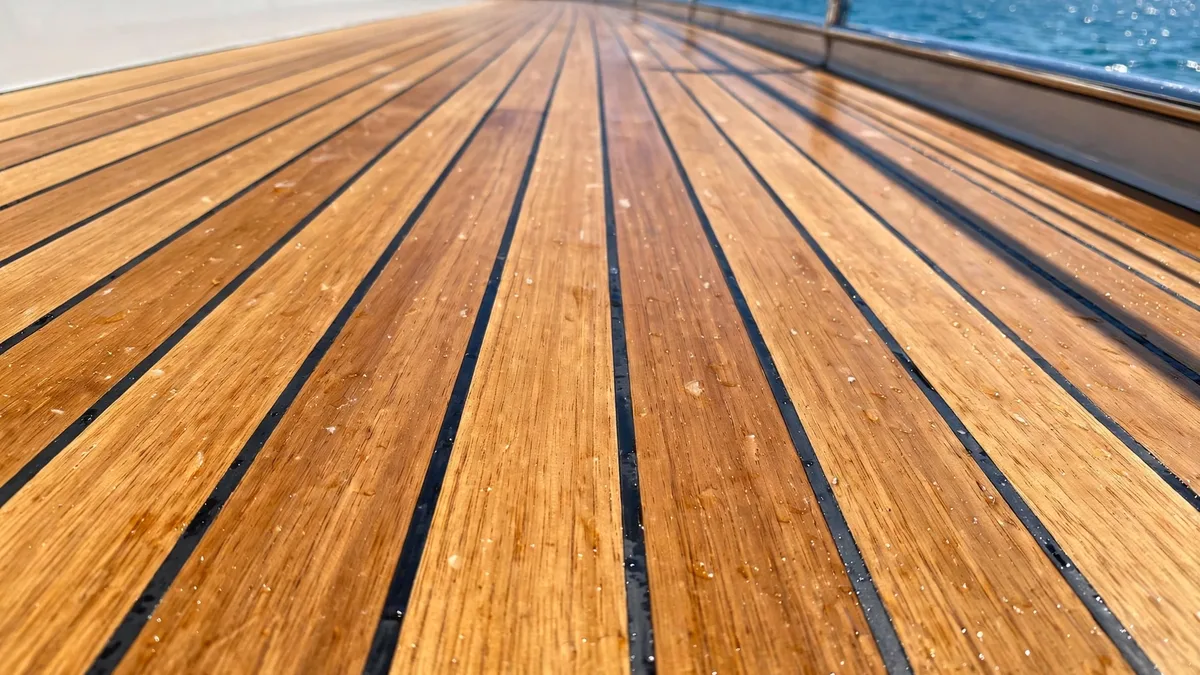
Walk the dock at a superyacht marina on a summer morning and you will notice it before anything else: the warm, honey-coloured deck underfoot, the planks running in long straight lines, the dark seams between them as neat as ruled ink. It looks simple, almost rustic, like a wooden floor that happens to float. Then you hear the price, and the simplicity falls apart. A teak deck can cost as much as a small house to lay, and replacing one can swallow the budget of a whole refit.
That shock is understandable, because a teak deck looks like timber and little else. What you are actually paying for is a rare tropical hardwood that takes most of a human lifetime to grow, a supply chain that is tightly controlled, and weeks of slow, skilled handwork in a boatyard, all of it held to a standard where a single badly laid plank can let seawater into the boat. The deck is the most walked-on, most weather-beaten surface on a yacht, and it has to survive sun, salt, bare feet and storms for decades. This is why it costs so much.
Why It Costs So Much
Reason 1: The tree itself is slow and scarce
Real deck teak is Tectona grandis, a hardwood that grows mainly in Southeast Asia and needs sixty to eighty years to reach the size and density a yacht deck demands. You cannot hurry a tree, and you cannot fake its properties with a faster-growing timber. Old-growth teak from Myanmar, the traditional source, has been restricted by export bans and conservation rules for years, which has pushed legal supplies tighter and prices higher. The way that timber is prepared before it ever reaches a boat is part of the story told in how a yacht teak deck is made, where the cutting, drying and grading set the tone for everything that follows.
Reason 2: Only a fraction of each log becomes decking
A teak log does not turn into deck planks in a tidy way. The heartwood, the dense, oily, golden-brown core of the tree, is the only part good enough for a deck, while the paler sapwood around it is softer, less durable and prone to rot. Sawing a log into thin, straight-grained planks wastes a great deal of wood, because planks must be cut to follow the grain, knots and defects are cut out, and the boards are then planed and dried until they are stable.
Reason 3: The laying is slow, skilled handwork
Laying a teak deck is not a job for a machine. Each plank is cut to follow the curve of the deck, fitted against its neighbours by hand, glued down with marine adhesive, and then caulked with a flexible black seam compound that must be pressed in, tooled flat and left to cure. The people doing this work are specialists, trained over years, and there are not many of them.
Reason 4: It must survive the sea, not just look good
A teak deck is a working surface, not a piece of furniture. It is walked on barefoot, dragged with ropes and fenders, soaked in salt water, baked in tropical sun and frozen in northern winters, and it is expected to do all of that while staying watertight and grippy underfoot. The wood’s natural oils and silica give it grip when wet and resistance to rot, but only if the planks are the right thickness, the seams are the right depth and the deck is bonded properly to the structure below.
Reason 5: Weight, regulations and the yard itself
Teak is heavy, and weight on a yacht is never free. A full teak deck can add hundreds of kilograms high up on the boat, where weight hurts stability and performance most, so the deck must be engineered as part of the whole yacht rather than simply glued on top of it. Yards balance plank thickness against strength, check the deck against the hull structure, and document the work for the yacht’s classification and insurance, all of which takes design time and surveyor sign-off.
Reason 6: Maintenance is built into the price of ownership
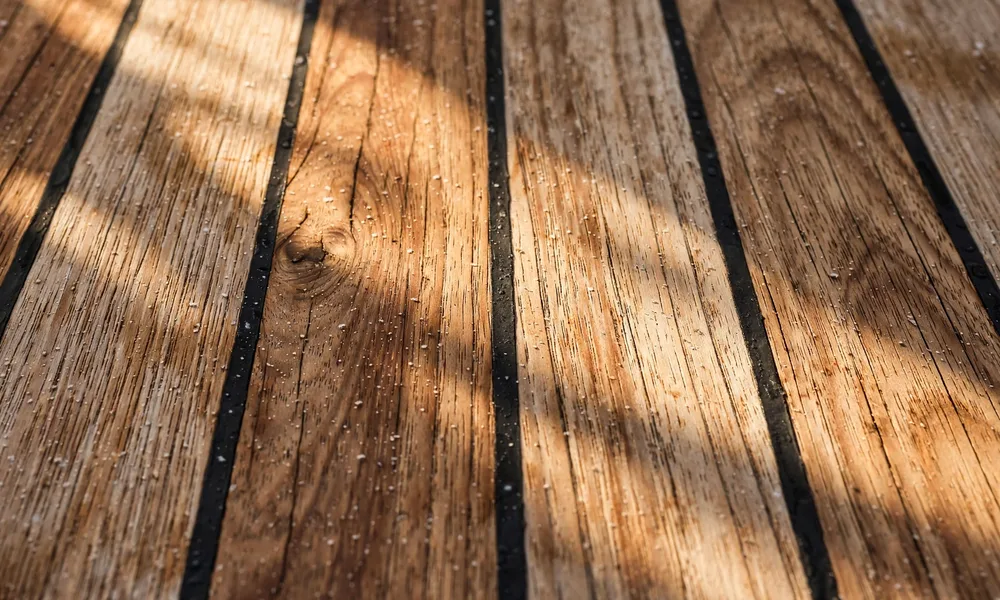
The cost of a teak deck does not end on launch day. Teak weathers to a soft silver grey if it is left alone, and keeping the honey colour takes gentle washing, careful oiling and a refusal to use harsh cleaners or pressure washers that strip the soft grain and leave ridges. Planks wear slowly underfoot, seams need attention, and after twenty or thirty years the deck will be too thin to sand again and must be replaced, a major refit that strips the old wood and starts the whole slow process over.

Yacht Teak Deck at a Glance
| Specification | Detail |
|---|---|
| Wood | Teak, Tectona grandis, from Southeast Asia |
| Growth time to maturity | 60 to 80 years for old-growth timber |
| Typical plank width | 40 to 60 millimetres |
| Typical plank thickness | 9 to 12 millimetres for a glued deck |
| Seam material | Modern polysulphide or polyurethane caulking |
| Fixing method | Marine adhesive bonding; older decks screwed and plugged |
| Typical lifespan | 20 to 30 years with proper care |
| Main advantage | Natural grip when wet, cool underfoot, rot resistant |
| Main drawback | Expensive, heavy, and needs regular gentle care |
What Does It Cost?
As rough estimates, a new teak deck typically costs around $800 to $1,500 per square metre installed, so a full deck on a mid-sized yacht can easily run to tens of thousands of dollars, and a large superyacht deck can pass $100,000 before the yard has finished. Those figures are estimates, not quotes, and the real number depends on the size of the deck, the quality and origin of the teak, the yard and the region. The timber alone can be a third or more of the total, with labour, adhesives, caulking and the shed time making up the rest. The system it protects, and the way it works as part of the boat, is explained in how a yacht teak deck works, while the steel structure underneath a larger yacht is covered in how a superyacht steel hull works.
A Rare Fact
Teak’s reputation at sea is so old that it was the deck timber of choice for warships and ocean liners for over a century, and the decks of the great liners, including the Queen Mary 2, are laid in teak. The wood was once so valued that the British navy reserved the finest teak forests for its ships, and a single mature teak tree could be worth more, in its day, than a small house. A modern teak deck is, in effect, a piece of naval history that you walk on every time you step aboard.
A teak deck is not the cheapest way to cover a yacht, and it is certainly not the easiest to look after. But it is the only deck that grips your feet in a squall, stays cool in the tropics, quiets the cabin below and grows more beautiful as it silvers with age. It costs so much because the tree is slow, the timber is scarce, the work is skilled, and the sea forgives nothing. Pay for all of that, and the deck will repay you for decades; cut corners on any of it, and the sea will send the bill back, with interest.