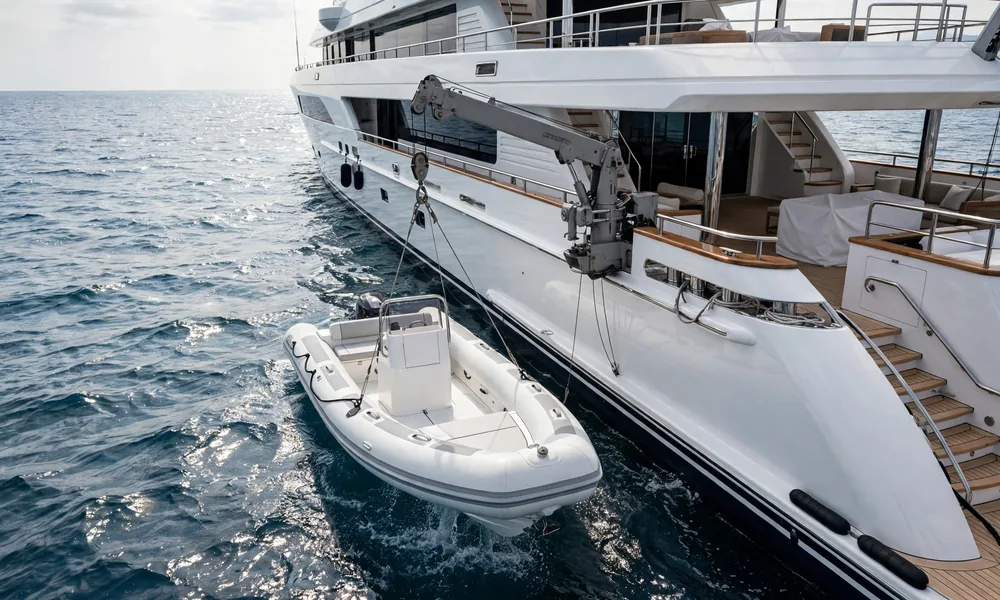
From the quay, a superyacht looks like a single smooth object, all glass and white paint and quiet money. Nothing on its flank gives away the secret it carries inside. But walk around to the stern on a calm morning, and you may see the back of the boat open like a garage door, a small boat sliding out on rails and a crane swinging it gently down to the water.
That hidden room is the tender garage, one of the cleverest spaces on a superyacht. Inside it lives the tender, the smaller boat used to ferry guests ashore, run errands, and tow water toys. Getting a boat in and out of a hole in the back of a moving ship, without flooding the yacht or damaging either boat, takes careful engineering. Here is how it works.

How a Superyacht Tender Garage Works
Step 1: The garage is built into the stern
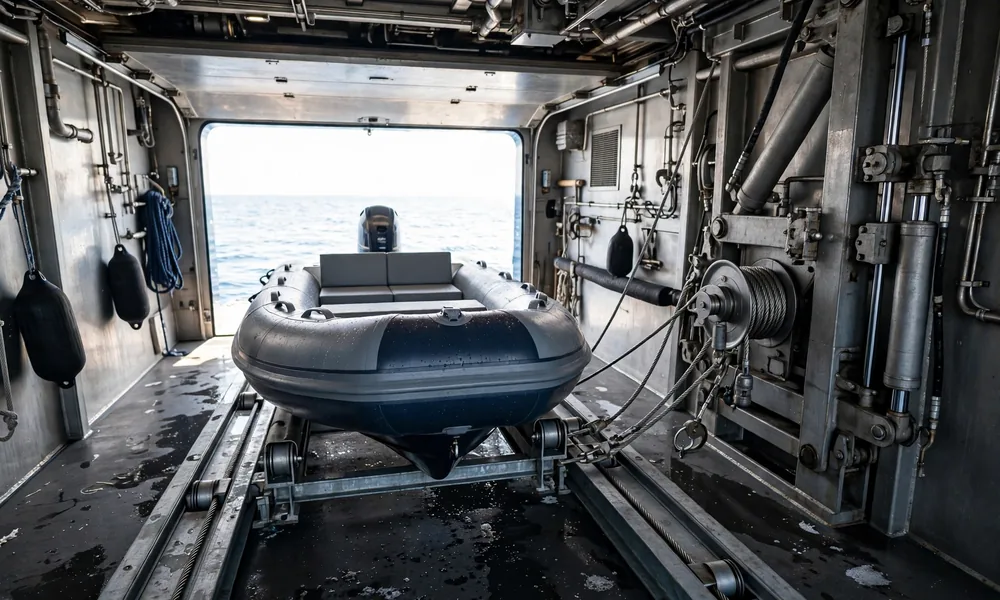
Everything starts with the hull itself. On most modern superyachts the tender garage sits low in the stern, just above the waterline, with its opening facing aft. The space is framed in steel or aluminium, watertight on all sides except the door, and sized to fit the tender with only centimetres to spare. The garage is part of the hull structure, not a room bolted on afterwards: its floor is the hull bottom, its roof supports the deck above, and its walls carry the loads of the stern.
Step 2: The tender rests on a cradle and rails
Inside the garage, the tender does not sit on the floor. It rests on a cradle, a shaped frame matching the curve of the tender’s hull, and the cradle runs on rails leading straight out through the door. When stored, chocks and straps hold the tender tight so it cannot move in a swell. When it is time to launch, the straps release and the cradle rolls the tender backwards, out of the garage and over the water.
The rails are the quiet heroes of the system: stainless steel, greased and sealed against salt water, carrying the full weight of the tender without bending. The way a tender itself is built and balanced is covered in how a superyacht tender works, which explains the hull and engine that make the little boat worth carrying in the first place.
Step 3: The transom door opens and seals
The back wall of the garage is a door, and it is also the yacht’s transom, the flat panel forming the stern. On most yachts it hinges down to form a swim platform, or swings sideways on heavy hydraulic rams. When closed it must be completely watertight, because it sits close to the waterline and the sea presses against it whenever the yacht moves. Rubber seals run around its edge, and hydraulic locks pull it tight against the frame.
Opening the door is slow and deliberate. The crew checks the sea is calm and the yacht barely moving, then the hydraulics ease it open. A raised sill at the bottom keeps water out, and if a wave splashes in, scuppers and a bilge pump clear it in seconds. The seals are inspected constantly, because a leak here floods the lowest room in the stern.
Step 4: A crane or davit lifts the tender clear
Once the tender is out on the rails, a crane or davit takes over. A davit is a small crane mounted on the deck above the garage, with an arm that swings out over the water and a winch that lowers the tender on straps. The crew clips the straps to strong points on the tender, the winch takes the weight, and the tender floats free. Launching a five-metre tender takes about ten minutes with a trained crew.
Recovery is the same job in reverse, and it is the harder half. The tender is driven up to the stern, the straps clipped on while both boats move, and the winch lifts it just clear of the waves. The yacht must hold its position precisely while the crew works, and the equipment that makes that possible is described in how a yacht bow thruster is made.
Step 5: Pumps, ventilation, and fuel safety
A closed garage full of a petrol-fuelled boat is a fire risk, so the room is fitted like a small engine space. Extractor fans change the air several times an hour, sweeping petrol vapour out through vents before it can gather. A fixed fire-suppression system, usually gas or fine water mist, can flood the garage at the push of a button, and the tender’s fuel tank is vented outside the hull.
Step 6: The door closes and the stern becomes a beach club
When the tender is away, the garage changes character. The transom door, hinged down, becomes a swim platform at water level, and the empty garage floor becomes a shaded beach club, a cool room at the back of the yacht where guests can sit with their feet in the water. Some yachts fit fold-out benches, a shower, and a bar, so the space earns its keep even when the tender is out.
This dual use is why the garage has become so popular. Twenty years ago a tender lived on deck under a cover, spoiling the yacht’s lines. The garage hides it completely, and the beach club idea has grown so far that it now has its own engineering, covered in how a superyacht beach club is made.
Superyacht Tender Garage Specifications
| Feature | Typical figure |
|---|---|
| Garage length | 5–8 metres, sized to the tender |
| Tender carried | 4–7 metres, rigid inflatable boat |
| Tender weight | 800–2,500 kg with engine and fuel |
| Door type | Hydraulic transom door or side shell door |
| Launch system | Rail cradle plus davit or crane |
| Launch time | About 10 minutes with a trained crew |
| Fire protection | Gas or water-mist suppression, vapour extraction |
| Bilge system | Dedicated pumps plus high-water alarm |
What a Tender Garage Costs
A tender garage is not a line item a buyer can order on its own; it is part of the yacht’s build, and its cost hides inside the hull price. As an estimate, the garage structure, door, rails, cradle, davit, and safety systems add roughly $500,000 to $2 million to the cost of a new superyacht.
A Rare Fact
On some of the largest superyachts, the tender garage holds not one boat but two, plus jet skis, paddleboards, and a small submarine, all packed into a space barely bigger than a double garage. The crew loads them like a puzzle, each toy on its own cradle, and the launch order is planned the night before, because the boat at the back cannot come out until the one in front has gone.
The tender garage is superyacht engineering at its best: a room that disappears when you do not need it, a crane that works in a swell, and a door that is also a swim platform. It solves a simple problem with a system so quiet and hidden that guests never notice it working.