At anchor off a quiet bay, the big yacht sits half a mile from the beach, too large and too deep to go any closer. The guests want lunch ashore, the crew needs supplies from the village, and the water between the yacht and the sand is too shallow for anything with a proper keel. So a hatch opens at the stern, a platform slides out over the water, and a small boat the size of a family car drives itself out into the sunlight. That little boat is the tender, and without it the superyacht is stranded in its own grandeur.
A superyacht tender is not a dinghy. It is a fully engineered boat in miniature: a fast hull, a powerful engine, seating for a dozen people, navigation lights, a sound system, and sometimes a shower and a fridge. It ferries guests, tows water toys, runs the crew to shore, and rescues swimmers. It must launch in minutes, survive being lifted by a crane in a rolling sea, and look as polished as the yacht it serves. Building one is a study in doing more with less.

How It Works
Step 1: A hull built for speed and shallow water
The tender’s hull is usually a deep-V shape in fibreglass or carbon fibre, with a sharp bow that cuts through chop and a flat run aft that lets it plane across the surface at speed. The V gives it a soft ride in waves, while the shallow draught means it can nose right up to a beach. Designers obsess over weight: every kilogram saved is speed gained and fuel saved, so the hull is laid up in vacuum-infused composite, cored with foam, and cured until it is stiff enough to take a pounding without flexing. A good tender planes quickly, turns flat, and stays dry inside even when the sea is up.
Step 2: Power from a compact inboard or outboard
Most superyacht tenders run on a petrol or diesel engine driving a jet pump or a sterndrive, putting out anywhere from 100 to more than 400 horsepower. A jet drive has no exposed propeller, which matters when the tender is picking up swimmers or nudging a beach, and it lets the boat run in water barely deeper than its own hull. The engine sits low and central for balance, breathing through vents hidden in the seating, and the fuel tank is baffled so the boat stays stable as fuel sloshes. At full throttle a large tender can top 40 knots, fast enough to outrun the weather back to the yacht.
Step 3: Seating, storage, and guest comfort
Inside, the tender is arranged like a small lounge. Bench seats wrap the bow, a helm console sits in the middle with a steering wheel and a chart plotter, and aft benches hide lockers for lines, fenders, and life jackets. Upholstery is marine-grade vinyl that shrugs off salt water and sun, and the deck is usually teak or a non-slip composite so wet feet do not slide. Some tenders carry a cooler, a freshwater shower, and a boarding ladder for divers. The whole layout is a compromise between carrying twelve people in comfort and keeping the boat light enough to lift.

Step 4: Launching and recovering from the yacht
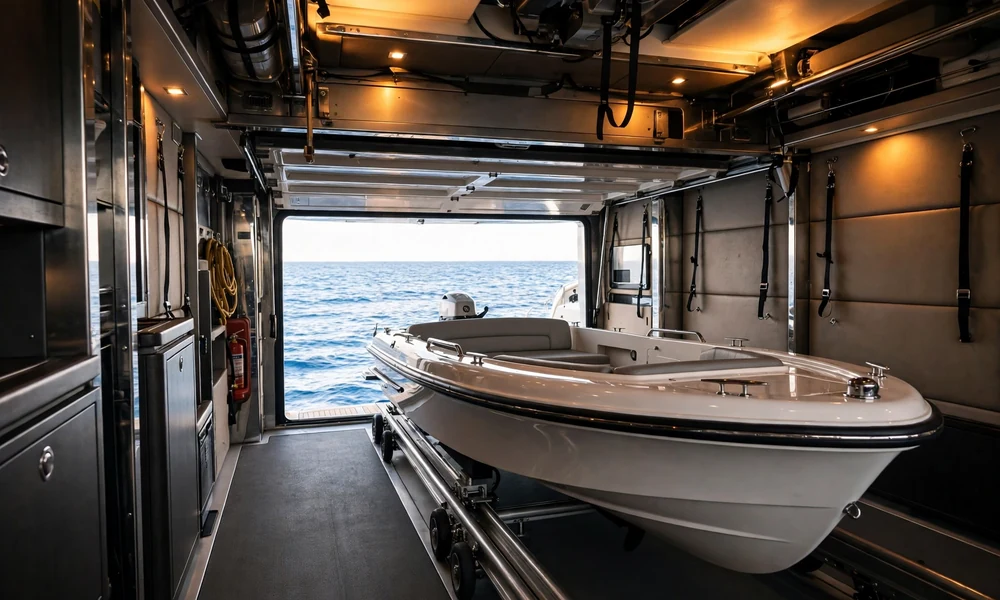
Getting the tender in and out of the water is a piece of engineering in itself. Many superyachts carry the tender in a garage in the stern, behind a transom door that folds down to form a swim platform. The tender slides out on rails or is lifted by a small crane, and the crew drives it clear before the door closes. Others stow the tender on the foredeck under a cover, lifted by a davit. Either way, the launch must work in a swell, at night, and with a tired crew, so the lifting points are built into the tender’s structure and rated for several times its weight.
Step 5: Handling, trim, and safety at speed
A tender at 40 knots is a serious machine, and its handling comes from trim tabs, a balanced load, and a hull that stays planted. The driver uses the tabs to keep the bow down as it accelerates onto the plane, then trims it up for top speed, watching the horizon rather than the instruments. Safety gear is non-negotiable: navigation lights, a kill cord that stops the engine if the driver falls overboard, a VHF radio, flares, and enough life jackets for every seat. The tender is the yacht’s lifeboat in practice, even if it is never called that, so it must start first time, every time.
Step 6: Care, cleaning, and matching the yacht
A tender lives a hard life, hauled in and out of salt water daily, so the crew rinses it with fresh water after every run, flushes the engine, and checks the hull for dings. The paint and upholstery are matched to the mother ship, often down to the exact shade of white and the stitching on the seats, because the tender is the first thing a guest sees up close. A scuffed, faded tender makes the whole yacht look tired, so the little boat gets the same detailing as the big one: polished gelcoat, conditioned leather, and a cover at night.
Specs
| Specification | Typical figure |
|---|---|
| Length | 4–9 metres, by yacht size |
| Passenger capacity | 6–12 guests plus crew |
| Engine power | 100–400+ horsepower |
| Top speed | 30–45 knots |
| Hull material | Fibreglass, carbon fibre, or aluminium |
| Propulsion | Jet drive or sterndrive |
| Draught | About 0.3–0.5 metres |
| Weight | 500–2,500 kg depending on size |
Price
A superyacht tender costs far more than a boat of its size has any right to, because it is built to yacht standards rather than boatyard standards. As an estimate, a small 4-metre tender can cost $40,000 to $80,000, while a large custom 8- or 9-metre tender with a powerful jet drive, teak decks, and full electronics can cost $250,000 to $500,000 or more — these are estimates, and the final price depends on length, engine, materials, and how closely it is matched to the mother ship. Owners rarely haggle: the tender is the yacht’s daily workhorse, and a cheap one shows.
A Rare Fact
Some of the largest superyachts carry tenders that are bigger than most people’s first boats and faster than the yacht itself by a wide margin. A 9-metre tender with 400 horsepower can outrun its 80-metre mother ship three times over, and on the biggest yachts the tender fleet includes a second, open workboat for the crew, a rescue boat, and sometimes a small sailing dinghy. The yacht may be the star of the show, but the little boats do the miles.
From a garage in the stern to a beach half a mile away, the tender is the superyacht’s connection to the world. It shares its home with the superyacht beach club at the waterline, it relies on the yacht anchor system holding the mother ship steady while it works, and it is built from the same thinking as the superyacht steel hull it serves. Small boat, enormous job.


