There is a piece of engineering on every yacht that almost nobody looks at, and yet without it the boat goes nowhere. It hangs below the stern, out of sight under the water, spinning in the dark: the propeller. A good one is a sculpture as much as a machine — a set of curved bronze blades, each one shaped to bite the water and push a hull of many tonnes forward, quietly and without vibration. A bad one shakes the whole boat and wastes fuel with every turn.
Yacht propellers are usually cast from nickel-aluminium bronze, an alloy that resists corrosion in salt water and is tough enough to survive a knock against a log or a rock. Most have three, four, or five blades, and each blade is a twisted, tapered wing whose shape is the result of a century of experiment. This is how one is made, from a pattern in a foundry to the first smooth run under power.
How It’s Made
Step 1: Designing the blades
Before any metal is melted, the propeller is designed. The naval architect starts with the yacht: its weight, its hull shape, its engine power, and the speed it should reach. From those numbers comes the propeller’s size, its number of blades, and its pitch — the distance it would travel in one turn if it were screwing through a solid. The blade shape is drawn in software and tested in computer models that show how water flows over each section.
Step 2: Making the pattern and mould
The design is turned into a pattern, a full-size model of the propeller, usually made from wood or resin and finished to a smooth surface. The pattern is pressed into special foundry sand to form a mould, which is built in two halves so the pattern can be removed. Channels are cut into the sand for the molten bronze to flow in and for air to escape. For a small propeller the mould may be made in a day; for a large one it can take much longer. The sand must be packed firmly enough to hold its shape against the weight of the metal, yet loose enough to let gases out as the bronze pours in.

Step 3: Pouring the bronze
Nickel-aluminium bronze is melted in a furnace at well over 1,000 degrees Celsius, then poured into the mould in a steady stream. The pour must be smooth and continuous: a hesitation can leave a cold joint, a weak seam inside the metal that no amount of polishing will fix. As the bronze cools, it shrinks, so the mould includes extra reservoirs of metal that feed the casting as it contracts. When the metal has set, the mould is broken apart and the rough propeller is lifted out, still warm, its blades covered in sand and scale.
Step 4: Machining the blades
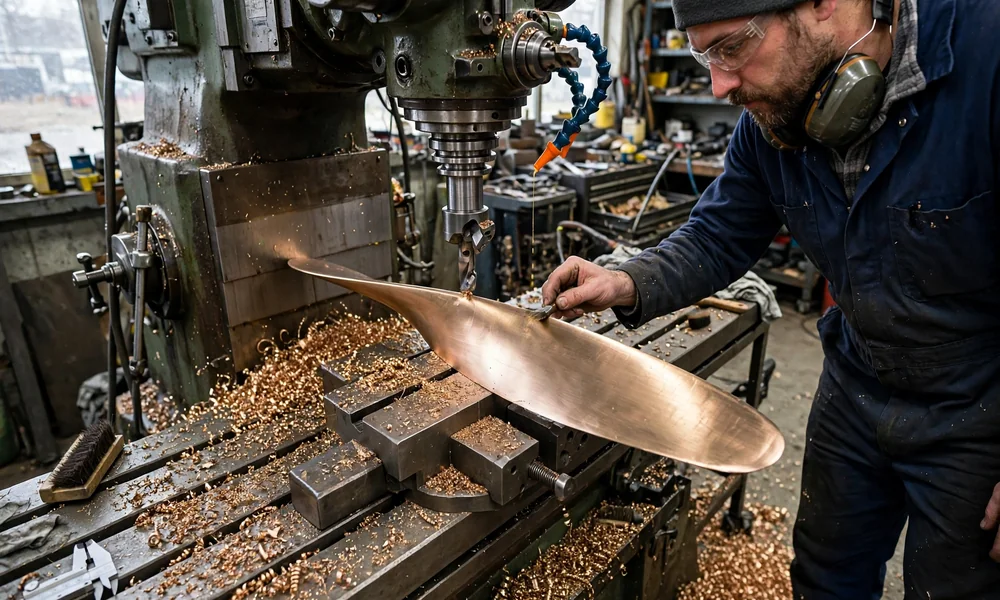
The rough casting goes to the machine shop, where its blades are milled and ground to their final shape. This is where the propeller’s performance is really made: the thickness, twist, and curve of each blade are cut to within a fraction of a millimetre, guided by the design and checked against templates. The hub is bored and keyed to fit the propeller shaft, and the blades are blended into the hub with smooth, flowing roots that spread the load. A machinist works on one blade at a time, measuring as they go, because the blades must match each other exactly — a propeller whose blades differ will vibrate, and vibration is the enemy of everything aboard.
Step 5: Balancing and polishing
With the blades shaped, the propeller is balanced. It is mounted on a balancing machine that spins it and measures where it is heavy, and tiny amounts of metal are removed until it runs true. Even a small imbalance becomes a shake at speed, wearing bearings and tiring the crew. Then comes polishing: the blades are ground and buffed to a mirror finish, not for beauty but because a smooth blade slips through the water with less drag and less noise. A polished propeller is also easier to keep clean, since marine growth grips rough metal far more readily. The same care for smooth, balanced rotation matters across the stern gear, and the wider story of propulsion continues in how a ship propeller is made, where the same craft is practised at a far larger scale.
Step 6: Fitting and sea trial
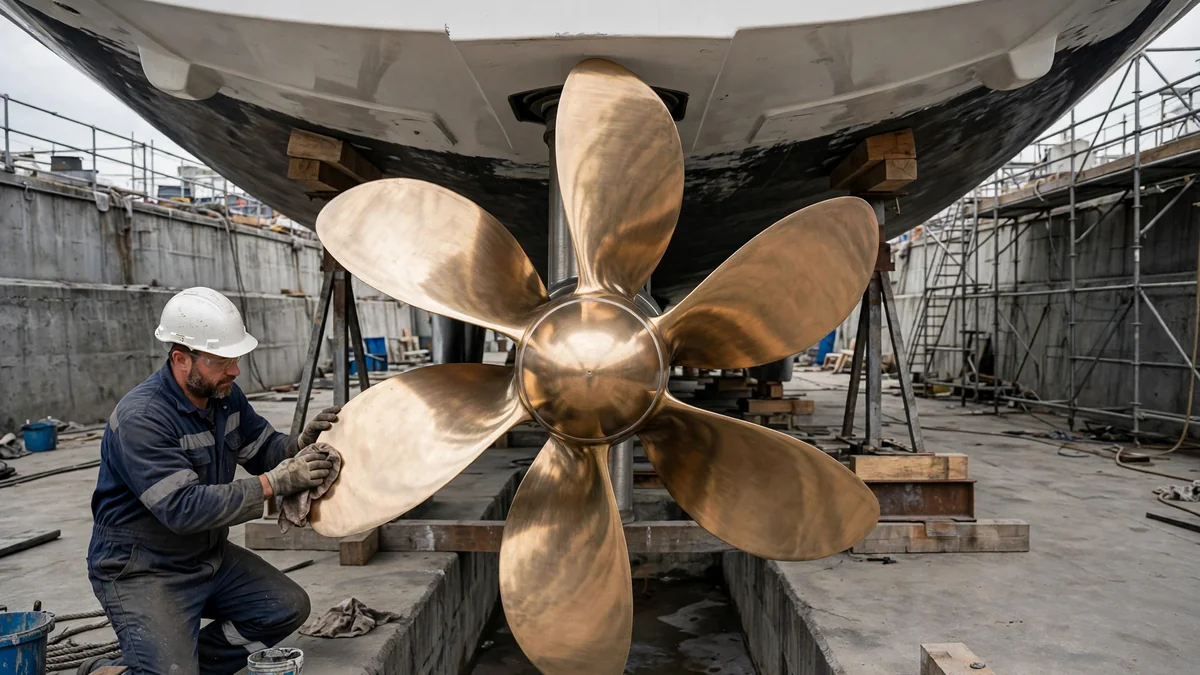
Finally, the propeller is fitted to the yacht’s shaft in the dry dock, with its nut torqued and locked and the gap between propeller and hull checked. The boat is launched, and the propeller is tested under power: the crew watches the speed, listens for vibration, and checks the engine’s revs against the design. If the propeller is over- or under-pitched, it may come off again for adjustment, its blades re-pitched by a specialist. When it is right, the yacht moves with a quiet push that the crew feels rather than hears. It works alongside the rest of the yacht’s underwater gear, from the stabilizer fins that steady the hull to the spars above, whose own build is told in how a yacht carbon mast is made.
Specs
| Specification | Typical figure |
|---|---|
| Material | Nickel-aluminium bronze |
| Blade count | Commonly 3–5 blades |
| Diameter | Roughly 400–900 mm for a cruising yacht |
| Pitch | Matched to the engine and hull speed |
| Manufacture | Sand-cast, then machined and polished |
| Surface finish | Polished to a near-mirror shine |
| Typical weight | Roughly 10–60 kg depending on size |
| Service life | Decades with care; blades can be re-pitched |
Price
A custom bronze propeller for a cruising yacht typically costs roughly $3,000 to $20,000 as an estimate, depending on size, blade count, and whether it is fixed, folding, or feathering — these are estimates, and the final price depends on the foundry and the design work involved. Folding and feathering propellers, which reduce drag under sail, cost more because of their moving parts. It is a modest sum beside the price of the yacht, yet it is the one part that turns all of the engine’s power into motion, and skimping on it is a false economy.
A Rare Fact
One of the propeller’s enemies is not the sea but electricity. Stray currents and the mixing of different metals underwater can eat a bronze propeller away through galvanic corrosion, sometimes in a single season. That is why yachts carry sacrificial zinc anodes — lumps of zinc bolted to the shaft and hull that corrode first, protecting the bronze. The propeller’s worst enemy is its own neighbour: the steel shaft, the stainless fittings, and the salt water between them form a tiny battery, and the zinc is the part that agrees to lose.
From sand and molten bronze to a mirror-polished screw turning silently under the stern, a yacht propeller is made by people who know that the most important part of a boat is the one nobody sees. It does its work in the dark, and it does it beautifully.


