Hold a wireless earbud between your thumb and forefinger and you are holding a loudspeaker smaller than a pea. Inside that tiny shell sits a driver — a miniature engine of sound — that must reproduce the rumble of a bass guitar and the shimmer of a cymbal, run all day on a battery the size of a lentil, and survive drops, sweat and pockets. The wonder is that anyone can build millions of them, each sounding almost exactly like the last. Behind that little disc of metal and polymer lies a supply chain of rare materials, hand-finished parts and measurement equipment that costs more than a house.
The driver in a premium pair of earbuds is a balancing act. It must be light enough to move thousands of times a second, stiff enough not to bend, and strong enough to push air in a space barely wider than a pencil. Engineers chase those three qualities at once, and every step toward one of them pushes the cost up. A flagship driver is assembled under microscopes, measured in thousandths of a millimetre, and tuned by ear as much as by machine.
Why a Driver the Size of a Pea Costs So Much
The price of a premium earbuds driver is not set by the cost of its raw materials alone. It is set by the rarity of the materials, the precision of the machines that shape them, the number of units that fail testing, and the small number of factories in the world that can do the work at all. Six reasons explain most of the bill. The full picture of the finished part is in how the wireless earbuds driver works.
1. The diaphragm is a film thinner than a human hair
The diaphragm is the part that moves the air, and in a flagship driver it is often a film of beryllium, diamond-like carbon or a multi-layer polymer less than twenty microns thick. Beryllium is light and enormously stiff, which is exactly what a diaphragm needs, but it is toxic as a dust, so it must be machined and handled in sealed rooms by workers in protective gear. Diamond-like carbon is deposited atom by atom in a vacuum chamber, one batch at a time. The film is the single most expensive part of the driver, and a scratch invisible to the naked eye is enough to scrap it.
2. The magnet is a rare-earth sliver that has travelled the world
Almost every premium driver uses a neodymium magnet, a sliver of rare-earth alloy that produces a field far stronger than its size suggests. Neodymium is mined in only a handful of places, refined through a long chemical process and sintered into shape. The magnet is graded and matched so the left and right earbuds produce the same field strength. A driver with mismatched magnets sounds lopsided, so the matching step alone adds cost and waste.
3. The voice coil is wound by machines that cost more than cars
The voice coil is a thread of copper-clad aluminium wire wound around a former no wider than a grain of rice, often with wire thinner than a human hair. The winding machines work under magnification, because a single overlapping turn changes the sound. The wire is drawn, annealed and coated in specialist plants. The machines that do this work are built in small numbers, cost hundreds of thousands of pounds, and need technicians who have trained for years.
4. Assembly happens under a microscope, by hand
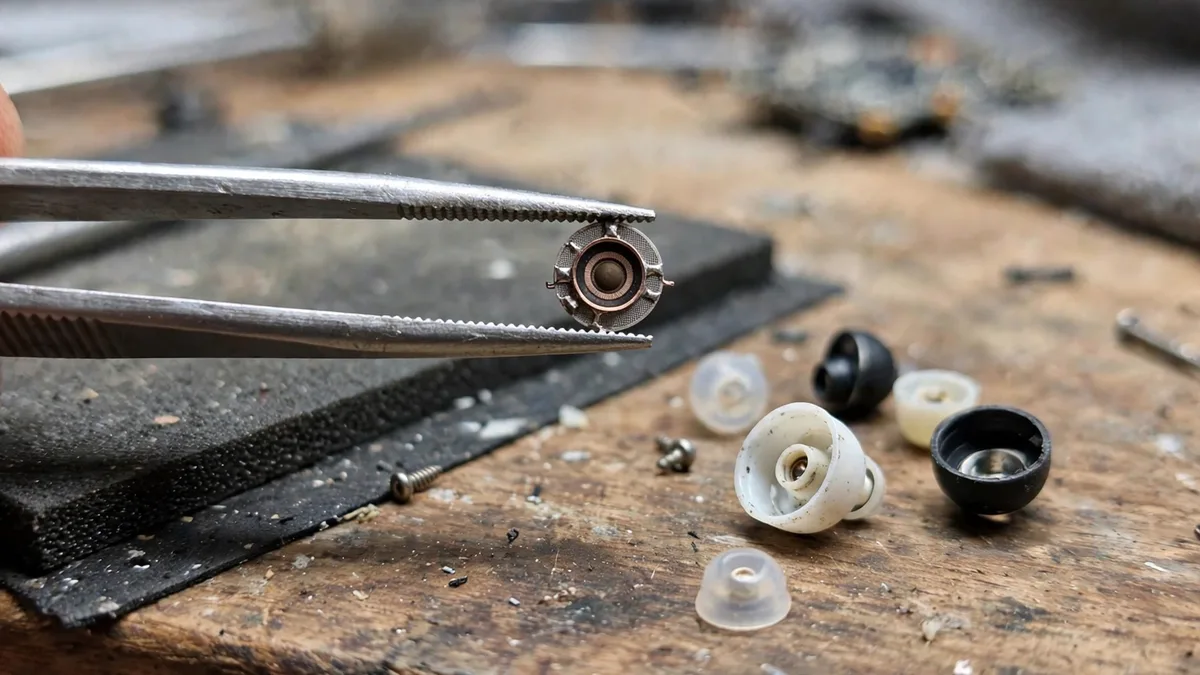
For all the automation in electronics, the final assembly of a premium driver is still largely done by hand. A technician working under a microscope glues the diaphragm to the surround, centres the voice coil inside a magnetic gap barely wider than the wire itself, and seals the assembly without letting a speck of dust inside. If the coil rubs, the driver buzzes and is scrapped. It is slow, skilled work, and the people who do it well are few. Much like the miniature motors inside a camera autofocus motor, a driver is a precision instrument first and a consumer part second.
5. Every driver is measured, and many fail
Once assembled, each driver is tested in an acoustic chamber that mimics a human ear. Its frequency response is plotted, its distortion measured, and its left-right balance compared against its partner. In a flagship line, a meaningful share of production fails and is discarded, and the cost of the failed units is carried by the ones that pass, which is why a driver that costs a few pounds in materials can cost many times more by the time it is cleared for sale.
6. Only a few workshops in the world can do it
There are only a small number of factories that can produce flagship-grade drivers at scale, and they guard their processes closely. The know-how is in the hands of the technicians, the tuning of the glue and the temperature of the room. That scarcity means brands pay a premium for capacity, and a single factory shutdown can ripple through the whole industry. The price reflects every link in that chain.
What Is Inside a Premium Earbuds Driver
| Part | Material | Typical size | Role |
|---|---|---|---|
| Diaphragm | Beryllium or diamond-like carbon | 6–11 mm diameter | Moves the air to make sound |
| Voice coil | Copper-clad aluminium wire | About 0.03 mm wire | Pushes the diaphragm in the magnetic field |
| Magnet | Neodymium rare-earth alloy | 3–6 mm disc | Creates the field the coil works against |
| Surround | Silicone or treated rubber | Under 1 mm wide | Lets the diaphragm move freely and seals the edge |
| Frame and housing | Engineered plastic or aluminium | Under 12 mm across | Holds everything aligned to a hundredth of a millimetre |
| Acoustic vent | Micro-mesh and felt | Under 1 mm opening | Balances pressure and tunes the bass |
How Much Does a Premium Driver Cost?
There is no single number, because brands do not sell drivers on their own and costs are closely guarded. As an estimate, the driver inside a mass-market pair of earbuds costs roughly £1 to £3 to make. The driver inside a flagship pair is estimated at roughly £8 to £25 per unit, with exotic beryllium designs estimated higher still, at £30 or more. The finished earbuds sell for far more — the driver is only one part of a product that also carries batteries, chips and microphones — but the gap between a £2 driver and a £20 driver is the gap between a pleasant sound and a remarkable one. The smartwatch health sensor packs a laboratory into a watch case for similar reasons, and at a similar premium.

A Rare Fact
Some flagship earbuds use drivers made from beryllium — a metal so light and stiff that it was first used in X-ray windows and fighter-jet parts — yet the diaphragm weighs less than a single grain of sand. It is rolled into foil and stamped into shape inside sealed rooms, because beryllium dust is hazardous to breathe. It is a large part of why the best-sounding earbuds in the world cost what they do.