Press the home button on a modern phone and nothing physically moves, yet your thumb feels a crisp, definite click. That sensation is a lie told beautifully by a haptic motor, a device smaller than a postage stamp that can fake the feeling of a mechanical button, a heartbeat, or the recoil of a camera shutter. Inside it, a heavy little mass is being thrown back and forth dozens of times a second by magnetic fields, and the materials that make that possible are some of the most demanding in any gadget you own.
The trick is precision. A spinning vibration motor from an old phone could only buzz, loudly and vaguely, like a bee trapped in a tin. A modern linear resonant actuator, or LRA, moves its mass along a single axis with sub-millimetre control, starting and stopping in milliseconds. Getting that illusion right depends on magnets strong enough to accelerate a dense metal weight, springs that never tire, and a housing that survives being dropped again and again.
The Materials Behind the Motor
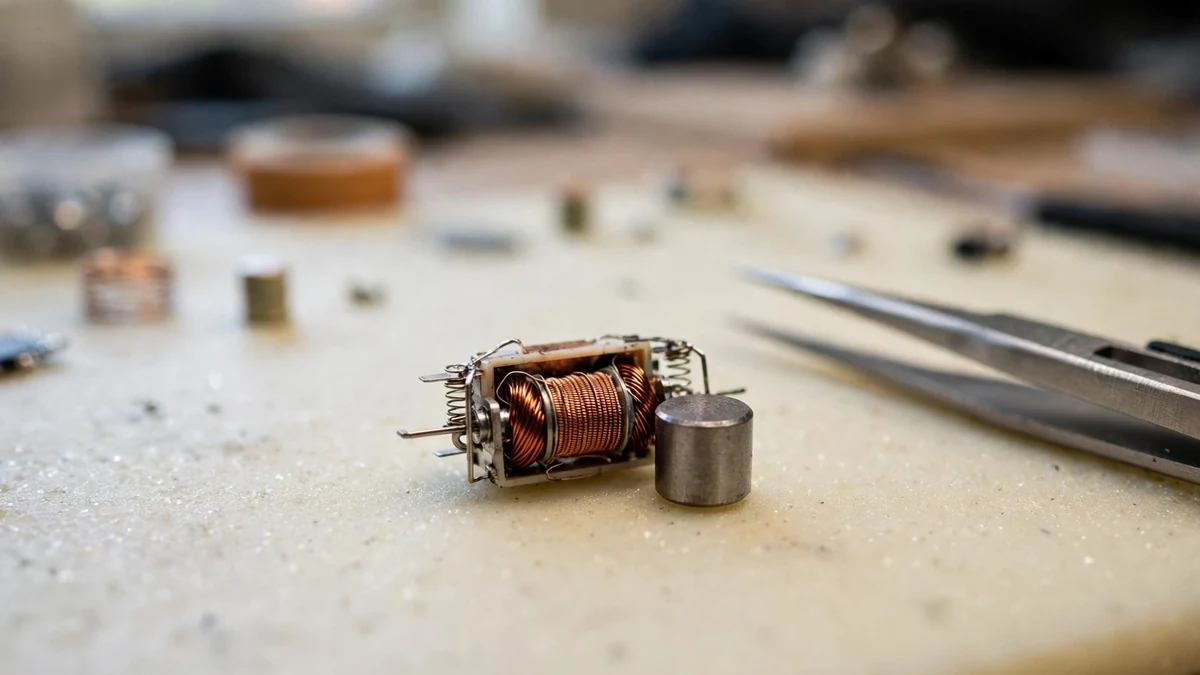
At the heart of every LRA sits a mass made of tungsten, one of the densest metals that can be machined into a small part. Tungsten is nearly twice as dense as steel, so a tiny slug of it carries enough momentum to make a whole phone shudder when it moves, yet it is small enough to hide inside a case a few millimetres thick.
The force that throws that mass comes from neodymium magnets, the strongest permanent magnets available at this size, paired with copper coils wound from hair-fine enamelled wire. When current flows through the coil, the magnetic field pushes the mass one way; reverse the current and it snaps back. The magnets are usually coated in nickel or epoxy, because bare neodymium corrodes quickly and a speck of rust inside a motor is enough to jam it. The whole assembly is suspended on stainless steel leaf springs that flex millions of times without losing their temper.
The housing matters as much as the moving parts. Most haptic motors live in a zinc-alloy or stainless-steel case that is laser-welded shut, keeping dust and moisture out while giving the springs a rigid frame to push against. Inside the phone, the motor is held in a bracket of machined aluminium, and a thin layer of silicone damps the vibrations that would otherwise rattle the camera module. Every material here is chosen for a trade-off: tungsten for density, neodymium for force, copper for conductivity, and steel for a spring that outlives the phone itself. The same obsession with tiny, precise moving parts shows up in other miniature machines, from the voice coil that drives the driver inside a pair of wireless earbuds to the sensors that track a pulse on your wrist, as in how a smartwatch health sensor works.
How It Is Made
Building a haptic motor is watchmaking at industrial scale: hundreds of parts, each smaller than a grain of rice, assembled by machines that never blink. The process runs roughly like this.
- Sinter the mass. Tungsten powder is pressed into a mould and fired in a furnace until the grains fuse into a solid slug, then ground and polished to its final shape and weight.
- Wind the coil. Enamelled copper wire is wound hundreds of turns around a polymer bobbin by a machine that counts every loop, then the coil is dipped in varnish and baked hard.
- Magnetise the core. Neodymium alloy is sintered, sliced into tiny blocks, coated against corrosion, and magnetised in a pulse of current strong enough to align every domain at once.
- Form the springs. Stainless steel strip is stamped into leaf springs, heat-treated so it keeps its elasticity, and inspected for micro-cracks under magnification.
- Assemble the actuator. Robots place the mass, magnets, coil and springs into the metal housing in a cleanroom, aligning them to tolerances of a few microns.
- Seal and test. The housing is laser-welded shut, and each motor is driven through a sweep of frequencies while a laser measures how far and how fast the mass moves. Any motor that responds late or weakly is rejected.

Why These Materials Win
Tungsten wins because there is no lighter way to get that much momentum into that little space. A steel mass of the same size would feel weak and mushy; a lead mass would deform and poison the factory. Neodymium wins because its magnetic field is so strong that a motor can be driven hard from a phone battery at just a few volts, sipping power in bursts of milliseconds. Copper wins because it carries current with almost no resistance, so the coil stays cool, and stainless steel wins because a spring that softens after a year would turn every click into a dull thud.
The failures are instructive, too. A cracked spring makes the motor buzz instead of clicking. A corroded magnet sheds particles that grind the moving mass to a halt. A coil that overheats melts its varnish and shorts, silencing the motor entirely. Engineers fight all three with coatings, welds and careful thermal design, and the result is a component that typically outlasts the phone around it. It is the same materials logic that shapes the rest of the handset: the frame must be light yet unbreakable, which is why the titanium frame of a modern smartphone is machined the way it is, and every gram inside the case is argued over by engineers who know the user will feel the difference.
Specifications
| Specification | Detail |
|---|---|
| Motor type | Linear resonant actuator (LRA) |
| Moving mass | Sintered tungsten slug |
| Magnets | Neodymium-iron-boron, nickel-coated |
| Coil | Enamelled copper wire, several hundred turns |
| Springs | Heat-treated stainless steel leaf springs |
| Housing | Laser-welded zinc alloy or stainless steel |
| Resonant frequency | Typically 150 to 235 hertz |
| Size | About 10 to 20 millimetres across, a few millimetres thick |
Price
A haptic motor is one of the cheapest parts in a flagship phone, yet it is priced like a precision instrument. Replacement LRA modules for popular phones typically sell as spare parts for around $15 to $40 (estimate), and the finished motor inside a new handset is estimated to cost the manufacturer only a few dollars at volume (estimate). The real expense is not the materials but the testing: every motor is individually driven and laser-measured before it leaves the factory, because a single weak actuator would make a thousand-dollar phone feel broken. That testing is why a phone can still click convincingly after years of daily use.

Rare Fact
Apple’s Taptic Engine, the most famous haptic motor in the world, is so precisely controlled that it can reproduce the sensation of a camera shutter, a heartbeat, or a ticking watch, and it can stop its tungsten mass so abruptly that the vibration ends within a few milliseconds of the signal. Engineers tune each effect by shaping the electrical waveform that drives the coil, and the motor’s resonant frequency is chosen to match the frequency human skin is most sensitive to, around 200 hertz.
That is the hidden craft of the haptic motor: a lump of the densest practical metal, thrown by the strongest practical magnet, on springs that never tire, all sealed inside a case the size of a coin. You never see it, you never think about it, and yet it is the part of your phone you touch most often, because every tap, swipe and alert passes through it first.


