A center console boat is the simplest layout in boating: a helm in the middle, open deck all around, and nothing to get in the way of fishing. It is also, at the luxury end, one of the most expensive boats per foot on the water. A forty-foot luxury center console can cost more than a house. The money is in the hull, the power, the electronics, and the finish, all of which must work at fifty miles per hour, fifty miles offshore.
Run one offshore on a rough morning and the price starts to make sense. The boat punches through a steep chop at forty knots and the crew stands at the helm without holding on. The hull does not slam, the spray stays low, and the engines never miss a beat. Fifty miles out, the crew is fishing in comfort with the livewells full of bait. That is the promise: a fishing boat that behaves like a yacht.
Where the money goes
Step 1: The hull is built to take punishment
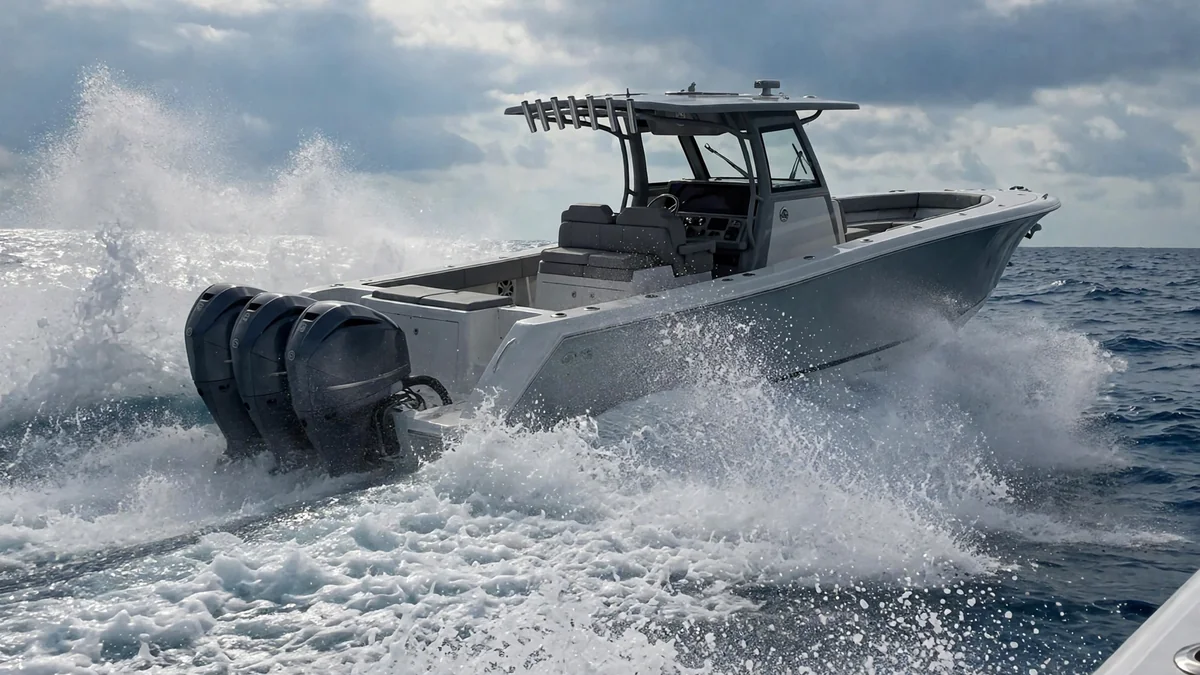
A luxury center console hull is a deep-V design with a deadrise of twenty-two to twenty-four degrees, built from fibreglass and vinylester resin over a foam core, often with carbon fibre in the high-stress areas. The hull is laid up thick, because it has to survive repeated impacts with waves at high speed for years without cracking or delaminating. The result is a hull that weighs several tonnes yet stays rigid.
Step 2: The outboards go on the transom
The most visible cost on a luxury center console is the row of outboards on the transom. A forty-foot boat typically carries three or four engines, each of 400 to 600 horsepower, for a total of 1,200 to 2,400 horsepower. Each engine costs an estimated $40,000 to $70,000, so the power package alone can cost more than a whole mid-range boat. The transom carries that weight on a reinforced bracket, with a jack plate to raise or lower the engines. Digital controls link all engines to one throttle, and a joystick docks the boat with fingertip precision.
Step 3: The console and the helm
The console is the heart of the boat, and on a luxury model it is a serious piece of engineering. It houses the helm with two or three large touchscreen displays for navigation, sonar, radar, and engine data, plus a full set of analogue gauges as backup. The console is built as a structural part of the boat, glassed into the deck and braced to carry the hard top above it.
Step 4: Fishing systems and livewells
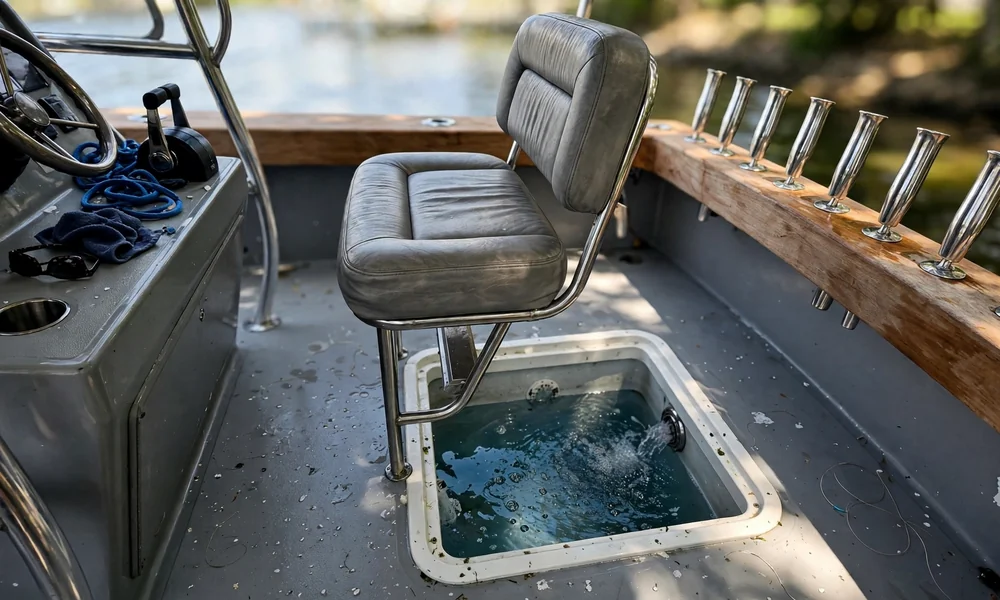
The fishing systems on a luxury center console are built to tournament standard. Livewells of fifty to a hundred gallons are plumbed into the transom and the leaning post, with pumps that circulate fresh seawater and keep bait alive for a full day. Rod holders line the gunwales and the hard top, and the deck is fitted with a fish box that can be iced down for the catch. Every fitting is stainless steel or marine-grade plastic.
Step 5: Electronics and the hard top
The electronics package on a luxury center console can cost an estimated $50,000 to $100,000 on its own. It starts with chirp sonar, radar, and a satellite system for weather and communication. The hard top above the helm carries the antennas, the radar dome, the outriggers, and the lights, and it is built from fibreglass or aluminium with a powder-coated finish. The outriggers are carbon fibre on luxury models, because aluminium poles of that length would be too heavy.
Step 6: Finish, testing, and delivery
The last step is the finish, and it is where a luxury center console separates itself from a working boat. The gelcoat is polished to a mirror shine and the deck is finished in a non-slip surface. The boat is then sea-trialled with a full load of fuel and crew, checking the top speed, the fuel burn, the handling in a turn, and the way the hull behaves in a head sea. Props are tuned and the engines synced before delivery.

The numbers behind the price
The spec sheet of a center console is dominated by power and range. The engine count sets the top speed, the fuel capacity sets how far offshore the boat can fish, and the deadrise sets how the ride feels when the sea gets up. The table below shows the figures for a typical forty-foot luxury center console.
| Specification | Typical figure | What it means |
|---|---|---|
| Length overall | 40 feet (12.2 m) | Total length, engines included |
| Beam | 12 feet (3.7 m) | Width; deck space, stability |
| Dry weight | 18,000 lb (8,165 kg) | Weight before fuel, gear |
| Deadrise at transom | 23 degrees | Hull V angle; softer ride |
| Engines | Triple 600 hp outboards | 1,800 hp total, transom |
| Top speed | 62 mph (54 knots) | Maximum, light load |
| Cruise speed | 40 mph (35 knots) | Comfortable fast cruising |
| Fuel capacity | 700 gal (2,650 L) | Sets range with cruise speed |
| Range | 350 nm at cruise | Distance before refuelling |
| Livewell capacity | 100 gal (379 L) | Live bait, circulating water |
| Draft | 30 inches (0.76 m) | Engines up; shallow capable |
What it costs
A new luxury center console in the thirty-five to forty-five-foot range typically costs an estimated $800,000 to $1.5 million, depending on the engine count and the electronics package. A flagship with four 600-horsepower outboards and a full electronics suite can pass an estimated $2 million. The engines are the biggest cost, and the electronics can add an estimated $50,000 to $100,000. Running costs are steep: fuel can cost an estimated $1,500 to $3,000 for a long day offshore, and annual servicing, storage, and insurance typically add up to an estimated $30,000 to $60,000 a year. All prices here are estimates.
A rare fact
The most expensive part of a center console after the engines is often the thing buyers never think about: the wiring. A luxury model can carry several miles of marine-grade tinned copper wiring, running through sealed conduits to dozens of pumps, lights, screens, and sensors, and every connection is heat-shrunk and waterproofed by hand. A single corroded connection can kill a pump, a screen, or an engine, fifty miles offshore. Builders that invest in the wiring produce boats that keep working for a decade, while boats with cheap wiring spend their lives in the yard.
The Takeaway
A luxury center console is expensive because it is a high-speed offshore fishing machine dressed as a yacht. The hull is built to take punishment, the outboards deliver supercar power, and the electronics and fishing systems are built to tournament standard. Buy the boat for the hull and the engines, and check the wiring first. For the systems that keep a boat steady at anchor, read how a yacht bow thruster is made, and for the gear that holds the boat in place, how a yacht anchor system is made explains the ground tackle, while the best electric boat brands ranked shows where electric power is entering the same market.


