On a racing yacht, the mast is the tallest thing for miles, a slender tower of black carbon fibre that can be thirty metres high and yet weighs less than the crew standing beneath it. It holds up the sails that drive the boat, it bends and flexes with every gust, and if it fails, the race is over in an instant. There is no room for error in a carbon mast, because the material gives almost no warning before it breaks, so every layer of fibre, every gram of resin, and every cure in the oven has to be perfect.
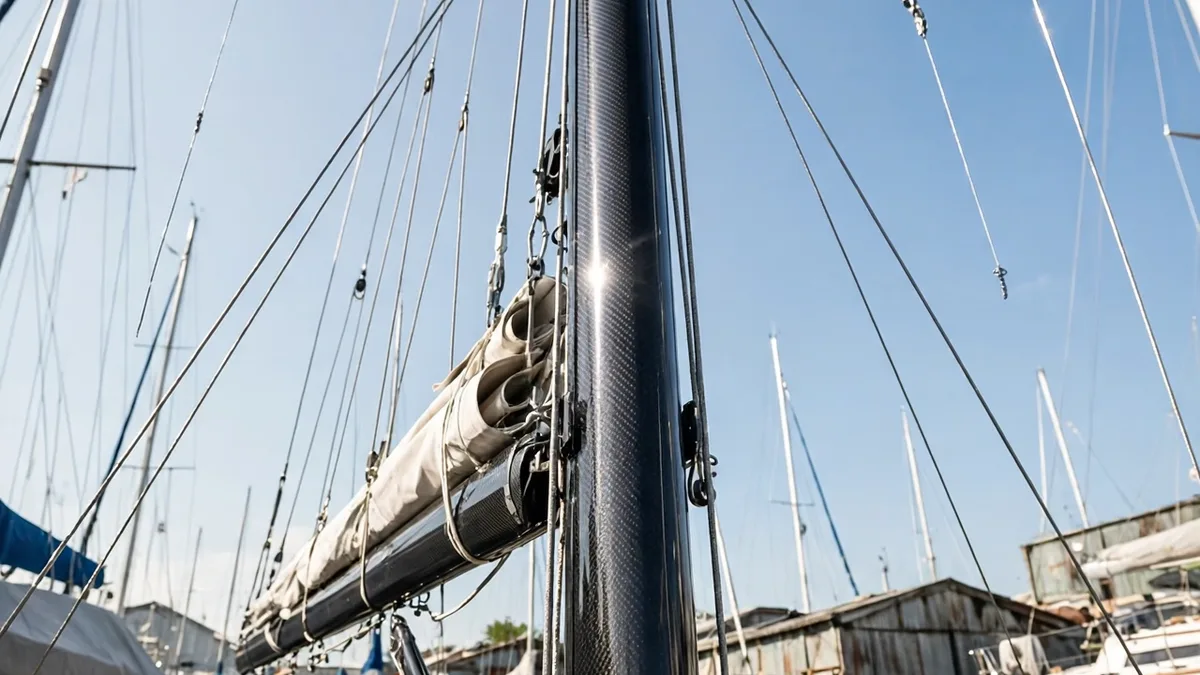
A carbon mast is not carved or cast. It is built up, layer by layer, from cloth woven from carbon threads finer than a human hair, laid into a mould, infused with resin, and baked under pressure until it becomes a single rigid structure. This is how a yacht carbon mast is made.
How It’s Made
Step 1: Designing the tube and the layup
Everything starts with the loads. Engineers calculate the forces the mast will see: the pull of the sails, the compression from the rigging, the bending from gusts, and the shock of waves, then design a tube that is stiff where it must be stiff and flexible where it must flex. The mast is not a uniform tube: it is thicker at the base, thinner at the top, reinforced where the spreaders attach and where the boom connects. The design is expressed as a layup schedule, a precise map of which type of carbon cloth goes where, in which direction, and in how many layers. The same carbon craft shapes the biggest masts afloat, as our guide to how a superyacht mast is made shows.
Step 2: Cutting the carbon cloth
Carbon fibre arrives as rolls of black cloth, woven from threads of pure carbon, and the first job is to cut it into the hundreds of pieces the layup schedule calls for. The cloth is cut on a large table, often by a computer-controlled cutter, and each piece is labelled with its position in the mast and the direction its fibres must run.
Step 3: Laying up the mast in the mould
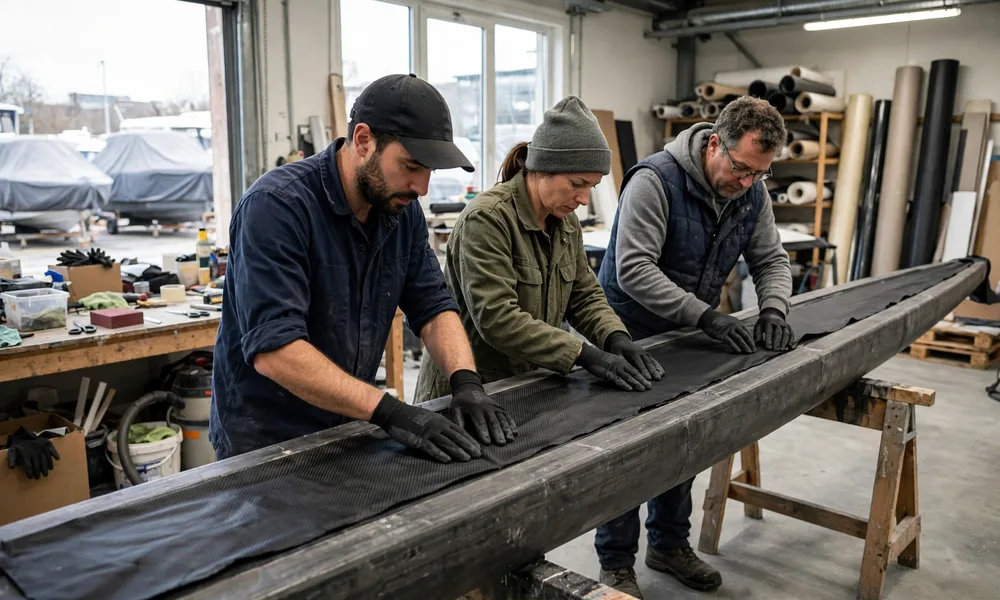
The mast is built inside a long mould, usually in two halves, and the layup is done by hand. Workers lay the cut pieces of cloth into the mould one at a time, smoothing each layer flat and pressing out air bubbles, building up the wall thickness from the tip toward the base. The work is slow and exacting: a large mast can take days to lay up, with dozens of layers in the most heavily loaded sections. Fittings for spreaders and halyards are placed into the layup as it grows, becoming part of the structure rather than being bolted on afterwards. When the layup is complete, the two halves of the mould are closed together and sealed.
Step 4: Resin infusion and curing
With the dry cloth in the mould, resin is introduced under vacuum, a process that pulls the liquid epoxy through every layer of fibre and drives the air out ahead of it. Once infused, the whole mould goes into an oven or autoclave, where heat and pressure cure the resin into a hard, rigid matrix that locks the fibres in place. The cure cycle is carefully controlled over many hours: too hot and the resin degrades; too cool and it never fully hardens. When the mould is opened, the mast emerges as a single glossy black tube, already close to its finished shape.
Step 5: Fitting out and finishing
The raw mast is trimmed, its ends are cut square, and the fittings are installed: the masthead crane, the spreader sockets, the halyard exits, the boom gooseneck and the track the sails run in. Each fitting is bonded or bolted into place with the same care as the layup, because a fitting that pulls out under load is as dangerous as a broken mast. The mast is then sanded and coated, usually with a clear coat that shows the carbon weave beneath, or with paint for owners who prefer a coloured finish. The deck it stands on must be finished to match, and our guide to how a yacht teak deck is made follows the craft that surrounds it.
Step 6: Testing, stepping and tuning
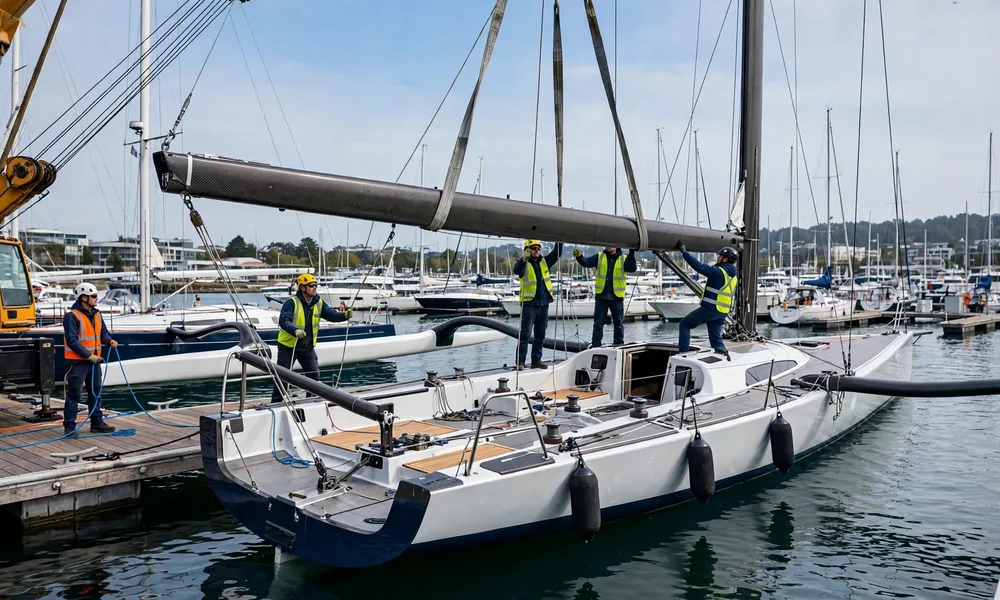
Before a carbon mast goes to sea, it is inspected and tested. Ultrasound and tap testing check for voids or delaminations inside the laminate, places where the resin never bonded properly, and any suspect area is repaired or the mast is rejected. Then the mast is stepped, lifted into place on the yacht and held by its rigging, and the rig is tuned: the stays are tensioned so the mast stands straight and bends in exactly the way the designers intended under sail. The first sail is a careful one, with the crew watching the mast’s bend and listening for anything unusual. A well-built carbon mast will flex gracefully in a gust and spring back, and it will do so for decades. Keeping the boat upright while it does is the job of the systems in our guide to how yacht stabilizer fins are made.
Specs
| Specification | Detail (typical racing yacht carbon mast) |
|---|---|
| Material | Carbon fibre cloth in epoxy resin |
| Height | Approximately 20 to 35 metres |
| Weight | Approximately 150 to 400 kilograms |
| Construction | Hand layup in a two-part mould, vacuum infused |
| Cure | Oven or autoclave, controlled heat and pressure |
| Wall thickness | Varies along the length, thickest at the base |
| Finish | Clear coat over the carbon weave, or painted |
| Build time | Several weeks from layup to stepping |
Price
A carbon mast is one of the most expensive single parts of a racing yacht. A mast for a large racing yacht typically costs from around $100,000 to $500,000 (estimate, based on typical pricing of custom carbon yacht masts), depending on height, design and fittings, and the most advanced grand-prix masts can cost far more. The price reflects the materials, the clean-room labour and the risk: a mast that fails inspection at the end of the build is a total loss, and the yard absorbs that cost, so every mast is priced to cover the ones that never make it to sea.
Rare Fact
Carbon fibre is five times stronger than steel by weight, yet a carbon mast can be damaged by something as simple as a dropped tool. The fibres are enormously strong in tension, along their length, but a sharp impact can crack the resin between them and start a delamination that spreads unseen inside the laminate. That is why every mast is tap-tested regularly: a dull thud where there should be a crisp ring means it needs attention before it is sailed hard again.