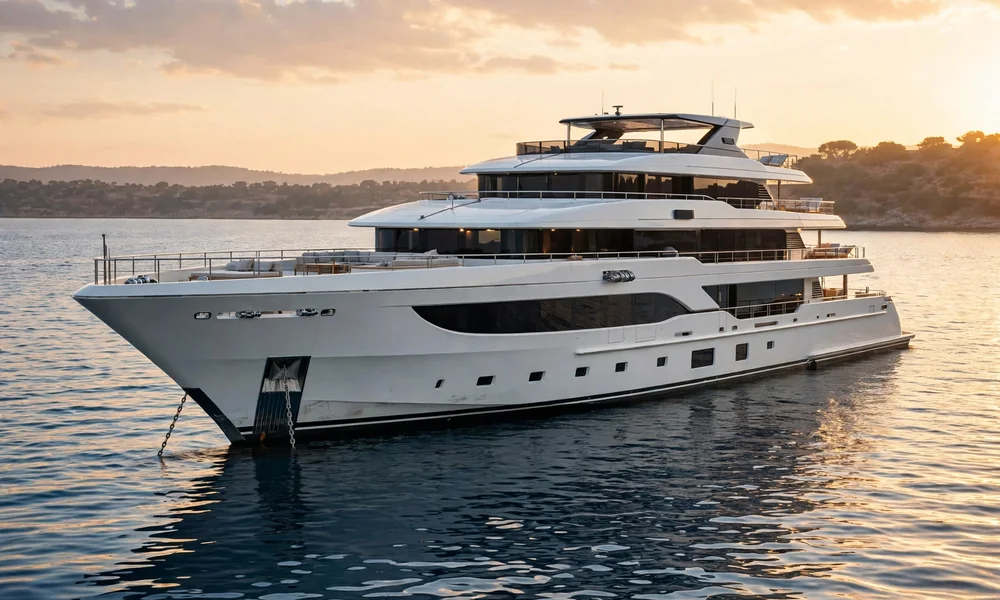
Out in open water, a superyacht rolls. A wave lifts one side, the hull tips, glasses slide across a table, and a guest grabs the rail. Then, almost magically, the roll stops. The yacht steadies, levels, and carries on as if the sea had changed its mind. Nothing visible has happened. But below the waterline, two fins have swung out from the hull and are pushing against the sea, hard, in exactly the right direction, at exactly the right moment.
Those are stabilizer fins, and they are the reason a modern yacht can feel calm in a sea that is anything but. This is how a yacht stabilizer fin is made.
How It Is Made
A stabilizer fin looks simple from the outside, a smooth, swept wing a metre or two long. Inside it is a small machine: a steel structure, a hydraulic actuator, seals that must keep seawater out under pressure, and sensors that report the fin’s angle many times a second. Making one means combining shipbuilding, hydraulics and precision machining, and the whole assembly must survive years underwater with almost no maintenance.
Step 1: Designing the fin for the hull
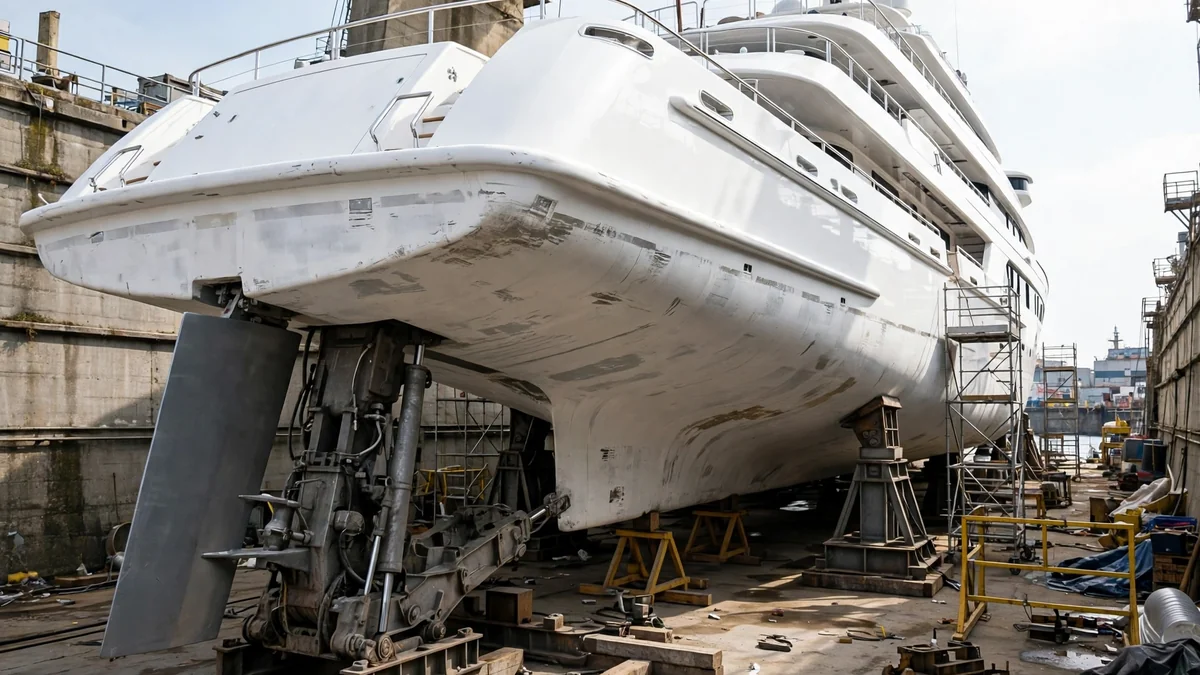
Every fin is designed for a specific yacht. Naval architects model the hull, its weight, its centre of gravity and the seas it will meet, then size the fins to produce enough lift to counter the roll without adding too much drag. The fin’s shape is a hydrofoil, like an aeroplane wing turned on its side, with a curved upper surface and a flatter lower one, so water flowing past it generates lift. The hull it bolts into is itself a major build, and the making of a superyacht steel hull is where the fin’s story begins.
Step 2: Building the fin structure
The fin itself is built around a steel spine, a machined shaft and internal frame that carry the loads from the water into the yacht’s hull. Around this skeleton, the fin’s skin is formed, either from welded stainless steel plate or from composite layers of glass and carbon fibre over a foam core. Whichever material is used, the surface must be perfectly smooth, because a rough fin creates drag and turbulence that wastes fuel and makes noise.
Step 3: The hydraulic actuator
Inside the hull, behind the fin, sits the actuator: a hydraulic ram or rotary vane motor that swings the fin through its arc. The actuator must produce enormous force, several tonnes of push, from a compact unit that fits in the yacht’s tight machinery spaces. Its cylinders are machined from stainless steel or marine-grade alloy, its seals are rated for seawater and high pressure, and its valves respond to commands in milliseconds.

Step 4: Sensors and the control system
A stabilizer fin is only as good as its brain. Gyroscopes and accelerometers mounted in the yacht measure roll angle, roll speed and acceleration many times a second, and a control computer turns those readings into commands for the fins. When the yacht starts to roll one way, the fins angle to produce lift in the opposite direction, pushing the hull back level. Modern systems can reduce roll by up to 90 percent, turning a rough passage into a comfortable one.
Step 5: Fitting the fin to the hull
Fitting is done in dry dock, where the hull is open and accessible. A reinforced mounting ring is welded into the hull structure, the actuator is bolted inside, and the fin shaft passes through a heavy seal that keeps seawater out while letting the fin swing. Engineers check the alignment with laser tools, torque every bolt to specification, and test the seals under pressure. Only when the fit is perfect is the hull closed up and painted.
Step 6: Sea trials and tuning
With the yacht back in the water, the stabilizers are tested in real seas. The crew runs the boat through waves of increasing size while engineers measure roll with the stabilizers on and off, tuning the control software until the reduction in roll is at its best. The trials can take days, and the tuning is as much art as science, balancing responsiveness against comfort. When the yacht can sit level in a sea that would once have emptied its tables, the fins are signed off. The same dry-dock discipline applies to every part of the hull, and the specifications of a working ferry hull show how the same engineering thinking serves very different boats.
Specifications
| Specification | Typical value |
|---|---|
| Fin length | 1 to 2.5 metres |
| Fin material | Stainless steel or composite |
| Actuator force | Several tonnes |
| Response time | Under 2 seconds full swing |
| Roll reduction | Up to 90 percent |
| Service life | 20 years or longer |
What It Costs
A stabilizer system for a superyacht typically costs between $100,000 and $500,000, depending on the size of the yacht and the type of system, with the largest installations exceeding $1 million. The price covers the fins, the actuators, the hydraulic power unit, the sensors and the control system, plus the shipyard labour of fitting them into the hull. For a yacht worth tens of millions, it is a small fraction of the total cost, yet owners consistently rate stabilizers as one of the most valuable systems on board, because they decide whether guests enjoy the voyage or spend it holding onto furniture.
A Rare Fact
Ship stabilizers were first proposed in the nineteenth century, but the first practical systems were fitted to ocean liners in the 1930s, using large fins driven by early gyroscopic controls. The most surprising development came later: zero-speed stabilization, where the fins flap back and forth to steady a yacht at anchor, a motion that looks absurd on a dry-dock drawing and feels like magic at sea. Nothing has. The fins are simply doing, quietly and invisibly, what they were made to do, and the hull they are fitted to carries the same lesson as every vessel on the water: the hull of a container ship, built to carry weight across oceans, and the fin of a yacht share one job, which is to keep what is above the water safe from what is below it.
Next time you step aboard a yacht and the deck stays steady under your feet while the sea moves around you, look down at the waterline.