From the marina, it looks impossibly tall, a black needle rising sixty metres above the deck, taller than the masts of ships that once crossed oceans under sail. It carries no engine, no electronics worth naming, and yet it is the most demanding structure on the whole yacht. It must hold tonnes of sail in a gale, bend without breaking, and weigh as little as possible.
A superyacht mast is not a pole. It is a hollow wing, built from carbon fibre in a mould, cured in an oven, and finished by hand, with tracks, fittings, and rigging points bonded into its walls. The largest masts are built in sections and joined together, because no oven is big enough to cure one in a single piece.
The mast is also the reason the yacht can sail at all. It holds the sails, it carries the rigging that keeps it upright, and it must survive loads that would snap a steel tube of the same weight. Here is how a superyacht mast is made.

How a Superyacht Mast Is Made
Step 1: Designing the mast and its loads
The build starts with naval architects and engineers working out exactly what the mast must do. They calculate the loads from the sails, the rigging, and the motion of the yacht in waves, and they design a mast section, the shape of its cross-section, that is stiff in one direction and flexible in another. A mast must bend forward under sail pressure but resist bending sideways, and it must do both while staying light.
Step 2: Laying up the carbon fibre
The mast is built in a long female mould, shaped like half of the mast section, and the carbon fibre is laid into it by hand. Layers of woven carbon cloth and unidirectional tape are placed one at a time, each in a planned direction, because carbon is strong only along its fibres. Dozens of layers go into the walls, thicker at the base where the loads are greatest, thinner towards the top where weight matters most.
Step 3: Curing the mast in the oven
Once the lay-up is complete, the mould is closed, sealed in a vacuum bag, and placed in a large oven called an autoclave. The oven heats the mast to around 120 degrees Celsius while the vacuum bag squeezes the layers together, driving out air bubbles and excess resin. This curing process takes many hours, and the temperature is raised and lowered on a precise schedule. When the mast comes out of the oven, it is a single rigid piece of carbon composite, lighter than aluminium and stronger than steel for its weight.
Step 4: Joining the sections and fitting the hardware
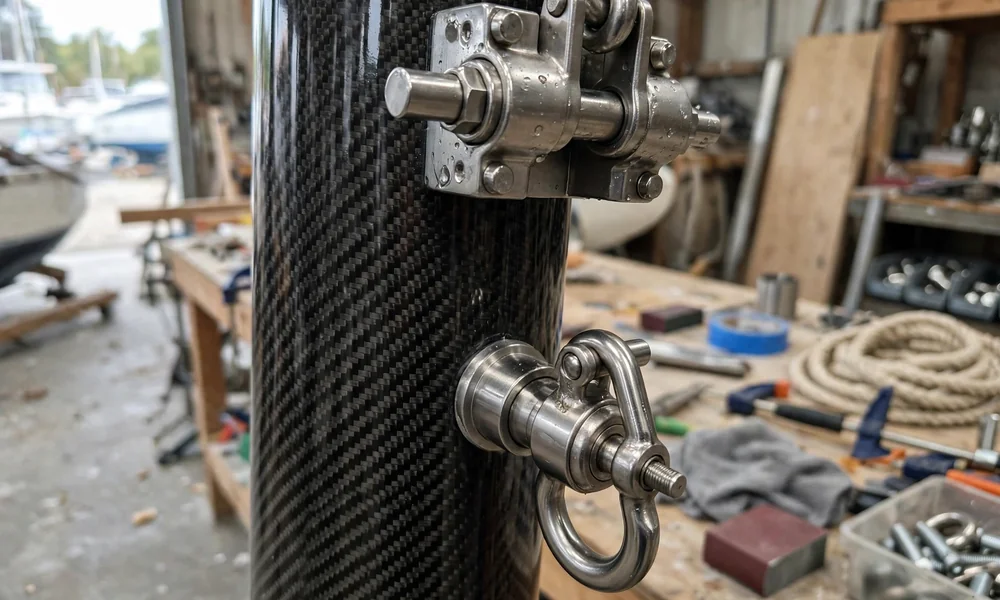
Very large masts are built in two or three sections, because no mould or oven is long enough for the whole mast. The sections are joined with internal sleeves and bonded with structural adhesive, then wrapped with extra carbon layers and cured again, so that the joint is as strong as the mast itself. Then the hardware goes on: the sail track is bonded along the back of the mast, spreader bars are fitted to hold the rigging out from the mast, and halyard exits, lights, antennas, and winch mounts are added. Each fitting is bonded and bolted, because a fitting that pulls out under load can bring the whole rig down.
Step 5: Painting, finishing, and testing
The bare carbon mast is faired, primed, and painted, usually in a deep black or white, with a clear coat that protects the carbon from sunlight. Ultraviolet light degrades carbon resin over time, so the paint is not decoration, it is protection. The finished mast is then tested: it is bent under load on a test rig, its deflection is measured against the design figures, and every fitting is pull-tested. The hull the mast will stand on is itself a major build, and the way it is made is explained in how a superyacht steel hull is made, the foundation the whole yacht rests on.
Step 6: Stepping the mast and tuning the rig
The final step happens in the boatyard, with a crane. The mast is lifted, swung over the yacht, and lowered through the deck into its step, the socket at the keel that carries its full weight. The rigging is attached and tensioned, wire by wire, while the riggers check that the mast stands straight and bends evenly. Then the yacht goes sailing, and the rig is tuned under load, with the crew adjusting the tension until the mast sets the sails perfectly. The numbers behind the finished mast are laid out in the superyacht mast specs explained, and the smaller carbon masts on racing yachts follow the same ideas at a different scale, as covered in the yacht carbon mast specs explained.
Superyacht Mast Specs
| Specification | Typical range |
|---|---|
| Height | About 40 to 70 metres above the deck |
| Material | Carbon fibre composite, epoxy resin |
| Construction | Female mould, vacuum-bagged, autoclave-cured |
| Sections | One to three, joined with bonded sleeves |
| Weight | About 2 to 8 tonnes, depending on size |
| Cure temperature | About 120 degrees Celsius |
| Rigging | Rod or wire, spreaders, halyard exits, lights |
| Finish | Primed and painted, UV-protective clear coat |
What Does a Superyacht Mast Cost?
A carbon superyacht mast is estimated at roughly $500,000 to several million dollars, depending on height, section, and fittings, with the largest masts for 60-metre-plus yachts estimated at $3 million or more. The carbon fibre and resin are estimated at a large share of the cost, followed by the labour of lay-up, curing, and finishing, and the rigging is estimated at a further significant sum. Stepping the mast and tuning the rig adds further cost, and a replacement mast after a dismasting can be estimated at millions of dollars including the rigging and sails. All prices are estimates only and vary widely by yacht size, builder, and specification. It is one of the most expensive single components on the whole yacht.
A Rare Fact
The tallest masts on sailing superyachts now reach beyond 90 metres, taller than the Statue of Liberty, and they are so tall that their yachts cannot pass under most bridges. One famous yacht had its mast built in sections and joined on site, because the finished mast was too long to transport by road. Carbon masts also changed yacht design in an unexpected way: because they are so much lighter than aluminium masts, designers could make yachts taller and narrower, and the masts themselves became a status symbol.

A superyacht mast is a strange piece of engineering: a hollow wing that must be light enough to race and strong enough to survive a storm, built by hand in a mould and cured in an oven like a loaf of bread. It carries no engine and no cargo, only wind, and yet it decides how fast the yacht sails and how safe it is in bad weather. That is why building one takes months, costs a fortune, and is trusted to only a handful of yards in the world.