Stand on the dock beside a big sailing yacht and look up. The mast rises above you like a black needle, so tall that its top seems to sway against the clouds, so thin that it looks too fragile to hold anything at all. Then the sails go up, the wind fills them, and that slender tube takes a load that would crush a steel beam of the same weight.
A carbon mast is one of the most extreme structures in sailing. It is a hollow tube made from carbon fibre, lighter than aluminium and stiffer than steel, built in layers by hand and cured in an oven the size of a room. Every gram matters, because the mast sits at the top of the yacht, where weight hurts most. Here is how a yacht carbon mast works, from the keel to the masthead.
How a Yacht Carbon Mast Works
Step 1: The mast is stepped on the keel
Everything starts at the bottom. The mast is lowered through the deck by crane and its foot, the heel, is seated in a steel socket on the keel, the backbone of the yacht. The socket spreads the load across the hull, because the downward push of the rig can reach dozens of tonnes. Stepping a carbon mast is a careful job: the tube is lifted vertically, kept perfectly straight, and lowered slowly while the crew guides the heel into its socket.
Step 2: Standing rigging holds it upright
A mast cannot stand on its own, so it is held up by standing rigging, a web of cables running from the mast to the hull. Forestays run forward to the bow and stop the mast falling backwards, backstays run aft and stop it falling forwards, and shrouds run sideways to the deck edges and stop it falling over. The tension is measured in tonnes, and it must be even on both sides, or the mast will lean.
The numbers behind these spars, including heights, weights, and wall thicknesses, are listed in the yacht carbon mast specs explained, which shows what these masts are built to.
Step 3: Halyards hoist the sails
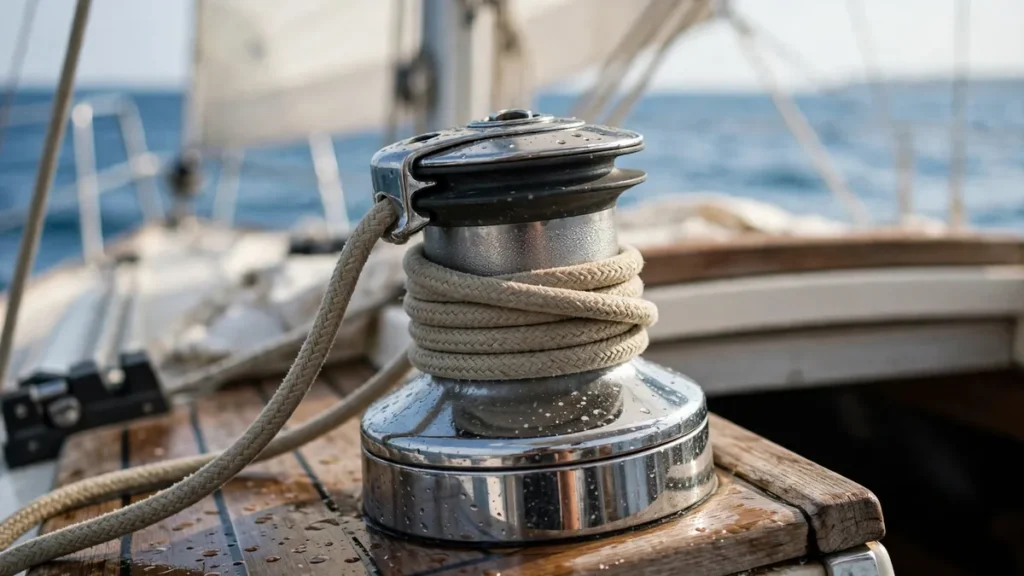
Inside the mast, ropes called halyards run from the deck to the top and back down again. To raise a sail, the crew attaches the halyard to the head of the sail and pulls, and the sail climbs the mast on a track, a groove running its full length. The mainsail on a large yacht can weigh hundreds of kilograms, so the halyard is pulled by an electric or hydraulic winch rather than by hand.
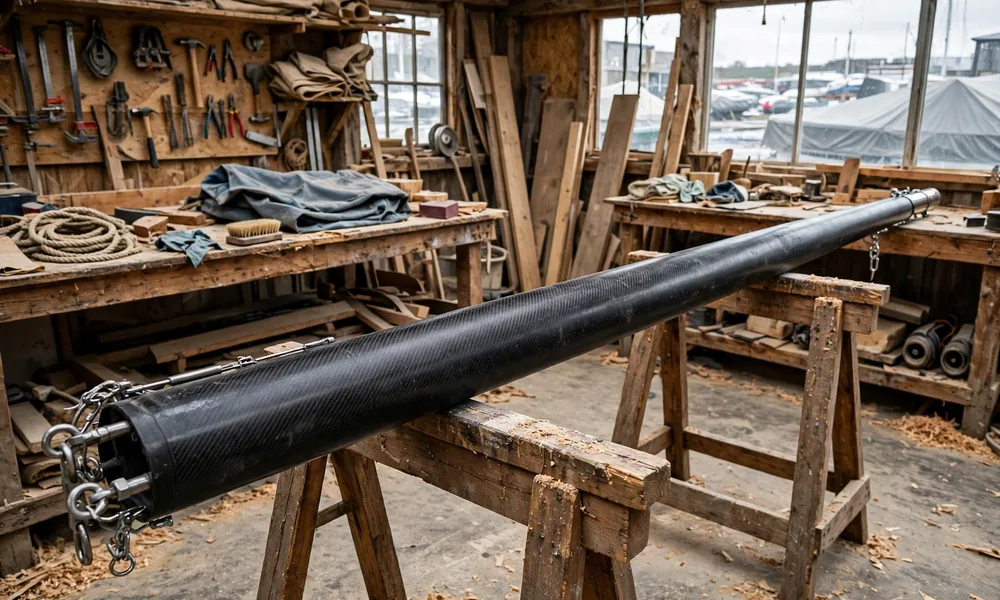
The mast is built in a long, careful process, and how a yacht carbon mast is made explains the layering, the mandrel, and the oven curing that turn cloth and resin into a spar.
Step 4: Spreaders widen the rigging angle
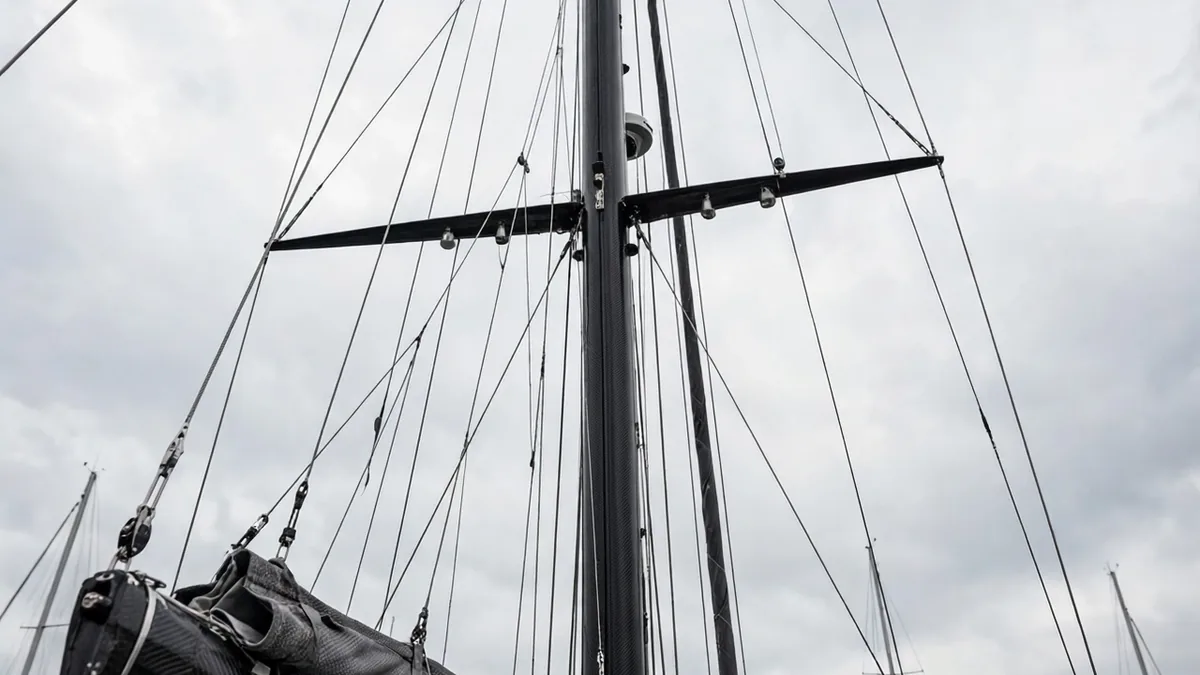
Halfway up the mast you will see horizontal arms sticking out sideways. These are the spreaders, and they push the shrouds out away from the mast so the rigging holds it at a wider, stronger angle. Without spreaders, the shrouds would run almost parallel to the mast and give it little sideways support. Spreaders on a carbon mast are themselves carbon, swept back slightly to match the angle of the shrouds, and attached with fittings that spread the load into the mast wall, because a point load on a thin carbon tube can crack it.
Step 5: The mast bends to control the sails
Here is the clever part: a carbon mast is meant to bend. When the wind strengthens, the crew tightens the backstay, which pulls the top of the mast aft and bends it forward in the middle. Bending the mast flattens the mainsail, spilling wind from the top and reducing power, like reefing without lowering the sail. Easing the backstay lets the mast straighten and the sail fill out again for light airs. Carbon bends predictably and springs back exactly, thousands of times, without taking a permanent set.
The whole rig is a system, and the bigger spars on the largest yachts work the same way, as shown in how a superyacht mast works, which covers the taller, heavier rigs on the very biggest sailing yachts.
Step 6: The masthead carries the instruments
At the very top of the mast sits a small cluster of instruments: a wind sensor, an antenna, a navigation light, and sometimes a camera. The wind sensor is the most important, because it tells the crew the true wind speed and direction, free from the disturbed air near the deck. Its signal runs down a cable inside the mast to the instruments at the helm. Everything at the masthead must be light and tough, because it is the worst place on the boat for weight and the hardest to reach for repairs.
Step 7: Inspection and care keep it safe
A carbon mast needs regular inspection, because its failures give little warning. Once a year, or after any hard sailing, the rig is checked for cracks in the clear coat, loose fittings, worn halyards, and corrosion where metal meets carbon. A tap test, knocking along the tube and listening for a dull note, can reveal a delamination, a spot where the layers have separated inside. Most carbon masts last twenty years or more with good care, which is remarkable for a structure that flexes in every gust.
Yacht Carbon Mast Specifications
| Feature | Typical figure |
|---|---|
| Mast height | 20–60 metres above the deck |
| Material | Carbon fibre epoxy, autoclave cured |
| Weight saving | About 30–40% lighter than aluminium |
| Wall thickness | 8–25 mm, thicker at the base |
| Rigging | Carbon rod or synthetic fibre stays |
| Spreaders | 1–4 sets, carbon, swept aft |
| Design life | 20 years or more with inspection |
| Main load | Compression of many tonnes at the heel |
What a Carbon Mast Costs
A carbon mast is one of the most expensive single parts of a sailing yacht. As an estimate, a carbon mast for a 15-metre yacht costs roughly $80,000 to $150,000, while a mast for a 40-metre superyacht can cost $1 million or more, with the rigging, winches, and furling gear adding hundreds of thousands on top.
A Rare Fact
The tallest carbon masts are so long that they cannot be shipped in one piece. Builders make them in two or three sections, join them with internal sleeves and bolts, and then fair the joint smooth so it is invisible. The largest sailing yacht in the world carries masts over 90 metres tall, taller than the Statue of Liberty, and each one was built in sections and assembled on the dock.
A carbon mast looks like a simple black pole, but it is a finely tuned spring, a crane, and a measuring instrument all at once. It holds the sails, bends to control them, carries the wind sensor that tells the crew what the weather is doing, and does it all while weighing less than the aluminium mast it replaced.