On a yacht at anchor in the late afternoon, the deck furniture does more work than anyone notices. The loungers hold guests who have been swimming all day, the dining table carries lunch while the boat swings gently on its anchor, and the chairs stay put when a wake rolls under the hull. Everything looks relaxed, almost careless, yet every piece has been engineered to survive sun that would crack a garden chair in a season, salt spray that eats ordinary metal in weeks, and rain that finds every unsealed joint.
Yacht deck furniture is not garden furniture that happens to be on a boat. It is a different discipline, where the materials are chosen for how they behave after five years of ultraviolet light, salt and soaking, not how they look in a showroom. Teak, stainless steel, marine textiles and modern composites each earn their place by surviving something the others cannot.
Here is what those materials are, and why each one earned its place.

The Materials Behind Yacht Deck Furniture
1. Teak, the wood that shrugs off the sea
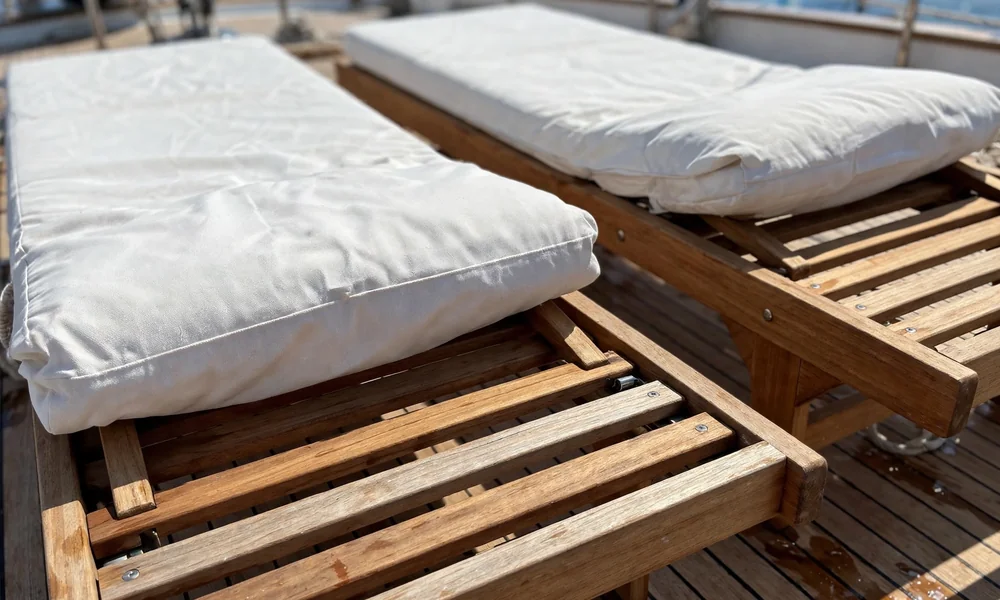
Teak is the classic deck furniture timber, and it is chosen for reasons that have little to do with how it looks. The wood is dense, naturally oily and resistant to rot, and it contains silica, which makes it hard wearing. It moves very little as it takes up and gives off moisture, so joints stay tight through wet winters and dry summers. Left bare, it weathers to a soft silver-grey. The deck it sits on is usually teak too, and the materials behind the yacht teak deck show how the planks, caulking and adhesives work together. Cheaper woods can imitate the colour for a season or two, but they swell, shrink and grey unevenly, which is why builders keep returning to teak despite its price.
2. 316 stainless steel, the metal that must not stain
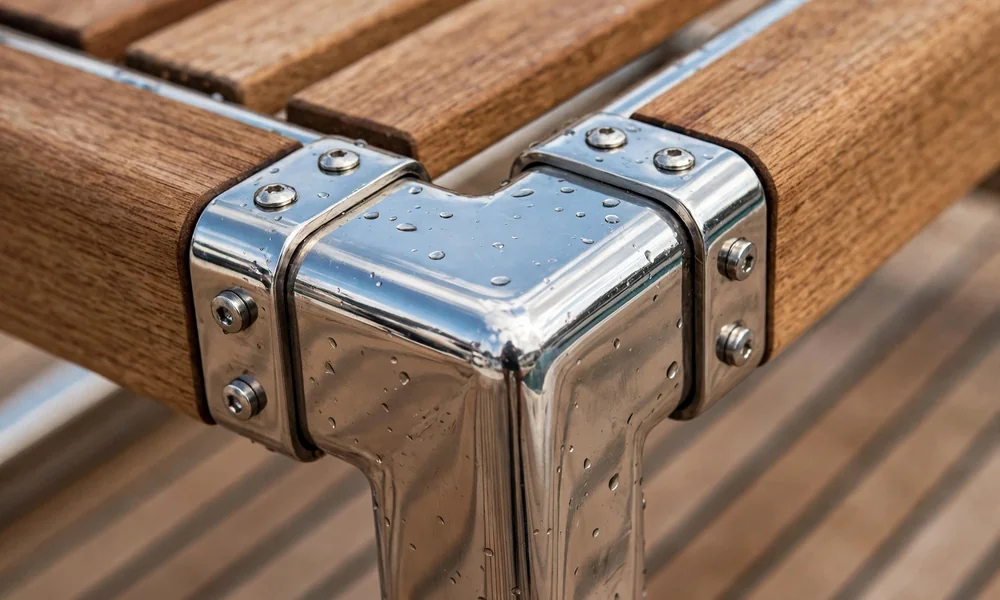
Every frame, hinge and fastener on deck furniture is stainless steel, and the grade matters. The usual choice is 316 marine-grade stainless, which contains molybdenum and resists the pitting that salt water causes in lesser grades. A 304 fitting looks identical in the workshop and rusts within a year at sea, staining the teak with brown streaks. Stainless frames are often polished to a mirror finish, which is not vanity: a smooth surface gives salt crystals nowhere to grip, so a rinse with fresh water keeps it bright. Where frames are welded, the welds are passivated to restore the protective chromium layer that welding destroys.
3. Marine textiles, fabric that refuses to rot
The cushions and slings on a yacht look like ordinary outdoor fabric, but they are engineered for a life of soaking and baking. The standard is solution-dyed acrylic, where the colour is mixed into the fibre before it is spun, so the fabric cannot fade the way a printed cotton can. The weave is open enough to drain, and the foam inside is open-cell reticulated foam that lets water pass straight through instead of holding it like a sponge. A cushion left out in a storm dries in hours rather than days. The way the finished pieces are put together is shown in how yacht deck furniture works, including why the frames and fabrics are designed as a single system.
4. Powder-coated aluminium, light frames that never rust
Not every piece is teak and steel. Much modern deck furniture uses aluminium frames, chosen because aluminium is light, strong for its weight, and never rusts. The frames are usually extruded into oval or rectangular sections, welded or bolted, then powder-coated in white, grey or a colour matched to the yacht. The coating is more than decoration: it seals the metal against salt and hides the welds. A full set of aluminium-framed chairs weighs far less than the same set in steel, which matters on a boat where every kilogram above the waterline affects stability.
5. Synthetic wicker and composites, the look of rattan without the rot
Real rattan rots at sea, so yacht furniture uses synthetic wicker, strands of polyethylene woven over an aluminium frame. The material is coloured all the way through, so scratches do not show, and it is immune to ultraviolet light, salt and rain. It gives the warm, woven look owners want without the maintenance of natural fibre. Alongside it, high-pressure laminate and solid-surface composites appear as table tops: thin, hard, waterproof sheets that shrug off wine, sun cream and hot plates, and can be wiped clean with a damp cloth. Both look delicate while behaving like something industrial.
6. Epoxy and marine sealants, the invisible bonds
The joints in deck furniture are glued as much as they are screwed. Marine epoxy bonds teak slats to their frames and seals end grain against water, while flexible polyurethane sealants fill the gaps where wood meets metal, allowing the two materials to expand at different rates without cracking. A screw concentrates the load at one point and leaves a hole for water; glue spreads the load and seals the joint. The build process, from raw timber to finished lounger, is described in how yacht deck furniture is made, including the joinery that keeps a chair solid after years of being dragged across a deck.
Yacht Deck Furniture Materials
| Material | Where it is used | Why it is chosen |
|---|---|---|
| Teak | Slats, tabletops, armrests | Oily, rot-resistant, barely moves when wet |
| 316 stainless steel | Frames, hinges, fasteners | Resists salt-water pitting, will not stain teak |
| Solution-dyed acrylic | Cushions and slings | Colour cannot fade, drains and dries fast |
| Powder-coated aluminium | Lightweight frames | Light, strong, never rusts, easy to shape |
| Synthetic wicker | Woven seats and backs | Looks like rattan, immune to rot and sun |
| Marine epoxy | Joints and end grain | Strong bond, seals out water |
What Does Yacht Deck Furniture Cost?
Yacht deck furniture is priced like the boat it sits on, not like garden furniture. A single teak lounger from a marine supplier is estimated at roughly $1,500 to $4,000, depending on size and finish, and a full deck set with table, chairs and loungers for a large yacht can be estimated at $20,000 to $60,000 or more. The teak itself is a large part of the bill, and good marine teak is estimated at roughly $150 to $300 per square metre before it is even cut. Cheaper aluminium and synthetic-wicker sets cost far less and need almost no maintenance, which is why they are common on charter yachts.
A Rare Fact
A teak tree takes decades to become deck timber. Plantation teak needs roughly 40 to 80 years before the trunk is wide enough to yield the long, straight planks a yacht deck or a lounger demands, and the slowest-grown trees produce the densest, oiliest wood. That long wait is one reason old-growth teak is so prized and so expensive, and why a teak lounger built today can still be in service fifty years from now, long after the yacht it was built for has been refitted twice over.
Deck furniture looks like the most relaxed thing on a yacht, and that is the point. The teak takes the sun, the stainless steel takes the salt, the fabric drains and dries, and the glue holds it all together while the boat moves underneath. Get the materials right and the furniture simply disappears into the afternoon, which is exactly what it is supposed to do.


